


by Giorgos Tsitiridis, Head of Programs, Northern Greece, SolidarityNow
Top search engines and websites of foundations and universities announce every year the words that the public has searched for most frequently during the year. Paradoxically, in most of them the top word is Google, the leading search platform. Following are various new definitions and words that describe trends and behaviors. Among those that attract global interest are the terms digital world and artificial intelligence (AI).
There are dozens of articles discussing the problems artificial intelligence can solve and its contribution to writing texts and creating images. Likewise, many refer to the dangers poor usage may pose in the future, and whether it could lead to the extinction of humankind as depicted in science fiction books and movies. What is certain is that AI usage is already widespread and increasingly entering modern life, from entertainment to core professional fields. Some AI technologies appeared as early as the 1970s‑80s. However, advances in technology, computers, and mobile phones now allow faster development and easier use.
Worldwide, the largest educational institutions, institutes, and research centers are investing time and resources in the potentials and innovations AI may bring for the future of humanity. The European Union has made artificial intelligence one of its priorities for the coming years. A group of Greek scientists abroad has joined forces to found “Greeks in AI,” aiming to support new researchers and scientists, to strengthen them, and to create a communication bridge between Greece and knowledge sources and business projects overseas.
The Centre for Public Impact, founded in 2015, aims to develop and promote programs that, through innovative tools, allow their implementation in the public sector.
In this context, in cooperation with Google.org AI Opportunity Fund Europe, which supports organizations and associations to deliver AI skills, the Centre for Public Impact has selected non‑profit organizations and civil society actors in over 23 countries, including Greece, to train groups of citizens in basic AI courses designed by Google. These groups include, for example, in Turkey those affected by earthquakes; in Ukraine, professionals affected by the ongoing war. In other countries, training includes unemployed people; LGBTQI+ persons; workers in agriculture and livestock; people with dyslexia, people with disabilities; journalists; artists; young people with fewer employment and educational opportunities; persons with hearing problems; single‑parent families; refugees; migrants; etc.
Standing beside the most vulnerable to bridge the gap
In Greece, SolidarityNow and Odyssea were selected by the Centre for Public Impact to receive funding from the Google.org AI Opportunity Fund: Europe, to equip workers from vulnerable social groups with AI knowledge and tools necessary for their long‑term professional success. Through the program, the two organizations receive support to provide targeted AI education to vulnerable Greek citizens and people with migration/refugee backgrounds.
Initial results have shown the vast scope of AI, but equal access must be ensured for everyone. SolidarityNow and Odyssea support vulnerable social groups including Greek citizens and migrants/refugees who are at risk of poverty and social exclusion. Through their regular programs, they offer services of professional integration, such as counseling, support in administrative procedures, and liaison with employers. This new program offers AI training in Athens and Thessaloniki, allowing the beneficiaries of the two organizations to develop their digital skills and gain a competitive advantage in the job market. To ease participation, interpretation services and childcare during training are provided.
Marilyn Polena, General Manager of SolidarityNow, states about the program: “We are committed to helping our beneficiaries adapt to the constantly changing demands of the labor market. Through this initiative, we hope to make a small step toward bridging the digital divide, which disproportionately affects the most vulnerable members of society.” SolidarityNow, through its Centers of Solidarity in Athens and Thessaloniki, has succeeded in supporting 97,000 beneficiaries, and through free services and non‑formal learning activities more than 350,000 people.
Lukas Oikonomakis, Co‑Founder and CTO of Odyssea, notes: “Artificial intelligence is radically changing the labor market, and the digital skills gap threatens to leave behind the most vulnerable social groups. Through this partnership, we are giving our students the essential tools to adapt to the new reality. We are turning this challenge into an opportunity for them to thrive in a future based on AI.”
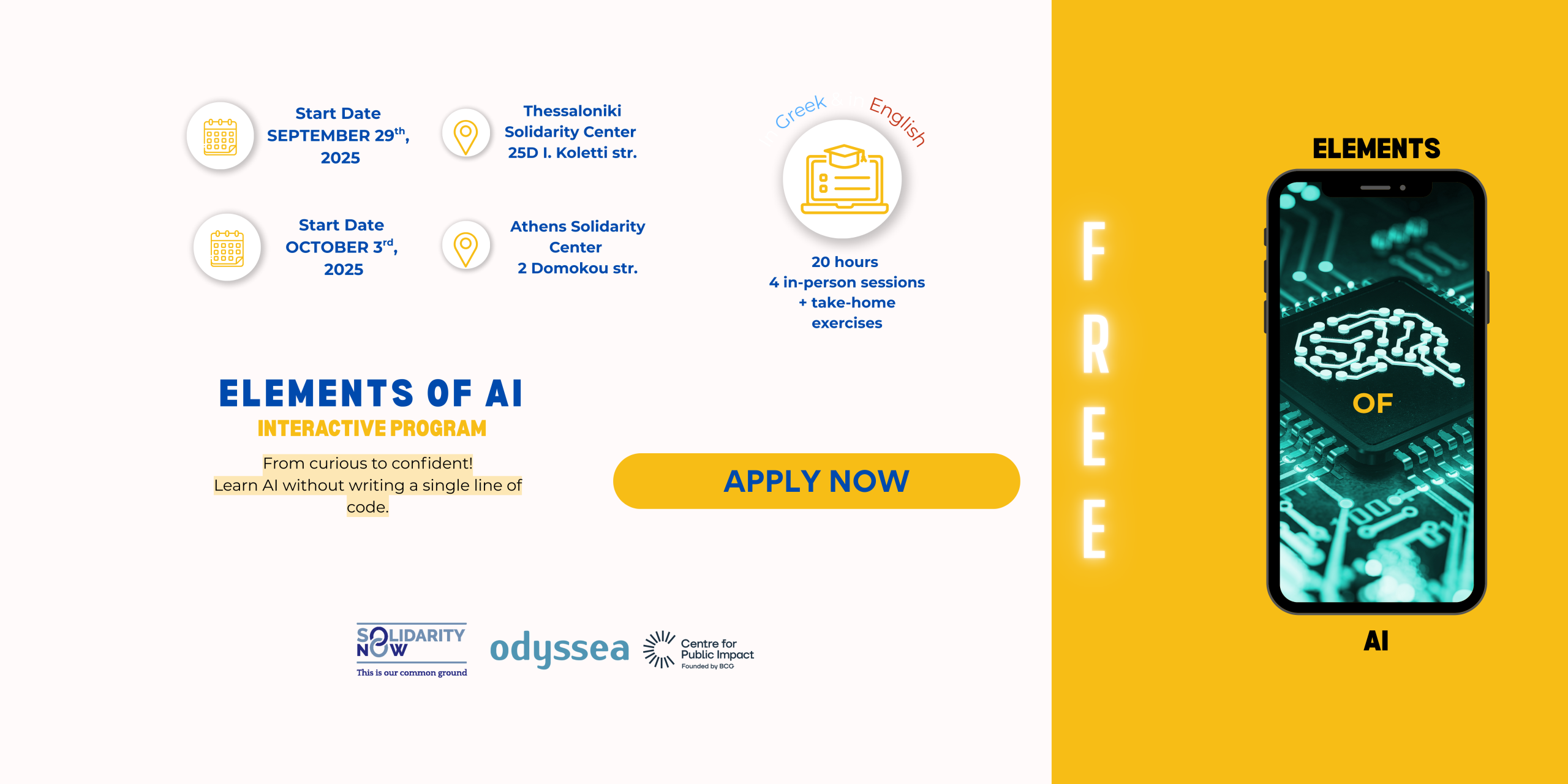
The first two cycles of training have been completed, with over 50 individuals in Athens and Thessaloniki obtaining certification from the Google.org AI Opportunity Fund. The next cycle begins soon, and registrations are open.
Results from the previous cycles showed that participants found the training particularly engaging, as it consists of exercises and practical applications of AI in everyday life, across four sessions of interactive learning. Moreover, the multicultural characteristics of the groups contributed to creating a different atmosphere, allowing contact between people of diverse origin, age, and socioeconomic background, etc.