


Interview at the Thessaloniki Solidarity Center: Needs, Challenges, and Support for the Most Vulnerable
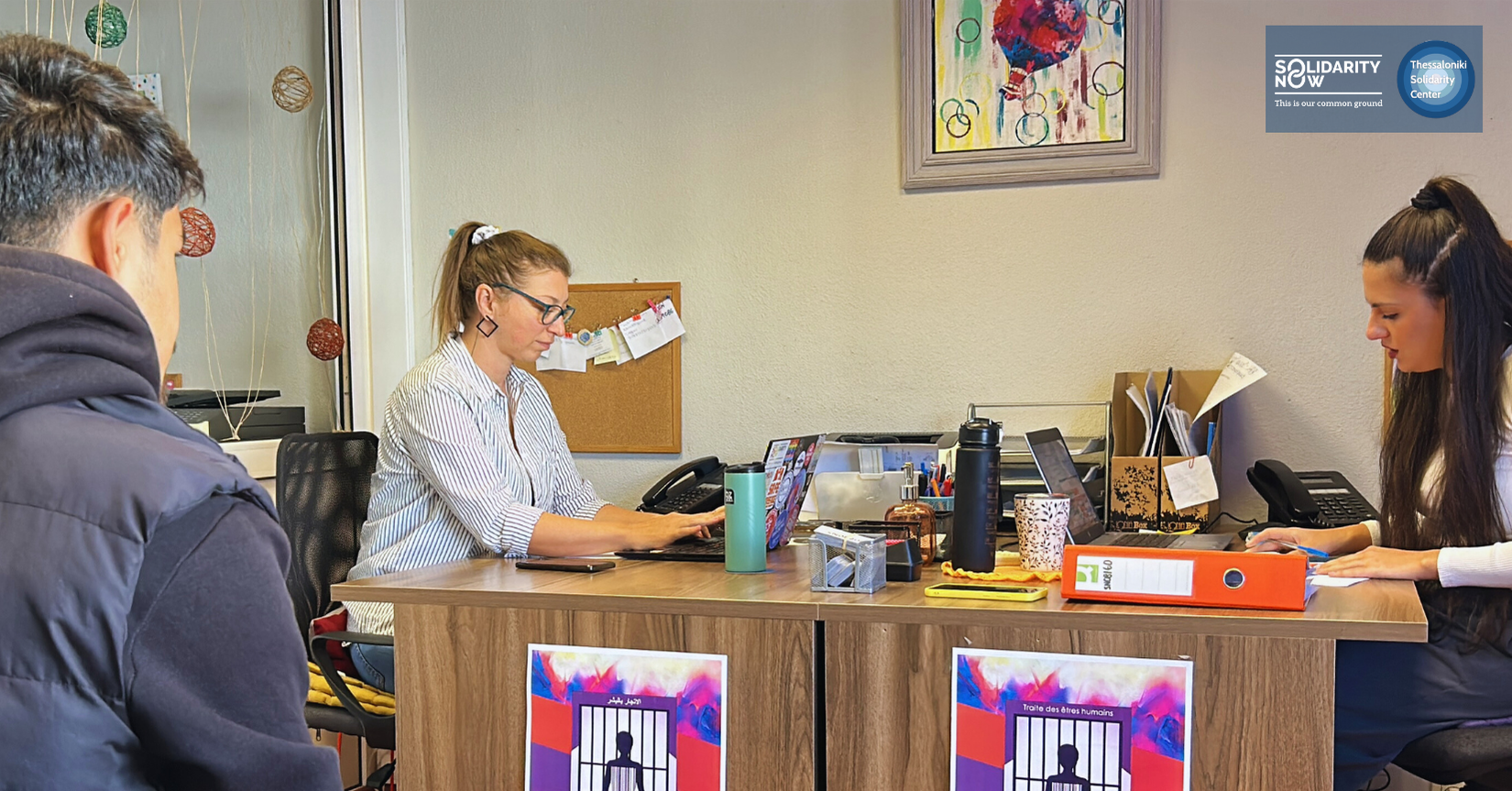
A conversation with social workers Dimitra Kefala, Meni Christidou, Evi Dimadi
and Giorgos Tsitiridis, Program Manager for Northern Greece, SolidarityNow
The Thessaloniki Solidarity Center serves as a hub of care and support for vulnerable social groups. Through the provision of integrated services, it aims to bridge critical access gaps in healthcare, social welfare, education, legal aid, employment, and overall social inclusion for individuals facing hardship and marginalization.
To gain deeper insight into the Center’s mission, we spoke with social workers Dimitra Kefala, Meni Christidou, and Evi Dimadi about their work, the challenges they face, and the priorities they set.
A Holistic Approach to Social Support
The Center opened in 2016 to support vulnerable individuals in their path toward social inclusion, offering holistic services tailored to real needs. Over time, service delivery methods have evolved to meet the shifting demands of the population. However, what remains constant are its “open door” policy, non-discriminatory access, flexibility and comprehensive approach.
Today, it remains a vital structure—particularly in Northern Greece, where no similar facility currently exists. The Center serves a wide range of groups, including: single-parent families, children, youth, the elderly, women, persons with disabilities, Roma, refugees, migrants, survivors of abuse, and more.
The Importance of the Social Services Department
“We are the first people that visitors meet when they come here. Regardless of what service they need, their first point of contact is with us. In what we call a ‘dialogue of life,’ we record their social history and assess their needs. This step is crucial, it’s not just about data collection, but also about acknowledging and understanding the emotions and experiences of each person. After this, we refer them to the most appropriate service”, Dimitra Kefala
Empowerment and autonomy are key goals of the Center’s social services. Through guidance and support, beneficiaries are informed and educated on navigating everyday processes, including administrative issues such as obtaining a tax number (AFM), social security number (AMKA/AMA), or access to the digital government system (gsis).
For many refugees and migrants, these bureaucratic procedures can be particularly difficult due to language barriers, lack of digital literacy, or limited access to technology. The digitalization of public services has only widened the gap, creating additional obstacles for those already at risk of exclusion.
“We often encounter people who are hearing about some of these bureaucratic steps for the first time. They don’t know what to do either because they don’t understand the language, or because they have no digital skills”, Meni Christidou
Referrals and Networking
“A core part of our work is making referrals. Depending on their needs, people may be referred internally to another service within the Center or another SolidarityNow program, or externally to other NGOs and public services. That’s why we’ve built a wide network of partnerships; to help us respond to increasingly complex needs”, Evi Dimadi
The Ongoing Housing Crisis
Despite the range of services offered, one issue dominates: housing.
Sharp increases in rent prices have impacted large segments of the population, leading to a rise in homelessness and placing added pressure on individuals and families already in precarious situations. In Thessaloniki, the city’s one and only emergency shelter is insufficient to meet demand. Eligibility criteria for entry exclude many, and there are no other available housing support services in the city.
The Right to Understand, the Right to Belong
There is a significant lack of interpretation and intercultural mediation across almost all local services and institutions. This severely limits people’s access to basic rights such as healthcare, and directly impacts their ability to integrate. In addition, there is a shortage of effective Greek language learning programs for non-native speakers, making the integration process even more difficult and demanding.
Solidarity with a Human Face
At the Thessaloniki Solidarity Center, social services are not just about offering aid. They involve a process grounded in human connection, trust, flexibility, and empathy. When support is offered with dignity and with a focus on individual empowerment, it can truly make a difference not just in one person’s life, but in the overall wellbeing of entire communities. At the end of the day, the Center is not just a place that meets needs; it is a beacon pointing toward a more just, inclusive, and humane society.
“In Thessaloniki, over the past few years, many programs that provided essential services such as shelters and specialized facilities have been drastically reduced. As a result, a large portion of the population finds everyday life increasingly difficult”, Dimitra Kefala