


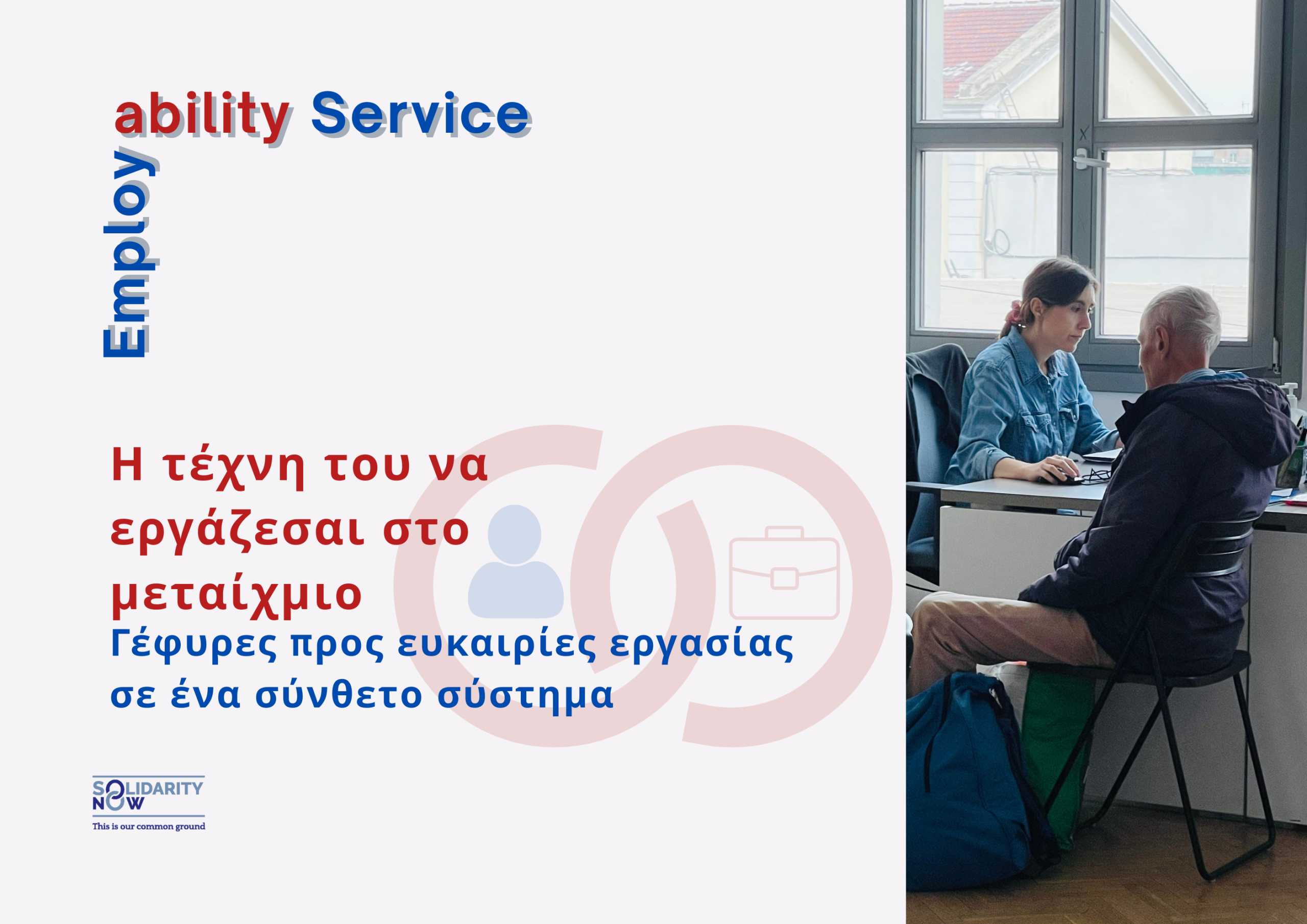
Every day, employment counselors at the Athens Solidarity Center welcome lots of people who are looking for work.
Their role is multifaceted: assessing backgrounds, identifying skills, exploring needs, creating CVs, providing information about the labor market, supporting job applications and interviews, explaining labor rights and, of course, offering guidance on the bureaucratic procedures required before or after employment.
At a time when the labor market needs workforce, and asylum seekers or recognized refugees are searching for stable, legal employment to begin their integration journey, employment counselors find themselves working in the space in between beneficiaries, companies, and institutions, striving to bridge the gap.
As a result, their work expands to include a wide range of additional actions, supporting all parties involved. Counselors inform businesses about recruitment procedures, provide practical tools, such as SolidarityNow’s new guide and manual on hiring third-country nationals, and, above all, support job seekers in preparing all the necessary documentation: collecting existing documents, issuing new ones, printing insurance contribution records, obtaining a Social Security Number, opening bank accounts, and more.
This is, in essence, the bureaucratic side of employment counseling: navigating a complex landscape of services that stand between employer and prospective employee: social security funds, tax authorities, banks, hospitals, call centers.
Although significant steps toward digitalization have been made in recent years, new obstacles often arise in practice, even where facilitation measures were intended.
Indicatively:
- Different requirements from bank to bank for opening a bank account.
- The need for frequent renewals of identification documents, leading to repeated updates with tax and social security authorities.
- Inactive social security numbers for recognized refugees.
- Issuance of online tax credentials only through someone who already has them.
- Limited English-language support in call centers.
- Public service websites available only in Greek.
Very often, these issues require employees to be absent from work in order to be resolved, sometimes more than once. Each such dysfunction translates into insecurity for the employee, who fears they may not be able to obtain documents they are entitled to and need, and into hesitation for the employer, who worries about taking a risk by hiring someone who must repeatedly be absent just to complete basic procedures.
This is the in-between space where employment counselors work every day: mediating, explaining, clarifying, reassuring and mainly trying to ensure that no one gets lost between intention and implementation.
And so, within a system that often complicates rather than facilitates, solutions are found elsewhere: in people. In colleagues who share knowledge, experience, strategies, and small victories; in informal support networks that emerge; and in connections with individuals within public services, banks, and organizations who are willing to help and become invaluable allies.
These human bridges are what ultimately allow counselors to continue their work finding pathways where procedures close doors, solving problems through collaboration, and supporting beneficiaries so they are not lost in bureaucracy.
In a world where state mechanisms do not always function as they should, the power of community and solidarity becomes the most stable foundation for moving forward together.