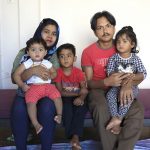
For those who don’t know, their name is synonymous with the word persecuted – for a Rohingya is his nation, the word that defines him; however, Sayeed Hussein says he cannot interpret it into something perceivable by others – a country, a mother tongue, tradition and customs.
Sayeed describes Rohingya as people who over the years have remained in a static situation without being able to ‘grow up’, evolve, instead of just surviving. Rohingya are expelled from everywhere.
What it means to be Rohingya
Sayeed speaks Rohingya (or Ruaingga), an unwritten language. He is moved by the question “what does it mean to you to be a Rohingya”, but tears are not apparent, he doesn’t cry; it seems like his body is crying. “They expel us. There is no homeland for us. In Myanmar we have no papers like the other citizens, we are not citizens, we only exist to be eliminated“.
Since 1982, Myanmar in Southeast Asia, has decided not to grant citizenship to Rohingya and that’s what Sayeed says – that he is officially stateless. But unofficially “my heart is still in Myanmar” because this is the place he knows as motherland: “Myanmar is where I was born, where my parents were born. This year is the tenth year that I haven’t seen them. I don’t know whether they live or not, I don’t know anything”.
“They hate us because we are Muslims. All my life I’ve worked in the rice plantations; rice is our food and we also had some chicken and cows“. The school was and still is forbidden for the children of Rohingya and Sayeed and his siblings didn’t have the chance to attend it. We ask him about the area he grew up in. He tells us that it is where most Rohingya live from ancient times – their presence in the area is historically documented since the 9th century – the western province of Rakhine State, which now belongs to Myanmar. Previously, Rakhine, the area bordered by the Bay of Bengal to the west, was called Arakan, and is due to the commercial roads opened by the sea that many residents of the area adopted, over the years, the Muslim religion.
Rohingya through the centuries and until today are Muslim people living in a Buddhist country, Myanmar. Sayeed says that Rohingya live as prisoners. They are not allowed to move without permission and they live in camps deprived of basic human rights. In fact, it is impossible to identify human rights that are not deprived of in a country that has been repeatedly denounced by Amnesty International and the United Nations (https://www.hrw.org/world-report/2018/country-chapters/burma).
The story of Sayeed
The personal story of Sayeed looks like, as he says smiling bitterly, in that of the majority of Rohingya. “I got tired; they were stealing our animals, burning our camps, hitting us and I could not tolerate this any longer. When I said that I was 21, today I am 29. I have traveled a lot. However, in these eight difficult years, my life got a meaning that has the name of my children: Nour, Kulsum and Maria“. They are the three children he has with Mobina. Mobina is also Rohingya. She met Sayeed at his third ‘station’ in Pakistan, after his fleeing from Myanmar.
“My first stop after Myanmar was Bangladesh. I only stayed there for two months because I was not safe without having an identity card; I was afraid they would send me back”. The next station was the neighboring India and the area of Hyderabad, where Sayeed lived and worked for two years at a large fruit store. He left again, this time for Pakistan. Four years in Karachi he worked in buildings’ construction, met and fell in love with Mobina. “That’s why I went to Pakistan. To meet my wife“, he says and smiles with his heart.
Sayeed, Mobina and little Nour left together from Pakistan. The authorities didn’t give Sayeed an ID there either. “I could not bear any more without identity. I couldn’t live like this“. They arrived at Iran. The family stayed there for four months and Mobina gave birth to their second child, Kulsum.
From Iran to Turkey and from Turkey to Lesvos. In Lesvos, along with Sayeed and Mobina, arrived thirteen more Rohingya – Sayeed says that all of them live in Greece today. Shortly after arriving in Greece, Sayeed learned from his brother that he also managed to get to the country with his family.
On the island that marked their entry into Europe, Mobina gave birth to their third child: “Fortunately, she did not give birth during travelling“, Sayeed says and embraces her. Mobina doesn’t understand anything Sayeed says to us because we speak English with him, and she doesn’t know a language other than that of Rohingya. She embraces him too.
Sayeed was taught the English language in Lesvos by attending the classes provided to the refugees by humanitarian organizations. Moria, Kara Tepe, but then “luckily, the moment came, and we were given a home“. His family joined the SolidarityNow accommodation program in December 2017, following a referral from the NGO Iliachtida.
Education, a non-negotiable right for his children
And since then, dreams have begun to find a place for the parents of the three little Rohingya who will live in Europe; the descendants of a long-suffering and at the same time unique people, a racial mixture that gives Rohingya, Indian, Mongolian and Indo-European physical characteristics.
Having a home and getting the decision to reside in Greece, have allowed Sayeed and Mobina to dream of a better future for their children, something they could not even imagine a few years ago. “I only need a job and everything else will come, I’m happy here“, Sayeed says with a more optimistic voice tone when the discussion about the past has finished. “I want my children to go to school; to learn Greek – I want to do more than I did“.
It is noteworthy to observe the tension with which Sayeed speaks about his children’s school and education. He has never had the opportunity to go to school, but he recognizes its importance and considers it as his children’s non-negotiable right. And now it is coming true; their older son, Nour, four-years old, attends nursery school and he learns his first Greek! When Nour is not in school, the whole family together makes daily walks in the city. Their beloved one is from their home to the area of the National Technical University of Athens and of the ‘Pedion Areos’.
Sayeed wants his story to close with his own words and it could not happen otherwise: “I cannot imagine my life without my children. I see people alone from Bangladesh and I cannot even imagine it! I lost all my family, but I have my children. As for the Rohingya, I am proud to belong to this people. Rohingya have never hurt anyone, they don’t love the war. In Greece, which is not a Muslim country and it is not my country, I am safe. In my own country, why am I not? I’m afraid of Rohingya, I’m worried about their future, although I feel safe now“.
According to the United Nations High Commissioner for Refugees, more than 1 million Rohingya refugees have fled from violence in Myanmar in waves since the early 1990s. The latest outbreak of violence against Rohingya, that has been described as ethnic cleansing and genocide by the United Nations, the organization Human Rights Watch, international bodies, and that began in October 2016, led in August 2017 another big wave of Rohingya to Bangladesh, reaching the total number of asylum seekers there at 723,000.
Find out more about the Rohingya: https://www.unhcr.org/rohingya-emergency.html, https://www.hrw.org/tag/rohingya-crisis, https://www.hrw.org/news/2018/08/21/myanmar-security-forces-torture-rohingya-returnees, “Myanmar’s ‘Gravest Crimes’ Against Rohingya Demand Action, U.N. Says”
*The family of Sayeed Hussein lives in an independent flat in Athens, in the framework of the SolidarityNow accommodation program which is part of ESTIA-the Emergency Support to Integration and Accommodation program, supported by the United Nations High Commissioner for Refugees and funded by European Civil Protection and Humanitarian Aid Operations (ECHO).