

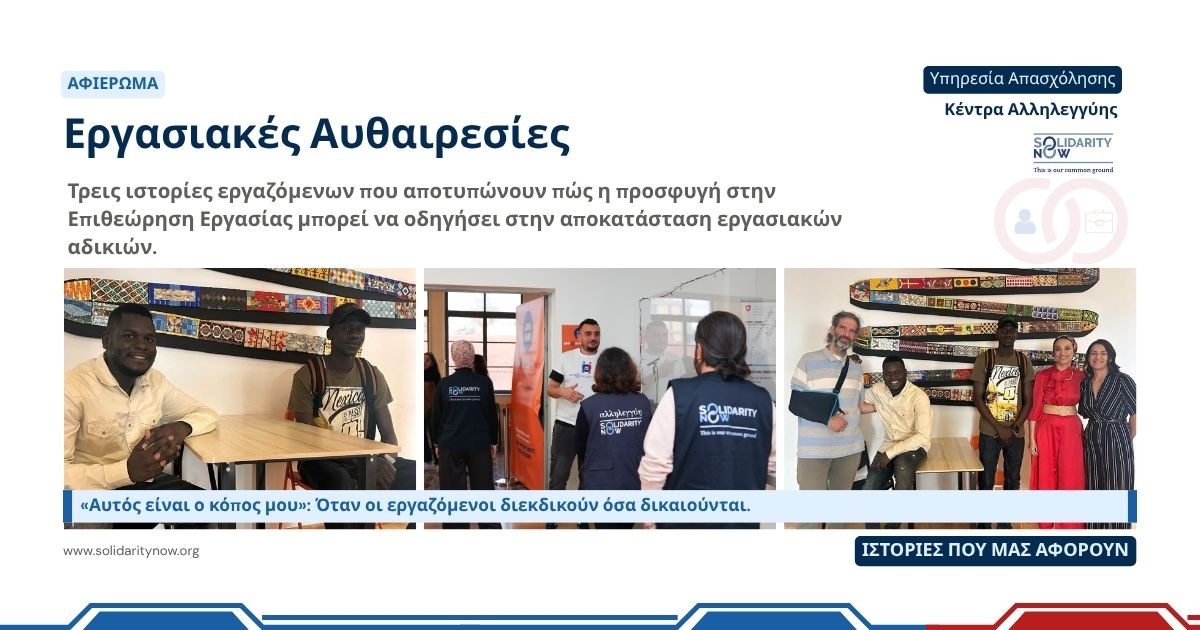

Many workers who turn to SolidarityNow’s Solidarity Centers have already experienced serious violations of their labor rights. Although many are afraid to file a complaint or take further action, access to information about their rights and the ongoing support provided by the Employment Team and Legal Service often enables them to claim what they are entitled to.
The following three cases illustrate how seeking support from the Labour Inspectorate can lead to the resolution of workplace disputes and the restoration of workers’ rights.
Ms E. started working at a food service business in June 2023. Although an employment contract had been registered in the ERGANI system, she soon realised that there were significant discrepancies between the agreed terms and the wages she was actually receiving.
She contacted the Employment Team at the Thessaloniki Solidarity Center in order to understand what was happening and explore the possibilities of claiming the wages owed to her.
The review of her employment records showed that the registered contract did not reflect her actual working hours, while the declared work schedule systematically differed from the hours she was actually working. In addition, she was not receiving the legally required additional payments for night work.
When she requested payment of the amounts owed to her, she faced pressure not to pursue her claim, including warnings that she would lose her job.
This situation caused her significant psychological distress. During a meeting with her employment counsellor, she shared that she felt exhausted by the pressure she was experiencing. Nevertheless, she remained determined to continue.
“This is my hard work”, she said.
With the support of the Employment Team, the unpaid amounts were calculated in detail, and the case was referred to the Labour Inspectorate.
The process was successfully completed for the worker, who received approximately €2,000, the amount corresponding to the wages that had unlawfully not been paid to her.
At the same time, she was supported in her search for new employment that meets the principles of Decent Work, as defined by the International Labour Organization (ILO).
A group of 22 men from Sudan, beneficiaries of international protection, approached the Employment Service at the Athens Solidarity Center seeking support regarding unpaid wages.
The workers were legally employed on a large construction project under full-time employment contracts. Over time, however, they were repeatedly asked to sign new contracts with less favorable terms, while they remained unpaid for a significant period.
According to their testimonies, they were regularly working more than ten hours per day, receiving lower wages than those originally agreed, and were never allowed to keep copies of the contracts they signed in order to know their exact terms.
When they requested payment of their outstanding wages, they were denied access to the workplace and lost their jobs.
With the support of the Employment Team and the Legal Service, the workers received detailed information about their rights and the options available to them. The case was referred to the Labour Inspectorate, while an out-of-court dispute resolution process was initiated at the same time.
Following the guidance of the competent authorities and after additional violations were identified, an agreement was reached and the workers received the full amount of their unpaid wages.
“My employer did not pay me my Christmas Bonus,” B. told the employment counsellor at the Thessaloniki Solidarity Center. “I don’t know how much it is, but I know I am entitled to receive it.”
During the review of her documents, including employment contracts, payment records, payroll information, and entries in the ERGANI system, it was found that B. had indeed received her Christmas Bonus. However, the amount had been paid gradually each month together with her salary, while she believed that this additional payment corresponded to her overtime work. This was not the first time the Employment Team had encountered similar practice.
For three consecutive months, B. had been working between 12 and 14 hours every day because, according to the employer, there was a shortage of staff. A cross-check of the available records showed that she was owed approximately €4,000 for overtime work, while she had received only half of that amount.
When she was informed of the actual amount owed to her, she broke down in tears.
The case was referred to the Labour Inspectorate. During the meeting to resolve the labor dispute, with support from the Employment Team, an agreement was reached between the two parties, and the case was closed without the need for court proceedings.
These three cases demonstrate that violations of labor rights are not always the end of the journey. When workers know their rights and have access to appropriate support, they can effectively claim what they are entitled to.
At the same time, they highlight the importance of close cooperation between the Employment Team, the Legal Service, and the relevant authorities, as well as the crucial role of the Labour Inspectorate in resolving workplace disputes.
Above all, they remind us that protecting labor rights does not depend only on a worker’s willingness to claim them. It also depends on the existence of mechanisms that can provide information, protection, and meaningful support throughout every stage of the process.
The operation of the Solidarity Centers in Athens and Thessaloniki is supported by the Swiss–Greek Cooperation Programme (Embassy of Switzerland in Greece) to reduce economic and social disparities in the EU and by the Ministry of Migration and Asylum.