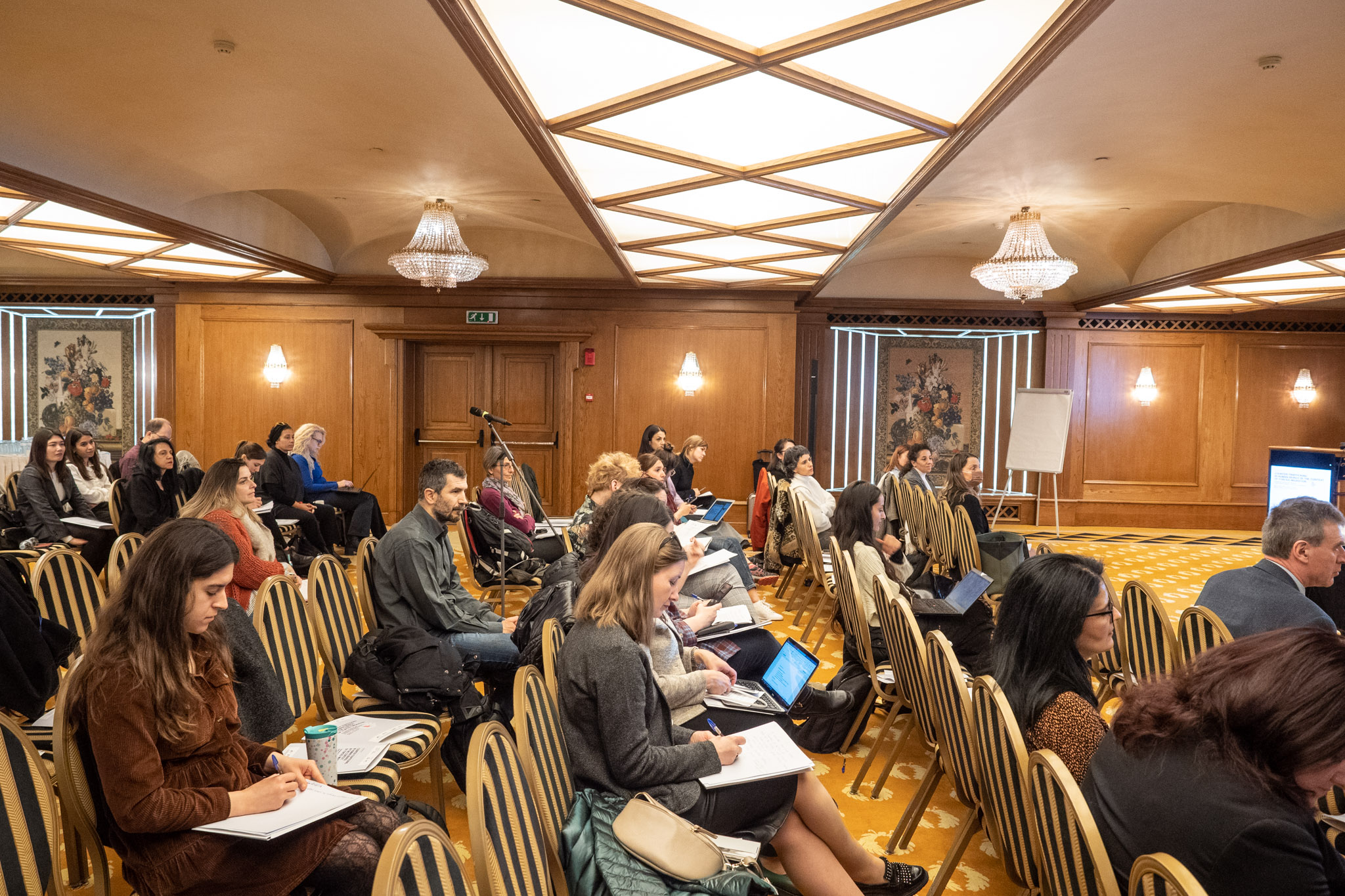
The conference was successfully held with the aim of finding collaborative solutions to the issue of human trafficking between Greece and Bulgaria.
The conference was organized on March 14 in Athens by the administrators of the Active Citizens Fund program in Greece – SolidarityNow, Bodossaki Foundation – and in Bulgaria – Open Society Institute Sofia, Workshop for Civic Initiatives Foundation and Trust for Social Achievement. The participants included representatives from the Council of Europe, the Academic Area, Embassies, institutional bodies, and international, European and local civil society bodies, which are actively involved in issues related to trafficking in human beings, migration and the protection of human rights.
Why Greece and Bulgaria?
Bulgaria is mainly a country of origin of human trafficking victims, while Greece is a transit or destination country. According to data from the National Referral Mechanism for the Protection of Victims of Trafficking in Human Beings in Greece for 2020, out of the 167 victims registered, 74 were children and 33 of them originating from Bulgaria.
During the conference, the need for transnational cooperation was emphasized, among others, by the Vice-President of the Council of Europe’s Group of Experts on Action against Trafficking in Human Beings (GRETA), Ms. Antoaneta Vassileva and the Special Secretary for the Protection of Unaccompanied Minors and former Head of the Office of the National Rapporteur on Combating Trafficking in Human Beings, Mr. Heracles Moskoff, who honored the conference with their presence.
Ms. Vassileva stressed that “The governments of both countries should secure the funding for the implementation of actions against human trafficking. In addition, the use of the national referral mechanism is considered necessary and, equally important is the continuous education and training in the identification of potential victims by the professionals involved, police officers, lawyers, social workers, psychologists. Human trafficking is actual an invisible crime, which today in the digital environment is becoming even more invisible. Protecting victims is a collective duty and should be at the top of the agenda.”
During his speech, Mr. Moskoff underlined: “Human trafficking knows no borders and national laws. The goal of the slave traders is profit and their product is humans. To prevent all those who exploit human dignity, we need to overcome conventional perceptions and build a multidisciplinary cooperation between the state, international organizations and civil society in terms of Preventing the phenomenon, Suppressing crime and Protecting victims with a more inclusive and victim-centered approach. Respectively, and aiming at prevention, we operate the National Emergency Response Mechanism for the early identification and immediate accommodation of unaccompanied minors living in precarious conditions or homelessness. To date, more than 3,258 children have benefited from the mechanism.”
The three critical aspects
The conference program included three panel discussions with more than 20 prominent speakers, who focused on the three critical aspects of the issue: the protection of victims through the analysis of existing protection systems and the application of victim-centered approaches; the exchange of best practices to prevent and reduce trafficking in human beings and the identification of the obstacles depriving victims’ of accessing justice.
The discussions and the productive exchange of views between the speakers and the participants underscored that, due to their vulnerable status, migrants/refugees are potential victims, while special reference was made to e-trafficking as the new way of approaching potential victims. A common ground was the need for prevention through information, education and awareness-raising of all stakeholders, including both institutional bodies and services, but also all the dynamic parts of societies and citizens.
Worldwide, according to the International Labor Organization, 40.3 million people are victims of trafficking, 75% of them are women and girls, and 1 in 4 are children.
You can watch the speeches made in the context of the conference here. We thank blod.gr for the video recording.
*The conference is a regional action of the Active citizens fund program, fund operated in Greece by Bodossaki Foundation in consortium with SolidarityNow.
The Active citizens fund in Greece is supported through a € 13.5 m grant from Iceland, Liechtenstein and Norway as part of the EEA Grants 2014 – 2021. The programme aims to develop the sustainability and capacity of the civil society sector in Greece, and to strengthen its role in promoting and safeguarding democratic procedures, active citizenship, and human rights. The Fund Operator for the Active citizens fund in Greece is Bodossaki Foundation in consortium with SolidarityNow.