#ArtIsMyLife | Therese

Giorgos Moutafis for SolidarityNow

“We sing Congolese gospel. The Bible says that to sing is to pray twice”

Therese, 30 years old, comes from Congo. She studied to become a nurse but her dream was to work in the music field. As a teenager she was singing in a band. When she announced to her father her decision to study music, he tried to change her mind by saying that she would not be able to find a proper job with such a degree. “Music is my passion. However, by listening to my father’s words, I was discouraged and decided to give it up. When I got my degree, I couldn’t find a job and I blamed my father for that”, says Therese.

It took her a long time to sing again. During that time, she had to leave Congo and travel alone to Greece. It was a difficult journey. Her first stop was in Lesvos. She moved to *Volvi on September 2017. “At the beginning I was sad. I was going to church, but I was just an observer. I was quite shy, and I did not want to participate in any activities. Moreover, I was not in the mood to connect with people”, Therese tells us. In December 2017, two Congolese, Richard and Moria, formed their own band in Volvi. They have been singing gospels every Sunday in the church. But the woman’s voice was missing from their band. So, Richard approached Therese and invited her to participate in the band. At the beginning she refused, but Richard insisted, and Therese became the first female member of the band. “We sing Congolese gospel. The Bible says that to sing is to pray twice. That’s why I want to sing and pray”, she notes. We ask her about her relationship with the rest of the band, which now is consisted of 3 women and 2 men. “We complete each other, and we are all equal. We never fight. Sometimes, I argue with Moria but we are actually teasing each other as we are very good friends. One word that describes our band is solidarity”, underlines Therese.

Therese has been given asylum status in Greece and wishes to live here. Her primary concern is to find a job in order to be independent. She has already applied for many jobs with the assistance of the NGO Caritas. This month, she is meeting with one of SolidarityNow’s  Employability Consultants. “I really want to find a job, because staying here (in Volvi) and doing nothing gets me stressed. It’s not good to sit and just do nothing”, she says. Therese would like to use her diploma and work as a nurse, but she knows that at this stage the lack of Greek language skills is an obstacle. “I cannot work as a nurse. I do not speak Greek, but I’m ready to do everything, to work as a housekeeper, as a babysitter, I can do everything. I know I’ll find something”.


*Therese is a beneficiary of the Child and Family Support Hubs program, which is implemented by SolidarityNow, supported by UNICEF, with funding from the European Commission’s humanitarian aid department (ECHO).

**The Organisation Internationale De La Francophonie (OIF) finances French language courses for asylum seekers in Athens and Thessaloniki.

*** Iliaktida as UNHCR’s partner has the management of Volvi Accommodation Scheme, through IATAP


#ArtIsMyLife | Richard

Giorgos Moutafis for SolidarityNow

“Painting is in my blood. I do not have to make any effort; it comes naturally”

Richard is slender. He is wearing a houndstooth scarf on his neck and a pair of jeans that has painted himself. He is only 24 years old but talks like a mature man. The forced migration, the loneliness of a difficult journey across different continents, that looks more like a game of hide-and-seek among adults, grow up people before their time, and if not, it makes them harsh. However, Richard has an inherent kindness. He looks stoically. He has placed his hands on the table and speaks in French about painting, singing and Congo, his homeland.

Richard arrived in Greece through Turkey. His first station was the island of Samos, where he stayed for 3,5 months. He moved to *Volvi, in ​​May 2017. The last few months he has been living in Thessaloniki. We ask him about Congo and the situation there. “I do not want to talk about the past”, he says, and we change the topic of our conversation.

Richard has studied and worked as a painter. He has participated in many art exhibitions in Congo, as well as in France, where he won the 2nd prize among 53 participants. In Kinshasa he had his own atelier. “Painting is in my blood. I do not have to make any effort; it comes naturally”, he stresses. He is a painter, an original artist; he was born creative. “I am the son of a great artist. My father has done a lot of things in Congo. His name is Emmanuelle”, he says proudly and adds: “my father was my mentor, I admire him so much”.

Richard remembers himself at the age of 3, watching his father paint one of the walls of their home. As he recounts, he took his father’s brushes and tried to imitate him. At the age of 7, he did the same unsuccessfully, because instead of helping his father, he was destroying his paintings. As a result his father was keeping him away from his studio. The only thing that Richard wanted was to paint with him. At the age of 15, he decided to reproduce one of his paintings. The painting represented a lion’s head. One day as his father wasn’t home he took the opportunity and hid the original painting while hanging his own on the wall. When his father returned home he didn’t see the difference and when Richard revealed him the truth, Emmanuelle decided to teach him the secrets of his art. “My father is very proud of me”, he says. Now Richard is a figurative artist. His paintings are inspired by society, by how people live, the difficulties they are experiencing, but also by his own life.

Richard’s talent doesn’t stop there. Because of his studies he has worked also as an actor. When he was living in Kinshasa he played in theatrical plays. Moreover, he writes cinematic scenarios, theatrical plays but he also sings. In fact, with the help of one of his compatriots, Moria, he created the first gospel music band at Volvi. “I did not create the band; we created it all together”, he says. The idea for the band was born out of an invitation he received to participate in a children’s music concert organized by IATAP. “At the beginning it wasn’t easy. All of us had to struggle with difficulties, but our passion for music led us to create the band. First, we were singing in the name of God, in church. I told the guys that if we want to grasp the opportunity and show our talent we have to work more. We saw that we were making progress with Antonis, who is on the keyboards, and since then we all sing together gospel”, he explains.

How does it feel to have your own band and to sing? “It’s amazing. It’s hard to explain. It is very nice. It’s so good”, he says. It’s worth mentioning here, that they have already written their first song, and now they are waiting for the opportunity to record it. Their song talks about determination. “When you are in a difficult phase of your life, you must have hope and believe that everything will go well”, he stresses.

When he arrived at Volvi, it was difficult for him to get used to the place. Despite the complicated political situation in Congo, Richard left behind a good life in Kinshasa. In Volvi Accommodation Scheme he stayed nearly a year. He decided to move to Thessaloniki because as he says there are more opportunities in the city. His goal is to continue the Greek language classes, that he had started in the past. We ask him if he sees his life in Greece and he answers: “Yes, why not? I want to continue painting, but I would also like to make films here in Greece”. 


*Richard is a beneficiary of the Child and Family Support Hubs program, which is implemented by SolidarityNow, supported by UNICEF, with funding from the European Commission’s humanitarian aid department (ECHO).

**The Organisation Internationale De La Francophonie (OIF) finances French language courses for asylum seekers in Athens and Thessaloniki.

*** Iliaktida as UNHCR’s partner has the management of Volvi Accommodation Scheme, through IATAP

#ArtIsMyLife | Sami

Giorgos Moutafis for SolidarityNow

“I am an artist and I will die as an artist” 

“I have my life back home”, says 33-year-old Sami who fled Congo to come to Greece. He has been living in Greece since December 2016. His long journey began from Moria, Lesvos and ended in Thessaloniki. We are sitting at the lounge of the Blue Refugee Center of SolidarityNow in Thessaloniki. He takes out of his backpack his drawings and he shows them to us. He has drawn an African woman wearing a traditional uniform and an African mask. As he explains us he was inspired by his Congolese heritage. Sami created these drawings in Greece. “My Greek teacher in Moria, gave me some markers and Ι came up with the idea to create these”, he says.

Sami has studied art since he was a child. He began when he was in kindergarten. When he was 12-years-old he took painting and sculpture lessons, and afterwards, in University he studied interior design. He graduated and created his own small company. He is showing us pictures of his work. “I miss my job very much. It was my whole life. This is my house. I designed the interior. I lost all of my photos. I lost my portfolio”, he tells us.

Sami is married with a beautiful woman and they have two children -one boy and one girl. He shows us a picture of them. They look happy together, but this image belongs to the past. The last 2 years Sami lives apart from his wife and his two children. “I lost everything. I lost my family. When I came to Volvi, I tried to face the new reality. I couldn’t change the situation, so I just accepted it”, he notes. Life in Volvi was harsh. The small spa town of Volvi is 50 km away from Thessaloniki. Living in a remote area can sometimes lead to feelings of isolation and loneliness. “Life was difficult in Volvi. I was anxious, I wanted to work but I couldn’t focus”, he underlines.

Some people discovered his talent in painting and encouraged him to create an art-piece. They were very persistent, and Sami made three drawings in order to leave him alone. Everyone was amazed by his talent. This reception of his work gave him the motivation and the courage to continue and produce more art. “When I am in pain art helps me a lot”, he stresses. “How do you feel when you paint?”, we ask him. “When I paint I feel inspired. I am disappearing. I am not here anymore. My mind is on the painting, everything goes there. I am experiencing the whole process from an external point of view. When I am drawing I am not present. When I finish, I return and I see the result. After 2 or 3 days I look at my paintings and I am wondering if I created them or someone else did it”, he answers.

The last few months Sami moved to the city of Thessaloniki. His life has changed a lot. In the meantime, he has been granted asylum in Greece. So, he decided to take Greek and English courses, something that will help him to communicate easier with the locals. “I have started to understand how the Greek society works. I have to make an effort to integrate here”, he states. Sami didn’t know many things about Greece. He started to discover it when he came here. Now his goal is to share with Greek people something from himself. “I arrived here and I learnt more things about the Greek culture and history. I want to show to Greek people that we also have history and culture and I want to do that through my painting. I want to give them something back”, he says.

“I am an artist and I will die as an artist”, Sami tells us. We ask him how he imagines his life in Greece. “I see myself as a great man. I think that people will appreciate my art, because I want to give them something. I know that I can do things, great things. However, I need opportunities to express myself”, he answers. At the moment, Sami is looking for a job. He needs to gain money and make some savings to send them to his family in Congo so as to help them to come to Greece. He is really worrying about them. “Since I am not home, life is difficult for them. I am responsible for their lives and I don’t want them to be in pain. I will never forgive myself if I learn that they are suffering because of me. That’s why I am doing all these things now. I wish them to come and live with me”.


*Sami is a beneficiary of the Child and Family Support Hubs program, which is implemented by SolidarityNow, supported by UNICEF, with funding from the European Commission’s humanitarian aid department (ECHO).

**The Organisation Internationale De La Francophonie (OIF) finances French language courses for asylum seekers in Athens and Thessaloniki.

*** Iliaktida as UNHCR’s partner has the management of Volvi Accommodation Scheme, through IATAP

#artismylife | MOMO

Giorgos Moutafis for SolidarityNow

“Here, when you want to succeed, and when you have a lot of ideas, people support you and encourage you. On the contrary, in Congo people hold you back”

Momo is 26 years old, and he is coming from far away, from Congo. He has studied Mass Communications, he had his own rap band, he worked as a graphic designer, he is a video maker, he paints and designs his own clothes. “Who are you?”, we ask him spontaneously. “I’m all these things”, he replies smiling.

We met Momo at the Thessaloniki Solidarity Center. He sits comfortably on the sofa and without any hesitation and inhibitions spoke to us about his dreams, his goals, his past, his beloved homeland, and Greece. He has been in our country since April 2017. “I left Congo for political reasons”, he says. In particular, he worked as a graphic designer at an advertising company, which was in collaboration with the government. Momo had to create a political campaign that would promote the positive image of the government. “I had to ignore everything and state that all were good and that the government is doing a good job, but at the same time many people were suffering. So, I decided to stop and leave from this company”, he confesses.

Momo didn’t want to abandon his dream to change the things in his country. So, with one of his friends they decided to create a movement-organization, in order to inform the young people of his country that they have the right to study and succeed in their lives. “We wanted to do something political. However, because I was working for the government, they knew me, and that would cause me problems and that’s why I left from Congo”, he explains us.

Momo was studying Communications, but due to the situation in his country he couldn’t complete his studies. “I chose these studies because I wanted to become a journalist”, he says. Prior to his studies, along with a friend, they had their own rap band. “I was very passionate about music and especially with rap”, he tells us. Momo sang and made the band’s videos and his friend wrote the music. “Through our rhymes, we wanted to express the social difficulties in Africa and in Congo”, he notes. According to Momo, in Congo there are no record labels, “and so we decided to make music for us”.

During uur conversation about the past, he recalls a fond memory of home. “I miss many things from Congo. I would like to go back, but it is not possible at the moment”, he points out. Momo is a self-taught graphic designer and video maker, he has many talents and many ideas. His skills in combination with his personality have given him the opportunity to have a good job, and to do the things he loves. “I was lucky, I could help other people, who were not lucky like me, I could help the young people”.  There is a cultural gap between Greece and Congo regarding the concept of success, Momo explains us. “Here, when you want to succeed, and when you have a lot of ideas, people support you and encourage you. On the contrary, in Congo people hold you back. I will bring you an example as to understand better, what I am saying. In my job I was much more creative and productive than my boss. I was an asset for the company. But if I wanted to go to another company, my boss would prefer to see me to be arrested by the government rather than see me in another company”, he states.

For one-year Momo lived at Volvi Accommodation Scheme, which is located many kilometers away from Thessaloniki. He is a person who has many interests and ideas, so he could not stay for a long time there, without doing something. In his attempt to express his creativity he started painting and making things. In the past, his father in his village created wooden masks and other sculptures. Momo inherited his father’s charisma. When he was a child he painted, but when he started working he was using only his pc. In Volvi, he didn’t have his pc, but he had a sketchbook and a pencil, so he began making sketches. He created the portraits of his friends, like Moria, he made the logo of Umoja -the Forum that was created by the Congolese community of Volvi- and like his father, he made his tribes’ masks. “Painting is a way of expressing myself. When I have an idea, I have a strong inner need to express it”, he states. His life, his experiences, are the source of his inspiration. As he shows us his drawings, we see a painting that depicts the Ctrl and Z symbols. “If we had the ability to press Ctrl and Z in real life, maybe we could erase all the bad moments of our life and keep only the good ones”, he underlines.

For the last month Momo lives in Thessaloniki. His life has changed completely. As he tells us, he feels free as he can go wherever he wants and he can meet and talk to other people, “a new world has opened up to me with many new ideas”. His goal now is to find a job and to finish his studies. “I have many dreams. I have a lot of ideas and plans; maybe I do not have the means to pursuit them, but I have a lot in my mind”, he tells us.

Momo would like to take his diploma and work for an advertising company. Beyond that, his dream is to create his own men’s clothing line, which will be called Shashengi Concept. “This is my logo. Shashengi means the leader of the tribe”, he informs us. “My tribe has a tradition in the making of fabrics. The best fabrics are given to the leader of the tribe”, he adds. Although he has not studied fashion design, he would also like to take some seminars. When he was a student, he was designing clothes and his girl-friends were knitting them. At the moment, Momo continues to create, to make videos and dream about his life.  


*Momo is a beneficiary of the Child and Family Support Hubs program, which is implemented by SolidarityNow, supported by UNICEF, with funding from the European Commission’s humanitarian aid department (ECHO).

**The Organisation Internationale De La Francophonie (OIF) finances French language courses for asylum seekers in Athens and Thessaloniki.

*** Iliaktida as UNHCR’s partner has the management of Volvi Accommodation Scheme, through IATAP.

#ArtIsMyLife | Armand

Giorgos Moutafis for SolidarityNow

“You need to have hope. If a star falls from the sky, it does not determine the end of the sky”

What can biochemistry and geology have to do with poetry and existentialism? “None” someone would answer with ease. But in Armand’s case, philosophy and science complement each other and can be used to better understand the world. It is no coincidence that at the door of Plato’s Academy the following phrase was engraved: “Let no one ignorant of geometry enter”.

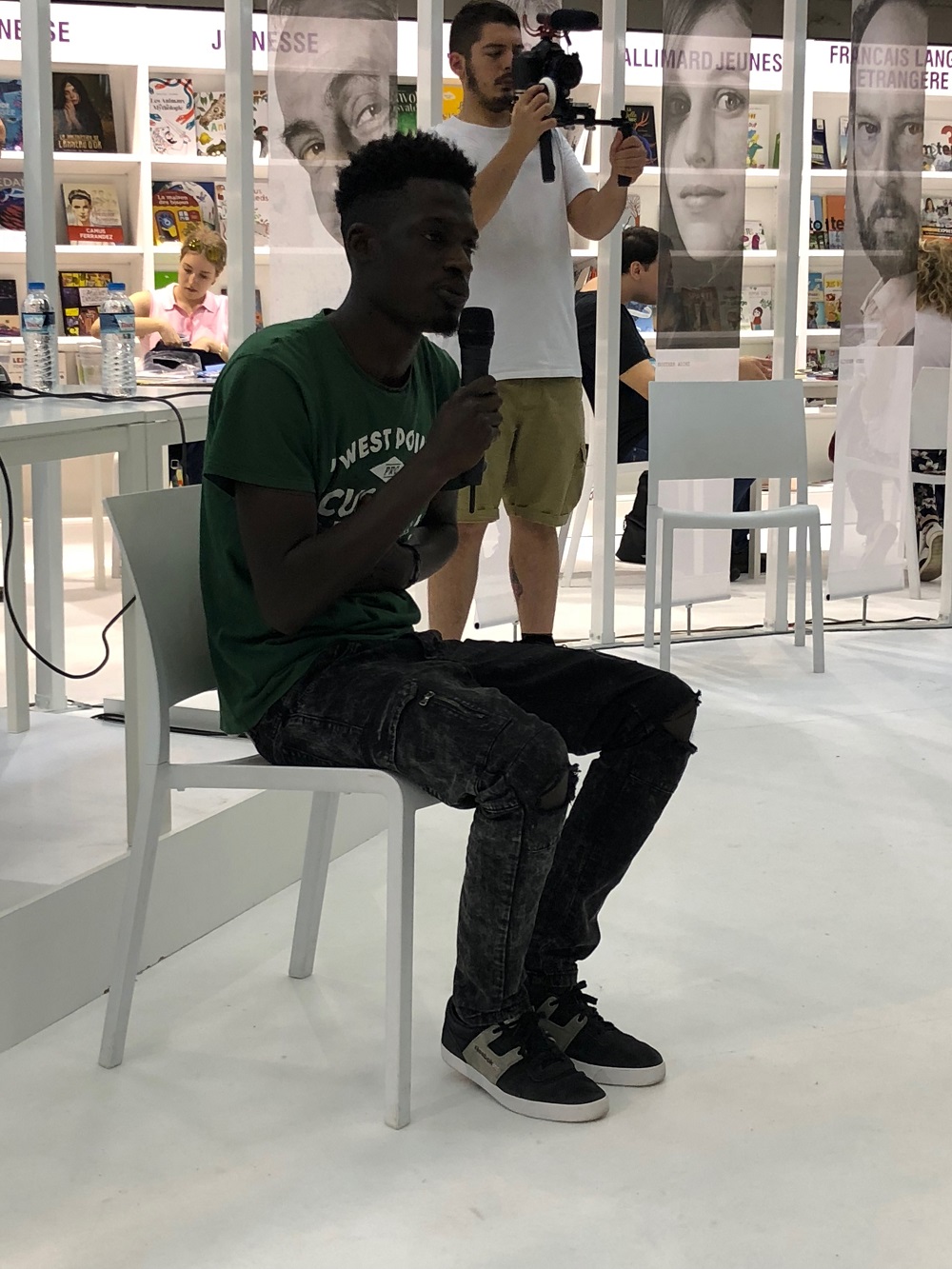
We met Armand at the International Book Fair of Thessaloniki this May. The French Institute, in collaboration with SolidarityNow, invited French-speaking artists-refugees, asylum seekers to participate in the parallel events of the fair. Armand took part, along with other Congolese. He wrote two poems, which were read by two women. Armand helped them to learn the rhymes and encouraged them to perform on stage. The poems’ words and metaphors in combination with the women’s performance gripped the audience.

Armand , 36, is a scientist and philosopher -as he states- who loves Paul Verlaine and writes poetry. He studied Biochemistry at the University of Kinshasa and Earth Sciences in France. “I am a philosopher. I like philosophy and I really like to ask questions about life”, he tells us. His need to capture his thoughts and feelings through writing began when he was a child. He wrote theatrical plays, which were performed at his school. His mother, a Professor of History at the University, always supported him. He wrote his first poem at elementary school. “I loved my mother very much. I wrote about her and about my life”, he says. In the Democratic Republic of the Congo, having a book published isn’t easy. The government is not willing to encourage and support artistic initiatives.

When he grew up he decided to leave poetry for a while and study science. His wife, who is a doctor, she used to say that she didn’t know if she was married to a scientist or a philosopher/poet. “I love my wife; we met at the University”, he tells us and shows us their wedding photo. She is very beautiful in her white dress. He was in Moria (Lesvos), almost 1,5 years ago, when he started writing again. “When I was there, I wrote a note about the inhuman living conditions, which I wanted to send to the UNHCR, but also to the European Parliament. The Congolese community was afraid that this note would have a negative impact on them, so they stood against its publication”, he explains. After that, he felt that he had to find a way to express all the things he was experiencing. As a result, he created a refugee forum.

Armand came to Volvi last August. Because of his personality he quickly gained the trust and respect of his compatriots. They were coming to him seeking for his help and his advice. After reflection and following many discussions, he decided and created “Umoja” (in Swahili means “together”), a refugee forum. Once a week, the group members gathered to discuss and exchange views on various topics. They put a lot of personal effort and they managed with their own expenses to design and publish three journals. The first issue was dedicated to the political situation in Congo, the second one to the journey from Africa to Europe and the third one was about the integration in the Greek society. They distributed the journals in the Book Fair.

After a big break he started to write again. “I was very busy with the forum, but I wrote these poems because I wanted to participate in the Book Fair. So, I wrote about the situation I’m experiencing. But my poems are not self-referential; I tried to make them more general”, he says. The two poems are as if they are one, there is a logical sequence between them. The first is more existential, it’s about losing your identity and all the things that determine who you are. “I thought the best way to express the importance of existence was through absence”, underlines Armand . The second poem is inspired by the French song “Espérer” by Michel Sardou, and it is about hope. “You need to have hope. If a star falls from the sky, it does not determine the end of the sky”, he notes.

“The best is to come”, with this phrase ends one of his poems. “I’m optimistic and that’s what makes me stand on my feet right now”, he says. He had to ask himself many questions about the meaning of existence and his own life in order to be able to write. The theory of existentialism always accompanied him throughout his life. “When I was young I was writing about existentialism, without even knowing the theory. Later on, I learned what existentialism is and I realized I was writing about it without knowing it”, he adds. “I asked myself many questions about the relationship between existence and dream. I thought my life was a dream in another dream and one day I would wake up and realize that everything was a dream”, he states.

“I need to express myself through writing. I want to talk about the difficulties that refugees are facing. A friend of mine says that you decompress when you express your sorrow”, states Armand and adds “writing is a way to express something, is a voice from a desert that wants to be heard”. “Throughout my journey, I met and lived with many people. I had to strengthen my willpower because I wanted to get out of Moria. I was shocked by all this violence and the problems that the asylum seekers were facing in Moria. I was shocked by the fact that the international community left them there without doing anything. It was very important for me to write about all these things. I had an inner need to talk about how people are treated, about the deportations and the EU-Turkey deal”.

For the future, Armand is moderately optimistic. He is rational without losing his hope. The last five years he is seeking to find stability. We all need to feel safe, and especially the people who were forced to leave their homeland. “I don’t thing that my life will be improved in the near future, because my wife is not here. At the moment, there is too much instability. I have to continue my professional career, but here there are not opportunities. So, it is somewhat utopic to talk about improvement, but I think I will find stability, and I will have my life back because I think positively”, he says. 


*Armand is a beneficiary of the Child and Family Support Hubs program, which is implemented by SolidarityNow, supported by UNICEF, with funding from the European Commission’s humanitarian aid department (ECHO).

**The Organisation Internationale De La Francophonie (OIF) finances French language courses for asylum seekers in Athens and Thessaloniki.

*** Iliaktida as UNHCR’s partner has the management of Volvi Accommodation Scheme, through IATAP

#artismylife | ABDUL

Giorgos Moutafis for SolidarityNow

“My mission is to give a meaning in my life”

“I am from Guinea”, Abdul says, and we are looking at the globe to find out where this country is. The Republic of Guinea is located in West Africa, is bordered by the Atlantic Ocean and neighbored by Guinea-Bissau, Senegal, Mali, Ivory Coast, Liberia and Sierra Leone. Guinea looks so distant in our own eyes, but not in the eyes of Abdul, who is dreaming to return back to his country.

Abdul, 21, came to Greece in May 2017. He is tall and solidly-built and very courteous. He speaks to us in French about his life and the importance and value of education for his country’s youth and not only. The words he uses are all carefully chosen and emotionally charged. Abdul finished high school in Guinea and registered at the University in the School of Insurance and Banking Studies. He was an excellent student and he really enjoyed reading. He has two favorite writers, the French Victor Hugo and his compatriot Camara Laya. “I really like this writer because he wrote very good books. If you find time, it’s worth reading his books. His books are taught at school. He writes about Guinea and more global on educational issues”, he informs us.

Abdul had to drop out from University because he hurriedly left Guinea. “Our world is complex, there is madness everywhere” he notes. He believed that everything would go as he had imagined. He was the good kid, the good student, his life was already predetermined. Suddenly everything was brutally overturned. “I thought that I would have a normal life, but everything changed. I wondered why all these things happened to me. I found that the people, I thought that would help me, were those who cut my wings”, Abdul adds.

The road led him first to Samos. There he discovered that he had a flair for writing. In the past, he had tried to write, but he was occupied with other things. In Samos were days that he did not know what to do. So, the only way out was through writing. He put his words down on a paper, to express his bitterness, as he tells us. Writing helps him to relax. “There are times when man feels no one will hear him, no matter how he shouts. I believe that you can attract more attention if you capture your thoughts on paper, in that way your message could be heard, and you can express the anger you may have. Here, I am going through a difficult time, emotions are many and mixed. I have an inner need to write down my thoughts, I don’t want to have an empty notebook. I want to express my anger”, he stresses.

We ask him about the writing process and he tells us that when he picks up the pencil, emotions and thoughts overflow him, and he captures them on paper. Then he returns to his writings. He re-reads them and tries to put them in order, to see how he can connect them, how to make rhymes and new ideas come to his mind. We ask him to tell us one sentence he has written. He grabs our notebook and writes a phrase in French, which in free translation can be read as follows: “the echo of my cry strengthens my anger”.

Education is one of the issues that concerns him, and it’s reflected in his writings. Education in Guinea is still trying to fill the gaps that the country’s precarious political situation has left behind. There is no education funding, no books for the children, and the academic year due to teachers’ strikes is shortened to 6 months. “The teachers, who have good intentions and are well-trained, work in the private schools and those who work in the public schools do not care about the teaching process and this negatively impacts the quality of education for students. I used to go to a public school”, says Abdul, who was the only one from his family who went to University.

From his University years, Abdul tells us that one image has been engraved in his memory. 200 students were trying to fit into a small room that had capacity for 80 people. The students were struggling to fit in the classroom and trying to listen the lecture and take notes. “It was something I experienced. I was impressed by the fact that young people in Guinea want to study, but they do not have the possibility”, Abdul says. “I do not know if you know Nelson Mandela’s quote about education. He said that the liberation of a nation is synonymous with its education. Without education we cannot do anything in life. It is the very basis for all things. All children are innocent, so if we deprive them of the educational process, we automatically deprive them of many things and that can have serious and long-term consequences. If everyone had access to education, things would be different, our world would be different, we would not have reached the point where we are today”, Abdul adds.

Abdul has applied for asylum in Greece. He wants to study Political Sciences. In Greece he decided to change his studies path. So, he tried to learn how to accomplish his goal. He discovered that in order to study in Greece he needs to go through some procedures that require time and patience. But that did not discourage him. He showed persistence and determination in pursuit of his dream. He chose the specific studies because, as he tells us, “I have a vision for my country”. Abdul wants to return to Guinea and help his country. We ask him if he likes Greece and if he imagines his future here. “I cannot say something that does not come out of my heart. I do not understand the language and I have integration difficulties. When I was in school, we were taught the Pythagoras Theorem. I also had the impression that I would come to Greece and find pensive people. But I realized that there are people who do not even know Pythagoras, so I am little bit disappointed”, he tells us honestly.

Today Abdul finds himself in a constant state of anticipation. He tries to put his thoughts in order. He recalls his journey from Africa to Greece. Despite the difficulties and obstacles, Abdul has not lost his optimism. “I see things from a positive point of view because I do not know what the future can bring; it can bring something positive. I have the following motto, while I breathe I hope. It’s not the time to put our hands down and resigning ourselves to our fate. On the contrary, I believe that the future is ahead. We will claim it”, he says.

His dream is to write a book to inspire everyone who share the same experiences with him. “I want to leave my traces so that those who will follow after me can find them. I want to write history. Camara Laya was a role model for me, so I want to leave something remarkable behind me like him. My mission is to give a meaning to my life”.


***Abdul is a beneficiary of the Child and Family Support Hubs program, which is implemented by SolidarityNow, supported by UNICEF, with funding from the European Commission’s humanitarian aid department (ECHO).

* Iliaktida as UNHCR’s partner has the management of Volvi Accommodation Scheme, through IATAP.

**The Organisation Internationale De La Francophonie (OIF) finances French language courses for asylum seekers in Athens and Thessaloniki.

#ArtIsMyLife | Gisele

Giorgos Moutafis for SolidarityNow

“Singing is my passion. When I sing, I feel nice. Music inspires me”

The girls have just finished their rehearsal and we walk along the small streets of Volvi*. Moria begins to sing one of his songs. We ask him to interpret the lyrics. “In few words, the song says that love is a crocodile” he explains us, and the two girls burst into laughter and start teasing him. Gisele just smiles. She is clutching her hands on her chest as she is on the defensive.

Gisele has her afro hair in cornrows. She is very tall and looks older than her age, but she is only 15 years old. Besides that, she is the youngest member of the band. She is quite shy and very timid, but at the same time extremely talented. In particular, she sings and writes poems. When she talks about the things she loves most, music and literature, her hands loosen up and her face becomes brighter. Gisele lives at Volvi along with her father and brother. Before they were in Moria, Lesvos. In July it will be one year since they came to Greece. However, Gisele hopes that they will soon be able to resettle to Belgium to reunite with her mother who lives there permanently.

We talk about Congo and her life there. “I really miss my school in Kinshasa. I went school till the 3rd grade of High School. I miss my friends and the activities I was doing. I miss everything from Congo. On Saturdays we were doing excursions with my family”, says full of nostalgia. Her love for music began when she was a child. Particularly, she participated in a church children’s choir. Gospel songs are her favorites. She became member of the band a few months ago. Everybody was very welcoming and warm. “I have decided to join the band because I love singing. Singing is my passion”, she says. “When I sing I feel nice. Music inspires me”, she adds.

In Greece, she goes to school and she tells us that she has three friends, Athanasia, Marina and Elena. “I like school very much, but it’s difficult because everything is in Greek”, says Gisele, who wants to study literature. We ask her about her life at Volvi and she confesses that when they arrived there with her father and brother, things were difficult. Back then she did not go to school and was obliged to stay at home all day; and that was boring. “My life in Congo was very different. I refused to accept the fact that I was staying at home and doing nothing. It was very difficult for me”, she notes. We ask her to tell us about her dreams and she tells us that when she grows up she wants to be a singer or a stewardess.

Gisele along with Moria, Richard, Sarah and Therese sang rumba and gospel at the 15th International Book Fair of Thessaloniki. Moreover, Gisele read out some of her poems.


*Gizel is a beneficiary of the Child and Family Support Hubs program, which is implemented by SolidarityNow, supported by UNICEF, with funding from the European Commission’s humanitarian aid department (ECHO).

**The Organisation Internationale De La Francophonie (OIF) finances French language courses for asylum seekers in Athens and Thessaloniki.

*** Iliaktida as UNHCR’s partner has the management of Volvi Accommodation Scheme, through IATAP.

#ArtIsMyLife | Moria

G. Moutafis for SolidarityNow

“One thing that makes me happy is to sing. When I sing I forget my problems. I forget everything”

We walk in the streets of Volvi. The area is full of small summer houses that were built in the past to accommodate the tourists who visited the small spa town. We listen to women and men’s voices singing gospel and rumba accompanied by a harmonium. Moria, Gisela, Therese and Sarah are rehearsing their songs. Richard the fourth member of the band couldn’t join them this time. Nowadays, the old tourist houses have been transformed into permanent residences, where refugees from Syria, Afghanistan, Iraq, Congo, Somalia, Eritrea and Pakistan live.

Moria comes and sits with us in the courtyard of the house, while the rest of the band continues the rehearsal. All of them are coming originally from Congo. Moria is 24 years old and on June 15th, for the second year in a row, he will celebrate his birthday in Greece. He used to live Volvi for 9 months. He studied engineering but has never worked on this field. Music is his big love. “Music in Congo is what football is for Brazil. It is in our blood”, he tells us. When he was little he used to sing in a church children’s choir. It is worth mentioning, that his grandfather was a priest. He remembers himself singing everywhere, even at school. As he was disturbing the class session, his teacher was getting annoyed and used to expel him from the classroom.

He took his diploma from the School of Engineering and he got a job as a DJ, but his family raised objections to his decision. “My family are Christians and very religious. In Congo, when you follow religion rules, you cannot work in night clubs that serve alcohol. There is no law that states that, this is a rule set by the family. My father’s sister raised me and she didn’t want me to work in a bar. So, I had to quit my job, but I continued singing with my friends”, he notes. Moria besides singing, is playing the guitar and writes lyrics. Rumba, Congolese music, love, his own life and the difficulties he has passed, as well as TV series, give him inspiration to write lyrics. Every day he listens to a lot of music. He really likes Michael Jackson, and he started English lessons to understand his songs. He also admires Papa Wemba and Tabu Ley Rochereau, – Congolese singers. “Their music is for me a source of inspiration. Their way of singing and also the tone of their voice, are elements that I want to add in my songs. One of the best up-and coming- Congolese musician is Ferré Gola. One thing that makes me happy is singing. When I sing I forget my problems. I forget everything”, says Moria.

On Saturday, May 3rd, Moria along with the rest of the band gave a live performance in the 15th International Book Fair of Thessaloniki. The occasion for this event was the collaboration between SolidarityNow and the French Institute and the OIF**. “I accepted to participate because I really like to sing; and I do not always have the opportunity to do so. Besides that, I am a French speaker and I want to meet and join the French-speaking community of Thessaloniki. For us this is very important as it is part of our identity. I hope that I would be given the opportunity to meet someone who will show interest in my talent and help me improve my vocal skills. The message I wanted to send was that all people are equal and that we have to fight racism”, he underlines.

Life in Greece for Moria has not been easy. He has experienced racism, as he confesses. Moreover, Volvi Accommodation Scheme -where he used to live- is located 50 kilometers away from Thessaloniki. “We felt isolated there”, he underlines. There are no coffee shops, restaurants or other shops in Volvi. The residents have to pay at least 8 euros to go to the city and they cannot afford it. And then, is Greece and the financial crisis. “We cannot find a job. Without work you cannot live, pay your tickets, buy clothes. I love Greece, but it is very difficult for us here. I come from Africa; I have relatives who think that because you are in Europe you are rich and everything is easy for you. I have no children, but I have friends who have children and they left from Africa to offer them a better life. Relatives call you and ask for money, and you cannot send them anything”.

Moria has been granted with asylum in Greece and now is a beneficiary of SolidarityNow’s Accommodation Program in Thessaloniki. Despite the difficulties, he is slowly trying to get used of his new life. “I am doing my best. I know one day I will make it”.


*The Accommodation Program is implemented by SolidarityNow and is part of the ESTIA Support Program for Integration and Housing of the United Nations High Commissioner for Refugees and funded by the European Union Humanitarian Aid and Civil Protection (ECHO).

**Τhe CFSH program is implemented by SolidarityNow in Volvi Accommodation Scheme, supported by UNICEF, with funding from the European Commission’s humanitarian aid department (ECHO).

***The Organisation Internationale De La Francophonie (OIF) finances French language courses for asylum seekers in Athens and Thessaloniki.

**** Iliaktida as UNHCR’s partner has the management of Volvi Accommodation Scheme, through IATAP.

#ArtIsMyLife

Giorgos Moutafis for SolidarityNow

Out of Africa, Kongo, Guinea, we are looking to find them on the globe. We do not know much about the Black Continent- only the Sahara Desert and the countries that border the Mediterranean sea. The rest is blood-stained by colonialists, civil strives, coup d’états, poverty and diseases. A war that lasts for many years.. A war that leaves behind thousands of victims and many refugees. How long has it taken for someone to go from Africa to Europe – the so-called Promised Land? “Long”, is the answer of the people who made this trip.

Out of Africa, with the countless indigenous tribes, tropical forests and steppes, rituals and music, clothes, jewelry and tattoos that adorn the bodies of women and men, with the struggles for human rights, with writers, poets, scientists and activists. We got in touch this aspect of Africa through the eyes, narratives, music, poems and paintings of 9 unique indigenous artists. As far as you go, you will always carry in your heart the feeling of returning home.

Through the #ArtIsMyLife project, SolidarityNow re-introduce us 9 artists from Congo and Guinea whose art is their life. Moria, Richard, Teresha, Giselle, Sara, Sami, Momo, Armond and Abdul, talk about their love for poetry, painting, music and writing. Art was and still is their companion throughout this difficult journey. Through art, they profess their pain, their wrath, their fears, and their dreams. Pablo Picasso said that “art washes away from the soul the dust of everyday life”. For these 9 artists, art has a therapeutic impact on them, it helped them to stand up straight, to try for the best, and dream for the future.

#ArtIsMyLife  remind us of something very important: that in life nothing has a single dimension. Everything has a complement. No one is just a refugee, or an asylum seeker, or a migrant, he/she is always and something else. He/She may be also a great poet, or a painter, or a writer, or a philosopher and musician.

We would like to introduce you these 9 artists. These are their stories.


* Iliaktida as UNHCR’s partner has the management of Volvi Accommodation Scheme, through IATAP.

**The Organisation Internationale De La Francophonie (OIF) finances French language courses for asylum seekers in Athens and Thessaloniki.

***The CFSH program, is implemented by SolidarityNow, supported by UNICEF, with funding from the European Commission’s humanitarian aid department (ECHO).

****The accommodation program is implemented by SolidarityNow and is part of the ESTIA Support Program for Integration and Housing of the United Nations High Commissioner for Refugees and funded by the European Union Humanitarian Aid and Civil Protection (ECHO).

#iAmStrong | JOHN

Giorgos Moutafis for SolidarityNow

“My world would be a better place if I had an identity”

 John comes from Syria and has Kurdish origins. When he introduced himself to us, he chose the name John, instead of his real name because he is still scared, causing him to still hide. Even though he is now in Athens, living so far away from his country, he is still scared to recount his story under his true identity.

This fear overtakes John since, in his life, he has experienced rejection, intimidation and threats from others because of who he is. People have judged him after getting suspicious about his sexual orientation.

John discovered who he was and understood how he felt at the age of 15.

He is gay.

From the moment he decided to be truthful with himself, he knew that his family would not accept his true identity. So, John, one of eight kids, decided to leave from his country in 2011 and go to Iraq. He lived there since 2016. The war, as well as the lack of privacy, inside his own home as well as socially, were the main reasons for him to leave again and go somewhere far. Before he left from home, he studied computers for a year at the University.

While he was studying and living alone, he learned how to cook and become almost professional. “I love cooking. I learned how to cook well with the help of my mother, who gave me instructions over the phone. And I absolutely adore my mother.” While in Iraq he worked as a chef at a four-star hotel and was able to afford his life.

He left Iraq for the same reasons he left his home country. He traveled to Turkey and from there to Chios, then Athens, Thessaloniki and finally Idomeni. He waited there, for the moment he could leave, for four months in a state of terror; “the others would have killed me if they found out I was gay”. His goal was to manage to go towards Holland or Switzerland, that’s what he wanted from the very beginning.  Those were two countries in which he imagined he could live freely. His dream died however when the borders closed. John explained that he had to face himself and became isolated and began battling depression.

He returned to Greece and learned about SolidarityNow. He joined the program Safe Refugee, which focuses on LGBT refugees.

He began living in a normal house where he wasn’t scared. He managed to offer help to one of his old friends Pinar, who searched for him in Greece when he too managed to overcome the same dangers and fears.

Today they are roommates and they share their everyday life in the city of Athens. John really likes Athens because the climate reminds him of Syria. Having, in some extend, overcome his severe sadness about the fact that he might not be able to go to another country in Europe, he thinks that Athens will prove to be a very important stop for him and for his future. John is doing everything he possibly can in order to enrich his knowledge while living in Athens.

He follows both Greek and English lessons, which are offered to the members of the program. He successfully takes part in many activities and events in relation with cooking. But, according to him, the most important thing is the scholarship he won through the program “From Camp to Campus”, and today he is graduating from the American College Deree; “My most memorable experience to this day is my time in Deree”.

Sadly, he still remembers some of the gloomier experiences he lived through when he received a negative answer about receiving asylum in Greece. Today however that is just a sad memory, since his application for asylum will probably be positive.

John is a very sweet, shy but active 26-year-old man. He believes that if he tries he will manage to make a better life for himself – a life in which he will overcome all boundaries. He is willing to travel wherever its best for him. In the meanwhile, he is soaking in as much information and knowledge as possible because he wants “to work as an interpreter, and in that manner, help other refugees”.

When our meeting came to an end, John stood up and was ready to go, but before he left, he said; “you know what? My world would be better if I had an identity with my name and not an identity that simply stated refugee.”


*John lives in one of the SolidarityNow accommodation structures in Athens under the Safe Refugee program implemented by the organization and is part of the United Nations High Commissioner for Refugees ESTIA Support Program for Integration and Housing and funded by the European Union Humanitarian Aid and Civil Protection (ECHO).

**Through the Safe Refugee Program, SolidarityNow provides accommodation to refugees, in independent apartments in Athens and Thessaloniki. The program’s beneficiaries receive free psychosocial support, legal counseling, they participate in educational and recreational activities, and are members of a wider support network that aims to improve their living conditions and support them during their stay in Greece.