The story of Zozan


Ζozan came to Greece from Syria in February 2016 and now she lives in one of the SolidarityNow accommodation structures. She is in Greece with her four children as a refugee and asylum-seeker.

She was teaching fashion design for the last eight years of being in Syria and she loved her job. She and her husband bought a house for their family, however they were obliged to abandon it, as well as their town, when bombs destroyed it; they went back to their village and live with her parents-in-law for a year. That year’s everyday life was very difficult for Ζozan since it deprived of her independence. The numerous family problems led the couple to the decision to leave for Turkey in 2012, where they remained for three months. But Ζozan returned to Syria; she could not accept the fact that her children could not go to school in Turkey. She rented a house alone to live with her children. “I said I will fight“, Ζozan admits. After about five months, her husband returned to Syria to find her, whereas he left again in 2015 for Turkey and from there to Italy.

By the time, when the village came in the sights of the war, she took the brave decision and left Syria with her children. Her life was becoming unbearable. Every time she was leaving without her children, to secure a wage to finally leave the country, she didn’t know whether to return. Ζozan didn’t accept to live with other, parents and relatives; she wanted and still wants a free life. “It was very cold, I remember that“, on January 10th, 2016 when she left with her children to Turkey. She was afraid; she was illegal. Three times she tried to cross the borders of Turkey within the same day. The third time she was caught, threatened with a gun; “kill me, I will never go back to Syria“; but she went; she was forced to.

By paying the Turkish policemen, she passed the borders of Turkey and arrived in Istanbul. Four times she tried to cross the borders of Greece by sea. The boat sank. Four times she returned to Turkey, which meant four imprisonments; every one of them meant at least 15 or 16 hours in a detention cell.

Finally, she arrived on the island of Chios by boat and from there to Idomeni, where she stayed for four months. During this time, she tried twice to pass the border with Skopia; She and her children spent days and nights walking in the mountains. They turned them back. When Idomeni closed, they were transferred to the camp of Kalohori. Ζozan became nervous with her children, she tried to commit suicide; she started walking every day to forget.

A friend of Ζozan from Ireland, made her a gift; the equipment to start painting. She did. At nights, at one until seven in the morning, she was painting; she was too afraid to sleep; she was afraid for her children. After seven o’clock in the morning, when everybody was awake she was sleeping; she was not that much afraid for her kids as she was during the night.

Ζozan’s life changed when she, and her children, moved to the SolidarityNow accommodation structure; she felt safe again. During the day, she goes her children to school, returns home, cooking and painting. She loves to participate in activities, learn new things and she wants to see her children grow up and progress in a safe environment.


*The Hosting Scheme Project Home for Hope is implemented by SolidarityNow with the support of UNHCR GREECE and EU funding.

The story of Rajab

(Ελληνικά) Συνέντευξη & φωτογραφίες: Steven Tagle.

Story and photo: Steven Tagle for SolidarityNow. 

Rajab, 21, lives in a single room in one of SolidarityNow accommodation structures for refugees in Athens, near Hashem and Nouri. His arms are thick from using his crutches. “My papers say I’m Syrian, but I was born in Iraq”. Half of his family lives in Iraq, half in Syria.

When he was nine years old, he lost both his legs.

He was riding in a tractor driven by his cousin, with his aunt, his cousin’s wife, and his cousin’s sister. He was sitting on the rim of the tractor tire. An American tank fired four shots at them.

“Three of the shots exploded near us. Big sounds. I didn’t hear the fourth shot. Dirt flew up. Hot diesel burned my chin. I don’t know what happened. I didn’t think; I was just afraid.”

The tractor was destroyed. The shot exploded under Rajab’s cousin, killing him. His aunt also died. His cousin’s wife lost one leg below the knee. His cousin’s sister lost two legs below the knee.

“People came to collect the bodies and thought I had died. They left me with the dead. But I waved my hand, and they found me and took me”.

The surgery lasted two hours. “I woke up before the surgery and saw my legs. When I woke up again, they were gone. ‘Where are my legs?’ I cried. ‘Where are my legs?’ To this moment, I’m still crying”. He stayed in the hospital for 27 days and then went home for three months. “Nobody helped me, not doctors, not Americans, nobody”. Three years later, four American soldiers came to Rajab’s house with a translator to say, “We are sorry.” They sat in the garden and spoke only with his father. Rajab never saw them again.

After the Americans bombed him, Rajab went to Syria to treat the pain in his legs. He stayed in Syria for two months, then the Red Cross took him to Rome to be fitted with prosthetics. “The Italian legs were so comfortable—I could sleep in them!”, Rajab said. He lived in Rome for four months with his uncle. He lived in Syria for a year, then returned to Iraq. “Every two months, the government gives me $1,100. Sometimes the money is enough, sometimes not”.

Because he was young when he received the prosthetics, he soon outgrew them. “The old legs started hurting me. They were too small. My skin stuck out over the prosthetic. There was blood”. Now he wears legs from Iraq. These legs are plastic with iron cores. The knee of the left leg is broken and does not lock. He must lock his right leg and then use it to stand. And there is no padding between the plastic and his skin, so the prosthetic digs in like a knife.

Because of the war, Rajab couldn’t go back to the Red Cross. He tried to go to Italy from Syria, but the trip was too expensive, so he chose to come to Greece instead. He traveled from Baghdad to Kurdistan then flew to Turkey. He sailed from Turkey to Leros, Greece on 30 June 2016. He spent three-and-a-half months in the camp, and it was very bad. There were 600 people living there, now maybe 350 to 400. The doctor at the camp said he did not need surgery and did not give him pain medication.

The UN connected him with SolidarityNow, and he lives in the accommodation structure in Athens since September 2016. A team of doctors came to the hotel a week ago, and showed him a video of a boy walking with prosthetic limbs. The doctors want to make a new pair of legs for him. They told him that they would do a simple surgery here in Greece, and then he could go to another country to do the major surgery. “I wish to go to America to fix my legs because the medicine there is good” Rajab said. “The Americans cut my legs, so I want them to make me new ones”.

But because of the EU-Turkey deal, it’s difficult for Rajab to move on to Italy. The Greek government told him, “Stay in Greece, and we will give you a passport and you can go to another country after five months.” A few days ago, he had an interview to begin the asylum process. Because he has a Syrian passport, the process will go quickly. He won’t have a problem unless the Greek government sends him back to Turkey without a passport. “I’ll stay here for five more months to wait until I can leave—I have no choice”.

“Two days before I left Syria, I met Gazia in person. I told my father, ‘This is my love. Take care of her’”.

After he fixes his leg, he wants to go back to Iraq. “When I go back to Iraq, I will marry, buy a house, start a family.” He’s been in a relationship with his girlfriend Gazia for two years. Her family agreed to the marriage, but he can’t marry if he doesn’t fix his leg.


*The Hosting Scheme Project Home for Hope is implemented by SolidarityNow with the support of UNHCR GREECE and EU funding.

The story of Nour


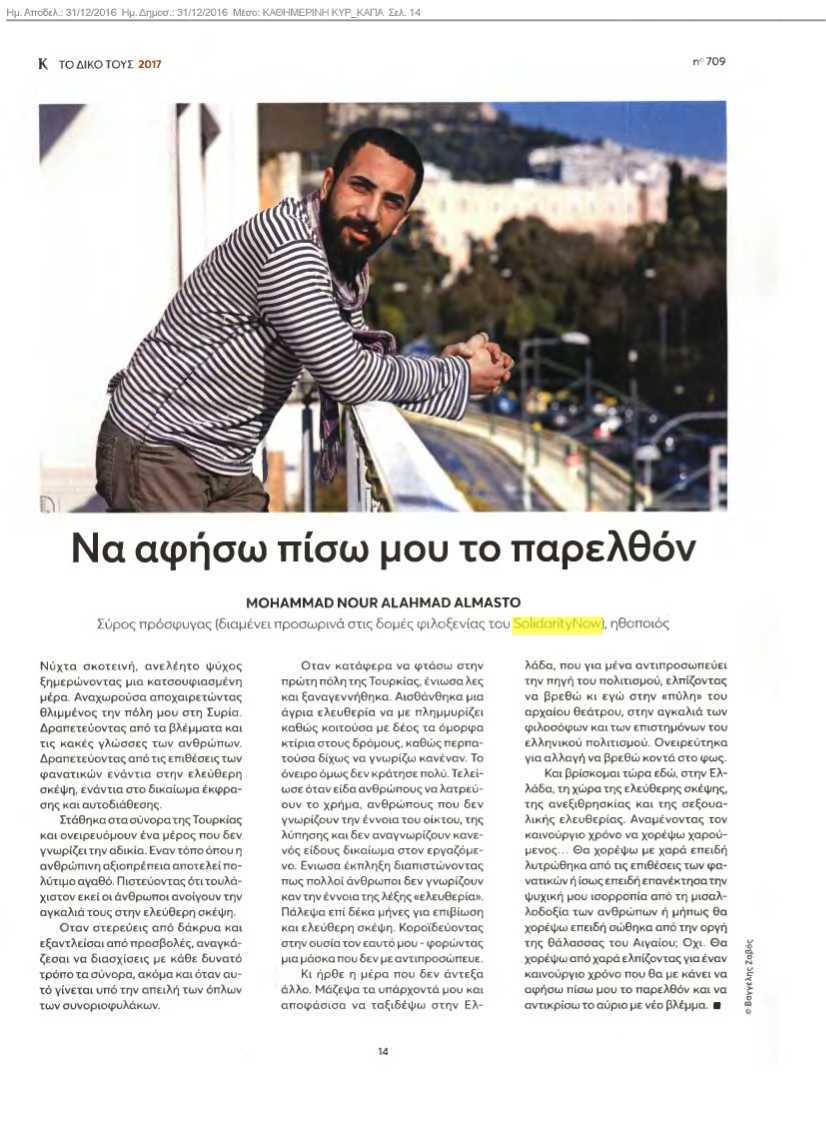
by Mohammad Nour Alahmad Almasto, actor, Syrian refugee – hosted temporarily in SolidarityNow accommodation structure

This story was also published in K magazine of Kathimerini newspaper (1/1/2017)

“An intense cold dark night, the dawn of a bad day; I was leaving, regretful, waving goodbye to my city in Syria; escaping from the resentment and nastiness of my compatriots; escaping from the attacks of fanatics against free thought, against the freedom of expression and self-determination.

I was standing at the border with Turkey dreaming of a place where there is no injustice. A place where dignity is a respected and valuable human right; believing that at least there, people will be open to others who think and act differently than them and have a different attitude towards life.

When you have no more tears to cry and you cannot tolerate any more offences, you are forced to flee, crossing every border on the way, even when subjected to the threat of border guards’ weapons.

Once I managed to arrive in the first city in Turkey, I felt reborn. A fierce feeling of freedom overwhelmed me as I looked in awe at the beautiful buildings in the streets and walked alone without knowing anyone. The dream did not last long. It ended when I saw people who worship money, people who don’t know the meaning of compassion, of pity and don’t recognize any labor rights. I was surprised by the discovery that many people did not even know the meaning of the word freedom; I struggled ten months for my survival and freedom of thought in Turkey, fooling myself by “wearing a mask” that didn’t represent me.

Then came the day that I could no longer stand my everyday reality. That day, I picked up my belongings and decided to travel to Greece, which in my mind represented the source of civilization, hoping to find myself in the arms of philosophers and scientists and to immerse myself in the universe of ancient theater. I dreamed to be closer to the light- for a change.

And now I am here, in Greece, the land of free thought, religious tolerance, and sexual freedom. Expecting the new year to dance cheerful … I will dance with joy because I left behind the attacks of fanatics or maybe because I regained my mental balance far away from people’s intolerance or because I was saved from the anger of the Aegean Sea!?
No, not for the above. I will dance with joy hoping for a new year that will make me leave the past behind and look to the future with a renewed point of view!”

The story of Ghanim


In October 2016, Ghanim Hameed’s family was included in SolidarityNow’s program “Extended”; the family consists of Ghanim, his wife Shaymaa and their two children, the minor 16-year old Hazim and the 21-year-old Samar. Their origin is from Iraq and they had requested family reunification in Germany since their oldest and youngest sons are there.

In June 2014, they decided to leave Mosul and travelled to Turkey. Ghanim decided to send the youngest son and his daughter to Germany, but finally at the beginning of 2015 the two sons, the oldest and the youngest went to Germany. Their trip from Istanbul to Germany lasted 45 days and cost 11,000 euros to the family. In the period, up to February 2016, the other four members remained in Turkey and the two children, Hazim and Samar, worked on occasional jobs; within a short time, they learned to speak both Turkish and English. Hazim is very good at computers and his dream is to finish school and then study computer science. Samar’s dream is also to be able at some point to study at the University.

When they first arrived to Greece and precisely in the island of Leros, February 2016, they didn’t manage to cross the border and consequently they remained in Idomeni for two weeks, until they were transferred to the camp in Diavata. Few days later, assisted by volunteer groups, they moved to a house in South Magnesia where the owner offered his home to accommodate the family.

The family joined the organization’s program in October 2016 and they began taking lessons of the English and German languages hoping to be prepared for their relocation to Germany. During October and November, they visited SolidarityNow offices very often to share their agony and impatience for the final decision on behalf of UNHCR. In November, when they were informed on the acceptance of their request to be reunited with their two children in Germany, they visited the organization’s offices directly to share their happiness and ask for the details of their transportation. They decided to pay for the transportation expenses to expedite the procedures. Upon great efforts by the organization’s people, they finally got the date for their trip to Germany; the big day was set for the 6th of December. In the meantime, they were lucky for once, since they were included in the prepaid card program of SolidarityNow which is operational in the context of the Hosting & Accommodation Scheme project implemented with the support of UNHCR, and thus they managed to cover their travel cost. They also had the time to say goodbye and celebrate with everyone they love; friends who remain in Greece as well as the organization’s personnel that have supported them all the way.

On December 6th, we accompanied the family to the airport. They had planned to surprise their youngest son, Yousif; only Mohamad, the eldest, knew about the family’s arrival. This time, Yousif’s request to Santa Claus came true and moreover it became reality on the 6th of December, the day that traditionally Germans receive their presents from Santa Claus.

Another surprise however had been prepared for the family, this time, by Mohamad. He had rented a house, small but enough to host the whole family!

The members of this family are all together now and they’ll welcome the New Year in their new home. All family members said they don’t wish to return home in Syria; they only wish for the war to end and only then they will visit again relatives and friends.

Welcome to our world, Haneen!


Welcome our small Haneen! Just these last few days, the family of Abdulamajid became a five member one. At the Accommodation & Housing SolidarityNow, and specifically in our structures at Sindos Thessaloniki, we welcomed our new member with great joy and enthusiasm.

Haneen we wish you the best of luck in our world!

Wasim’s story: “I miss my father so much”


Wasim, 27, has a single room on the sixth floor of Theoxenia Hotel. In the afternoon, he blasts music from through speakers connected to his smartphone. He ran a shop in the Jbela neighborhood of Deir ez-Zur, Syria, where he programmed and sold remote keys for cars. He lived in a house with his grandfather and uncles. There are seven people in his family: his mother and father, three sisters, him and his brother. His father, 55, hurt a disc in his back and went to Berlin in August 2015 for treatment and to find work. The rest of his family now lives in Kurdistan, and he talks with them every day.

In 2012, Wasim moved to Iraq. He worked sanding tables and with vents and decor. He spent four years in Iraq and learned to speak Kurdish. To get to Greece, he traveled from Kurdistan to Izmir, Turkey, then to Chios. The boat ride to Chios was difficult. The boat was packed with women and children and rocked back and forth on huge waves. Turkish police chased the boat, but did not catch them before they reached the border. Wasim stayed in Chios for six days, then moved to Camp Ritsona for six weeks. In Camp Ritsona, about an hour north of Athens, there were snakes and pigs. There he had his first interview on Skype, where he showed officials his photo and passport.

He spent four months living in Skaramangas. “For ten days, I slept in a tent outside Camp Skaramangas. I couldn’t shower, and they wouldn’t let me in because I didn’t have the right papers. My friends inside the camp found me and gave me food and shelter. I didn’t have my own food card for four months.” Finally, he talked with the organization Caritas Hellas. After a month, they entered his name in the computer and connected him with SolidarityNow. He then spent a month at Hotel Galaxias in Petrothalassa, a four-hour drive from Athens by bus. He arrived at Theoxenia Hotel in September.

Wasim’s been living in Greece for eight months and is on his way to Germany to reunite with his father. “I haven’t seen my father in two years. I miss him so much.” They haven’t told him when he is leaving yet, but perhaps next month. At Theoxenia, his balcony door does not close properly, and it gets cold at night. During the heavy rains this past weekend, water leaked into his room. Recently, during a football game, he was carrying his phone in his pocket and the football hit it, shattering the screen. It cost him 40 euros to repair his phone.

Wasim loves to work, swim, and play sports like basketball and football. He participated in the 5km race of this year’s Athens Classic Marathon as part of the first refugee team. He visits friends in Skaramangas and Exarchia. “Every day I go out to Exarchia. I’ve made friends with Germans, Italians, Egyptians, Syrians, Albanians, French, Greeks.” He met Ana, his Spanish girlfriend, in Athens as well as her friends Ramiro and Fetha from Argentina. As of December, he has been reunited with his father in Germany.


#WEAREFAMILY 04 – Eleftheria’s and Avin’s family


“They are children and they need a hug“, Eleftheria Delipaltidou, retired, mother of two

A lovely morning in the area of Prochoma at Thessaloniki begins with this short but indicative greeting:

–        Good morning, mom!

–        Good morning, my baby!

Then, they exchange the day’s first kisses and hugs and sit together around the table to have breakfast. This takes place every day since August, when they started living together.

A beautiful family moment, among people who are not blood related, however they became a family thanks to the offer of Eleftheria and George, who opened their home and most widely their arms, to host and embrace the Syrian family of Avin, Kawa and their daughter.

Watch here the very moving video of this wonderful cohabitation.

Alaa: We feel that we live in our own home!


“Ask her whatever you want! She is Google!”;  with this incitement to address encyclopedic questions to his 8-year old daughter, we started our conversation with Alaa Touisan, 41 years old Iraqi refugee.

But we hesitated at the beginning; Therefore, Alaa started asking:

  • What is the capital of Indonesia?
  • Jakarta
  • When was, the Berlin demolished?
  • In 1988
  • Who wrote Hamlet?
  • Shakespeare

The 8-year old Rania replies to the questions with the maturity of an adult and of course, she wins besides the applause and our unlimited admiration. Rania is a little girl whose only window to the world and information was and still is the internet, through which she managed to gain so much knowledge; Rania did not have the chance to attend school ordinarily in her country due to the prosecutions by ISIS.

Certainly, her parents, Alaa, expert computer analyst and Nadia, professor of English, contributed decisively to the intellectual development and education of their daughter.

Today Alaa, Nadia and their two daughters, the 8-year old Rania – their “wise child”- and the 6-year old Lanya have gone away from threats against their lives, intimidations, and constant persecutions; they do not fear for their lives any longer. They were forced to leave Iraq, their country, when the ISIS “destroyed my work and my life“, Alaa says. As a small company owner, trading laboratory equipment and computers, Alaa was cooperating with the state and had public work contracts. This was enough to be prosecuted as well as to be threatened for his life and his family life. He initially fled to Jordan, where he stayed for a short period, before making the decision to come to Greece dreaming to go further to Europe.

“We left with $5,000 and we thought that we would be able to go somewhere safely; this was my priority – to find a shelter for my family where we would feel safe. Thus, my children would continue their school and I would find my way to start a job“.

Alaa and his family arrived to Greece risking their lives. But finally, they arrived and now they feel safe at home that has opened to accommodate them in the framework of the SolidarityNow hosting and accommodation program Home for Hope. “We have a home that we feel it like our home; we are grateful to those people who offered it to us, although we know that we will not stay in Greece forever. Our asylum application has already been approved and we will soon leave for Ireland. However, we will never forget this feeling of solidarity we felt here”, Alaa says.

Alaa, like many of his countrymen who were obliged to leave their country because of threats and persecutions, dreams living in a safe place; a safe place for him and his family. A place where children are free to live their childhood. Α place where human life has its indisputable value and human rights apply to everyone.

*Today, Alaa and his family have already been relocated to Ireland and try to begin their life from the scratch.

*The Hosting Scheme Project Home for Hope is implemented by SolidarityNow with the support of UNHCR GREECE and EU funding. 

#WEAREFAMILY 03 – GEORGIA’S AND SOULIMAN’S FAMILY


“Until they find their own Ithaca, let’s open our hands and embrace them”, Georgia, retired from Thessaloniki, hosts the 12-member family from Syria.

A beautiful story of solidarity and smooth coexistence among 13 people, unfolds in Thessaloniki. This story began when Georgia decided to open her paternal house for the 12-member family of Souliman from the Daraa Governorate of Syria.

Parents and their ten children began together the long journey from Syria to flee away from the war, that destroyed their dreams for the future and ended up threatening their lives. The first stop of the trip was Turkey. Then, they managed to reach Lesvos island by a small boat along with many compatriots of them. After remaining for a short time there, the next stop for the family was the northern border of Idomeni and the last, the accommodation structure in Oreokastro.

The 43-year-old mother, Naima narrates the difficult conditions she lived together with her ten children and her husband in Idomeni and ends up saying that “we cried because we were feeling sorry for ourselves”.  Today, she lives a different reality with happy moments, full of gratitude and safety and feels very happy that “someone who does not know me opened her home for me”.

Naima, mother of ten children, both juvenile and adult, manages to always smile, while at home she takes care of everyone! Of course, Georgia supports the household of Naima and helped the family to create a garden, where the family cultivates their own fruits and vegetables and they have also their own eggs. The two women share identical worries as all mothers around the world and they find in that too, similarities that exceed every other difference between them – religion, nationality, language. Naima’s dream is to provide her children with a beautiful and safe life as well as with the opportunity to study.

Georgia does not regret for the decision to open her parental house and host the 12-member family, while expressing what she felt as an observer of the refugee crisis – “the living conditions in the camps were terrible and inhuman leading these people a life of misery“.

This act of solidarity by Georgia is an example of generosity and peaceful coexistence among many and different people, while she encourages others to do the same; “open their hands and hug the ones in need“.

Let us introduce the members of this family via the #WeAreFamily project, here.

*The Hosting Scheme Project Home for Hope is implemented by SolidarityNow with the support of UNHCR GREECE and EU funding.

Adel, the poet from Syria: “I decided to stay and live in Greece!”


A prospective economist and an amateur poet, Adel decided at his 18 years to change country and life refusing to accept war as his everyday life.

His attitude is enclosed in the phrase “I was afraid because of the conditions, but at the same time, confident I would make it“; with no fear but full of courage, as a privilege of his age but character also, he began his adventure from Syria stopping at first in Turkey.

It took several days for him to arrive to Turkey, making the longest distance of the route on foot and less by bus, like most of his compatriots.  He succeeded, keeping strong the faith for a better life already seem to be ahead. However, Adel had left behind anymore his parents and his five siblings.

He spent some time in Turkey by working to raise money and thus buy a place in a boat to Mytilene. Adel eloquently describes his time in Turkey, having only unpleasant memories both by people’s behavior toward refugees as well as because of the extremely difficult working conditions.

Adel’s next station was Mytilene, after an overnight journey in the Aegean Sea. A trip that included a forced break due to boat damage, intense moments of people crying, be afraid and separated from their belongings which had managed to save and overexertion of men passengers like Adel, for all’s rescue.

The attempt to continue his trip to Europe led him to Idomeni, but the closed borders led him finally to Athens. In Athens, he joined UNHCR’s relocation program being registered as an asylum seeker. Shortly after, he denied his relocation to Romania; Adel preferred to stay in Greece.

Today, Adel is a young man who makes gradually steps ahead. He works in SolidarityNow as an intercultural mediator, helping this way his compatriots, whereas he soon expects to begin his studies again; although he has not chosen yet among his preferences – biotechnology, philosophy and economics. In the meantime, he writes poems in Arabic and English, he learns Greek and he is always eager to participate in the organization’s actions.

Recently, Adel was the tour guide for SolidarityNow guests at the event entitled “Migration flows and SolidarityNow activities”, held at the Museum of Cycladic Art on October 20th. Adel talked about his own journey and guided the guests in the photographic exhibition about the refugee crisis of the Chinese artist Ai WeiWei, hosted at the Museum until the end of October.


Watch Adel’s video here: