parallaxi.gr: Refugees in Thessaloniki will run five kilometers of solidarity


During the reporting period, the 2nd SolidarityNow Refugee Team took part in the 6th International Thessaloniki Night Half Marathon.

Following the participation at last year’s Athens Classic Marathon, with the 1st group of refugees in the history of the Marathon, this year and this time in Thessaloniki, more than 20 refugees and immigrants – SolidarityNow beneficiaries from the hosting scheme project and the Blue Refugee Center)-, along with SolidarityNow staff members, ran together.
Read the article here

RED PEPPER: Waiting for the future to begin: refugees’ everyday lives in Greece


A very interesting article by #SolidarityNow #volunteer in #Thessaloniki, Karolina Partyga, about her experience offering her services to the programs concerning the beneficiaries of the organization.

Read the article here


Waiting for the future to begin: refugees’ everyday lives in Greece

Solidarity volunteer Karolina Partyga on what she has learned from refugees in Thessaloniki

September 26, 2017

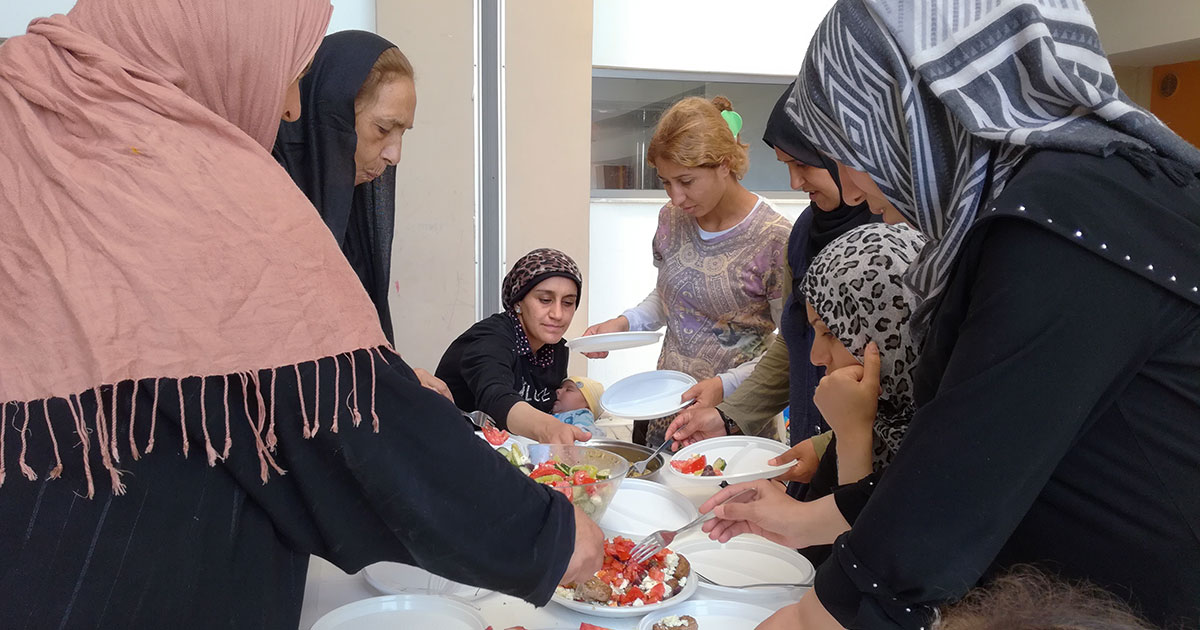
Food and drink can help communication across language barriers. Photo: Solidarity Now

Two years after the world made a photo of a dead toddler into the image of mass forced migration, refugees are no longer front page news in Europe. If we want the next image to be a different one, we need to fill the insides of the newspapers with stories of our shared everyday life that bring us closer to one another. Great injustice and suffering is being inflicted every day – but the complexity of the refugee experience requires everyday stories be told as well.

As a volunteer at Solidarity Now in Thessaloniki, Greece, I am not confronted with stereotypical images of suffering. There are profound moments, when people share their extraordinary stories with me – a 14-year-old who says she always wanted to be a jet pilot, but now doesn’t really have a home to defend; a man who mentions it took him two years and eight months to get to Europe (during a Greek class on basic means of transport); a teenage girl who has just found out she will see her father after three years apart; a woman who lived in a prison with her husband and their baby boy.

Pretty much everyone can tell you something that will break your heart, and I am reminded that I’m surrounded by people whose lives have been turned upside-down. But, far more often, we talk about our everyday lives – housework, books and music, the impossible heat, and, of course, food.

Space for solidarity

Usually, I work in the Blue Refugee Centre, a space run by Solidarity Now in central Thessaloniki. There, we offer a variety of services – psychosocial support, language lessons, employment help – and create opportunities for refugees to socialise, to exchange experiences and tips on life in Greece, and to find out about the diverse programmes available to them.

There isn’t a single profile of a typical person who comes to the centre. We support people of very different ethnicities, socioeconomic backgrounds, levels of education and sexual orientations. Here you can meet a lawyer fleeing political repression, a man who worked in a family import-export business until the road they used for transport was blown up, a housewife who was famous in her village for her baba-ganoush, and a pre-school teacher who topped up her income working as a tailor. Those identities are again complicated by their experiences since leaving their homes, and the situation they encounter in Greece.

Some people commute to the centre from nearby camps (eg. from Davata – you can see a map with camps in Greece ), some stay in housing units managed by one of the many NGOs, some have already found homes in the city. But even some camps feel worlds apart. The infamous Softex camp, run by the Greek army, was meant to gather those considered ‘troublesome’ (which did not prevent many children from living there), leaving many people traumatised by the experience. The small Drama camp, meanwhile, inhabits a converted warehouse, so each family has a private space and life is relatively well-organised.

The situation in the camps has also been changing in the last few years. Many camps came under increased pressure after hotspots such as the Idomeni border crossing were evacuated, and the overpopulation and tensions have threatened the sense of security among many families.

Housing is allocated by UNHCR (the UN refugee agency), but the agency hires other NGOs to manage various accommodation schemes, and to communicate with refugees about their housing situation. This often depends on a variety of factors – from the individual’s intention to claim asylum in a specific country, to the relationships they develop with the community around them. Understandably, many refugees find the system too complicated, and feel that there is not enough transparency around housing.

Non-verbal communication

I’ve heard a lot of those stories in the Greek lessons I take at the Blue Refugee Centre, as my colleagues and I learned how to talk about our experiences in the new language. But, as a volunteer, I am hardly at the forefront of such problems, and I mostly admire the patience of everyone involved and the dignity with which they handle those difficulties.

It turns out the best conversation starter, when it seems like you can’t communicate at all, is coffeeI work primarily in the Women’s Safe Spaces. One of my main responsibilities is teaching English in the Mother-Baby Corner at the refugee centre, where I work with women who have never learned the language. Many don’t read and write in their native tongues.

I do not speak Arabic, Farsi, Kurdish, or any non-European language. This means I do not share a single verbal means of communication with my students, but, often, the groups I teach are composed of so many different nationalities that it wouldn’t really make that much of a difference if I spoke one of those languages.

It turns out the best conversation starter, when it seems like you can’t communicate at all, is coffee. We might despise sugar for being a menace of modern society, but I am thankful the word is almost identical in a variety of languages. The most beautiful thing about the ‘do you like coffee? With sugar?’ chat is that it ends the ‘me no English’ one. And then it turns out communication is 80 per cent non-verbal, so you can start having a great time.

For certain practical arrangements, we sometimes turn to a form of ‘Chinese whispers’, as some women speak both Arabic and Kurdish, or Turkish, or Farsi. It can produce an unexpected result. Once, I asked my students to try to translate their favourite recipe, but my request must have got lost in translation, and some brought the prepared dishes instead. The food was fantastic.

Sharing stories

My work is never dull. Students always ask to see pictures of my family, and to satisfy their curiosity about my life, I had to develop some acting skills. There are numerous surprises: when I met a new group of women, they expressed far greater enthusiasm in a deal that would involve me teaching them English for an hour and them teaching me Arabic for another. Another surprise was when I made Polish pierogi (it took me over four hours, and I was so happy with myself) and the overwhelming response of my students was something like: nice, but we make the same dish (surprise!), just better (well, no surprise!)

Then there are the touching moments: after a session, a student used Google Translate to tell me she ‘greatly enjoyed this activity’ – I guess she did not feel that the English phrases she knew were properly expressing her satisfaction. Or when a new student – the first Farsi speaker in the group – joined, even the shyest of my students employed their new English vocabulary to find out about her children.

I don’t usually ask personal questions, and so was surprised and moved to find out that this was precisely what my students wanted to shareThere is seemingly nothing extraordinary about those moments, but, as time passed, they allowed us to grow close. One day we were learning how to express our feelings, and someone said: ‘Today I am angry, because my husband in Germany doesn’t telephone.’ While I only wanted to teach the basics of expressing causality in English, that turned out to start our most incredible conversation.

Given the traumatic experiences of many refugees, I don’t usually ask personal questions, and so was surprised and moved to find out that this was precisely what my students wanted to share. It turned out that some of my students stayed quiet before because they didn’t know how to say the things that actually mattered to them – I miss my husband, I am lonely, I feel confused. There were tears, hugs, and words of comfort, all shared by women who just two months earlier weren’t sure how to say where they’re from in English.

That session was perhaps one of the most humbling experiences of my life. The stories we hear of refugees are usually a lot more eventful than those of the women I have the pleasure to work with. But I am amazed at their strength and resilience in a context they have found themselves in – the protracted uncertainty, the seemingly endless wait for the bureaucratic procedures to finally be completed so they can see their loved ones.

Living in limbo

Currently, the waiting time for an asylum, relocation or family reunification application interview is at least half a year. For Syrian nationals (and stateless people who can prove residency in Syria), the so-called ‘Fast Track’ option is advertised as requiring a six-month waiting period. If you’re not Syrian, your asylum claim will take much longer, but at least you can work in the meantime – though this isn’t much of a consolation in crisis-ridden Greece, where the unemployment rate doesn’t fall below 20 per cent. This means that many people are forced to live in limbo, uncertain of their future, unable to begin rebuilding their lives.

At the same time, those who are waiting to leave Greece face an often-changing and increasingly complex situation. Germany has imposed a (unofficial and unlawful) limit on the number of people who can be flown into the country under the family reunification law. Families who believed they will soon see each other have been waiting since October 2016 for their flights. Perhaps some of the most depressing cases involve individuals who were mistakenly informed their reunification papers are ready, only to find out that the call from the ministry was meant for someone else.

In this bureaucratic nightmare, spending another Eid video-chatting with their families, people begin to see their life in the given Western European country as a new beginning. This is why many believe that everything will change, and that life will become easier once they leave Greece.

Someone here once told me that in Syria the system was corrupt, but at least you knew how to use it. In Greece, all you can do is wait for your future to begin. Renew your temporary permit card and try to focus on everyday life – the housework, the books and music, the weather, and, of course, the food.

If you want to find out more, social media profiles of NGOs and volunteer groups can be the best source of information. Solidarity Now is the organisation I volunteer at. On our profile, you can find individuals’ stories, opinion pieces, and updates on programmes available for refugees, although some posts are only available in Greek. Refugee Info is an Arabic and English language resource which posts reliable updates for refugees, and for those who want to have a more detailed view of the circumstances in which a refugee finds themselves in Europe. The Mobile Info Team is a similar resource, but focused on Northern Greece. For Northern Greece, you can also check out the page of the independent Volunteers Network. I also follow the UNHCR country-specific profiles, and major organisations like Help Refugees.

The Christian Science Monitor: On one tiny Greek island, a warm welcome for Syrian refugees


See the whole article here

AUGUST 7, 2017  TILOS, GREECE—They are the forgotten people – more than 60,000 refugees who have been languishing in camps in Greece after their dreams of finding a new life in Europe were thwarted.

The Syrians, Iraqis, and Afghans are stuck in limbo, waiting to hear whether they will be granted asylum and allowed to settle in the European Union – or rejected and sent back to Turkey, from where they crossed in boats to Greece.

But amid the grim picture, a tiny island in the Aegean Sea is offering a glimmer of hope and possibly a lesson for how the rest of Greece – and indeed the whole of Europe – could tackle the continent’s refugee crisis.

Ever since the migration crisis erupted in 2015, the island has embraced asylum seekers. It is now home to a dozen Syrian families, about 70 people in total, many of them young children. That may not seem a large number in the scale of things – until you bear in mind that the entire population of Tilos is fewer than 500 people.

The islanders are keen to integrate the newcomers as much as possible and hope they will forge new lives amid the olive trees and ancient stone terraces of Tilos. And they think their acceptance of refugees could – and should – provide an example to the rest of Europe.

“If a little island like ours can support 12 families, then others can do the same, in proportion to their population. Bigger communities can take larger numbers. We can solve the refugee problem,” says Maria Kamma, the outspoken mayor of Tilos. “We think that the arrangement we have here is a model that could be exported to the rest of Greece and the whole of Europe.”

A more welcoming home
Tilos is an outcrop of limestone mountain peaks, pebble beaches, whitewashed churches, and goats – lots and lots of goats. A two-hour boat ride from Rhodes, it is part of the Dodecanese chain of islands and lies just a few miles off the coast of Turkey.

The Syrians live in a cluster of prefabricated cabins grouped around a shower block and a communal cooking area.

It is hardly luxurious, but it is much cleaner and less institutional than the refugee facilities on other Greek islands such as Lesbos, where thousands of asylum seekers are crammed together behind wire fences.
Here on Tilos, the people are free to come and go. Many of the adults have found jobs – in shops, restaurants, the local bakery, and as day laborers.

It helps that the camp, shaded by mature trees, is right in the heart of Livadia, the main port.
It is a few hundred yards from a long beach, where the Syrian children have been learning to swim.

“It is so much better than where we were before,” says Mohsen Barak, who fled his native city of Al-Hasakah in northeastern Syria because of the war. He and his family have been living on Tilos for seven months.
“We were on Rhodes, in a refugee camp inside an old slaughteryard. It was really bad. We spent nearly a year there.”

The camp on Tilos was established about a year ago by Solidarity Now, a Greek nongovernmental organization, with help from UNHCR, the UN’s refugee agency.

“The refugees are much happier than they were at first, especially now they have found jobs. It’s not good to sit around all day with nothing to do, you become angry and depressed,” says Spiros Aliferis, a team leader from the NGO. “The kids go to the playground in the village, they swim in the sea.”
The children attend Greek and English language classes from Monday to Friday and many can already converse comfortably in their adopted language. They will start going to the island’s primary and secondary schools when the school year starts next month.

‘Greek with a Scandinavian attitude’
The presence of the refugees has inspired plans to build a cheese factory on Tilos, to make cheese from the milk produced by the many goats that wander its herb-scented mountains and valleys.

There are 15,000 of them, outnumbering the human population by 45 to 1.
Currently, just one or two shepherds use the milk to make cheese, and that’s for their own consumption. The plan is to produce enough to export, in a cheese factory that will provide jobs for both Syrians and locals.

“We think there’s a big potential,” says Stathis Kontos, adviser to the mayor.

“The mentality on Tilos is different from other islands,” he says. “I like to say the people are Greek but with a Scandinavian attitude. They like to help others.”
While some of the refugees hope to be reunited with relatives already settled in Germany and other EU countries, the mayor hopes the rest will remain and rebuild their lives on the island.

“I’d like them to stay,” she says. “They’re human beings. It’s their right to live in humane conditions. Tilos is a place where we can support their dreams of a peaceful life.”

BUSINESS INSIDER: Syrian refugees are being welcomed on this small Greek island where goats outnumber people


See here the full article

They are the forgotten people – more than 60,000 refugees who have been languishing in camps in Greece after their dreams of finding a new life in Europe were thwarted.

The Syrians, Iraqis, and Afghans are stuck in limbo, waiting to hear whether they will be granted asylum and allowed to settle in the European Union – or rejected and sent back to Turkey, from where they crossed in boats to Greece.

But amid the grim picture, a tiny island in the Aegean Sea is offering a glimmer of hope and possibly a lesson for how the rest of Greece – and indeed the whole of Europe – could tackle the continent’s refugee crisis.

Ever since the migration crisis erupted in 2015, the island has embraced asylum seekers. It is now home to a dozen Syrian families, about 70 people in total, many of them young children. That may not seem a large number in the scale of things – until you bear in mind that the entire population of Tilos is fewer than 500 people.

The islanders are keen to integrate the newcomers as much as possible and hope they will forge new lives amid the olive trees and ancient stone terraces of Tilos. And they think their acceptance of refugees could – and should – provide an example to the rest of Europe.

“If a little island like ours can support 12 families, then others can do the same, in proportion to their population. Bigger communities can take larger numbers. We can solve the refugee problem,” says Maria Kamma, the outspoken mayor of Tilos. “We think that the arrangement we have here is a model that could be exported to the rest of Greece and the whole of Europe.”

A more welcoming home
Tilos is an outcrop of limestone mountain peaks, pebble beaches, whitewashed churches, and goats – lots and lots of goats. A two-hour boat ride from Rhodes, it is part of the Dodecanese chain of islands and lies just a few miles off the coast of Turkey.

The Syrians live in a cluster of prefabricated cabins grouped around a shower block and a communal cooking area.

It is hardly luxurious, but it is much cleaner and less institutional than the refugee facilities on other Greek islands such as Lesbos, where thousands of asylum seekers are crammed together behind wire fences.

Here on Tilos, the people are free to come and go. Many of the adults have found jobs – in shops, restaurants, the local bakery, and as day laborers.

It helps that the camp, shaded by mature trees, is right in the heart of Livadia, the main port.

It is a few hundred yards from a long beach, where the Syrian children have been learning to swim.

“It is so much better than where we were before,” says Mohsen Barak, who fled his native city of Al-Hasakah in northeastern Syria because of the war. He and his family have been living on Tilos for seven months.

“We were on Rhodes, in a refugee camp inside an old slaughteryard. It was really bad. We spent nearly a year there.”

The camp on Tilos was established about a year ago by Solidarity Now, a Greek nongovernmental organization, with help from UNHCR, the UN’s refugee agency.

“The refugees are much happier than they were at first, especially now they have found jobs. It’s not good to sit around all day with nothing to do, you become angry and depressed,” says Spiros Aliferis, a team leader from the NGO. “The kids go to the playground in the village, they swim in the sea.”

The children attend Greek and English language classes from Monday to Friday and many can already converse comfortably in their adopted language. They will start going to the island’s primary and secondary schools when the school year starts next month.

‘Greek with a Scandinavian attitude’
The presence of the refugees has inspired plans to build a cheese factory on Tilos, to make cheese from the milk produced by the many goats that wander its herb-scented mountains and valleys.

There are 15,000 of them, outnumbering the human population by 45 to 1.

Currently, just one or two shepherds use the milk to make cheese, and that’s for their own consumption. The plan is to produce enough to export, in a cheese factory that will provide jobs for both Syrians and locals.

“We think there’s a big potential,” says Stathis Kontos, adviser to the mayor.

“The mentality on Tilos is different from other islands,” he says. “I like to say the people are Greek but with a Scandinavian attitude. They like to help others.”

While some of the refugees hope to be reunited with relatives already settled in Germany and other EU countries, the mayor hopes the rest will remain and rebuild their lives on the island.

“I’d like them to stay,” she says. “They’re human beings. It’s their right to live in humane conditions. Tilos is a place where we can support their dreams of a peaceful life.”

HUMANITE: Grèce. À Tilos, un îlot d’humanité dans un continent cadenassé


See the article here

Meisoun, Mohamed et leurs enfants sont arrivés de Syrie en février. Aujourd’hui, Meisoun travaille, souriante et ravie.
C’est l’histoire d’une petite île grecque perdue quelque part dans la mer Égée. Avec à peine 500 habitants, Tilos a décidé de devenir le havre de ceux qui ont dû quitter leur patrie pour rester en vie. Reportage.
Maria Kamma, 47 ans, est la maire et l’âme de Tilos. Débordante d’énergie, enthousiaste et pleine d’humour, elle dégage une impression de volonté inébranlable. Élue en 2014, elle a déjà laissé une trace indélébile sur la vie de l’île. Encartée au Pasok (parti socialiste grec) depuis plus de vingt-cinq ans, elle force le respect de tous, même ceux qui pourraient la voir comme une adversaire politique. Les quelques militants de Syriza qui vivent sur l’île la saluent d’un simple « camarade ». Mais tout ce que fait Maria s’inscrit dans la tradition de solidarité des habitants de Tilos.

Cela fait maintenant sept ans que l’île reçoit un flux de réfugiés plus ou moins constant. Les premiers arrivent en 2010. Parmi eux, Nima, un Afghan de 15 ans à l’époque. Aujourd’hui âgé de 22 ans, il habite toujours à Tilos. C’est Maria qui l’a invité pour qu’il raconte son histoire. En arrivant, ils s’embrassent comme deux membres d’une même famille. Nima a tout de quelqu’un d’heureux. Sourire aux lèvres, il raconte son histoire : en 2010, il arrive à Lesbos depuis la Turquie, puis part pour Athènes. Là, tandis qu’il se cache dans des taudis, il rencontre un autre Afghan qui lui parle d’une île où il « sera accueilli comme s’il était un d’entre eux ».

Au début, Nima voulait aller en Norvège ou en Suède. Mais il a préféré Tilos, « un endroit magique » .

Jusque-là, Nima rêvait d’aller en Suède ou en Norvège. Mais, épuisé par son voyage et coincé à Athènes dans une chambre qu’il partage avec 18 autres personnes, il se laisse convaincre et décide de tenter sa chance à Tilos. Les deux compagnons de route y partent le jour même. Dès leur arrivée, ils y rencontrent une autre famille de réfugiés afghans logés chez des locaux. « Au début, je leur demandais de me cacher. Je n’arrivais pas à croire que ma présence ne posait problème à personne. » Quelques jours plus tard, Nima ose enfin sortir et se balader dans le village. Il sera immédiatement pris en charge. Pendant un an, il suivra des cours de grec intensif tout en assistant à quelques cours avec les autres enfants du village.

Maria n’était pas encore la maire, mais son prédécesseur, Tasos Aliferis, aujourd’hui décédé, était dans la même logique. Nima nous raconte : « Pendant l’année scolaire, deux fois par semaine, le maire venait me chercher après l’école pour me faire rencontrer les habitants de l’île. Au bout de quelques mois, je connaissais déjà tout le monde. Une fois l’année scolaire terminée, je parlais déjà assez bien le grec. On m’a proposé de travailler dans un des restaurants du village. J’ai accepté. » Son travail est déclaré et rémunéré normalement. Il vient d’avoir 16 ans et fait désormais pleinement partie de la société locale. On est en 2011. Jusqu’à aujourd’hui, il ne partira de l’île que pour trois mois, le temps de passer par Athènes et de se « rendre compte à quel point Tilos est unique ». Dans la capitale, il reçoit une offre d’emploi d’une ONG pour être interprète auprès de réfugiés et d’immigrés fraîchement arrivés en Grèce. Mais il choisit l’île. « Tilos est un endroit magique », lance-t-il avec un large sourire.

Quatre ans après l’arrivée de Nima, le flux de réfugiés va s’intensifier du jour au lendemain. C’est désormais Maria qui doit tout organiser pour que l’île puisse y faire face sans y perdre son âme. Le challenge est de taille : en 2014, comme en 2015, Tilos va à plusieurs reprises accueillir le double de sa population en l’espace de quelques jours…
Parmi ceux qui seront en première ligne, il y a aussi Eleni Pissa, aujourd’hui responsable du « centre d’accueil pour familles vulnérables » de l’île. Regard pétillant et sourire malicieux, Eleni se souvient. Tout a commencé un matin de printemps en 2014. Se rendant à son magasin, elle a « vu un grand groupe de Syriens qui venaient d’arriver. Ils avaient le regard de ceux qui ont longtemps côtoyé la mort. Ça m’a fait froid dans le dos. Tout de suite avec Maria, on a créé un groupe de volontaires pour voir comment les nourrir, les loger, leur expliquer leurs droits…. Les jours suivants, le flux augmentait, mais de plus en plus d’habitants venaient se déclarer volontaires pour aider »…
Ils décident de transformer un vieux camp militaire abandonné en centre d’accueil. Le conseil municipal approuve à l’unanimité. « On a d’abord organisé l’essentiel : mettre l’eau courante, l’électricité, remettre en état deux bâtiments abandonnés. Au départ, on ne disposait que de notre travail et des maigres moyens de la municipalité. » Quelques mois plus tard, l’ONG Solidarity Now, ayant entendu parler de leur initiative, leur rend visite et propose de les financer. Dix conteneurs sont installés et transformés en habitations autonomes. « À l’époque, nous fonctionnions en tant que centre de premier accueil. Mais, une fois que l’accord entre l’UE et la Turquie a été mis en place, le flux vers notre île s’est quasiment arrêté. Ce n’est pas pour autant qu’on ne voulait plus aider ! »
Dans le camp, on apprend le chant et la musique, les langues, on fait du dessin et parfois aussi du yoga.

Les habitants de Tilos se portent alors volontaires pour accueillir d’autres réfugiés. Maria Kamma nous raconte : « Quand j’ai appelé le ministère pour leur dire que l’on souhaitait qu’on nous envoie des familles réfugiées, ils ne m’ont pas vraiment crue, ajoutant que notre île était tellement petite que cela n’était pas nécessaire ! Mais on a insisté. » L’idée est lancée de transformer le camp de premier accueil en camp pour les « cas vulnérables », c’est-à-dire les familles avec de nombreux enfants en bas âge et sans moyens. Idée acceptée avec enthousiasme par les locaux, et approuvée de nouveau par le conseil municipal à l’unanimité. Le camp est placé sous l’égide du Haut-Commissariat des Nations unies pour les réfugiés.
C’est ainsi que les premières familles arrivent des quatre coins de la terre à la fi n du prinntemps 2016. « Dès le début, notre but a été de les intégrer, pas juste de les nourrir et de les loger », explique Eleni. Sont mis en place immédiatement des cours de grec et d’anglais pour les enfants et les adultes. « S’ils restent en Grèce, à Tilos ou ailleurs, le grec leur sera nécessai re, et l’anglais plus qu’utile. S’ils partent vers d’autres pays européens, au moins, ils auront appris l’anglais, ce sera pour eux un atout. » C’est dit avec une facilité déconcertante, mais tous les habitants du camp le savent : s’ils veulent rester sur l’île pour toujours, ils sont les bienvenus ! Cette attitude unique amènera de nombreux volontaires de passage ainsi que le soutien officiel du gouvernement.
Entrer dans le centre d’hospitalité de Tilos, c’est un peu rentrer dans une colonie de vacances où les tentes seraient remplacées par des conteneurs. Des enfants souriants courent à droite et à gauche et s’amusent d’un rien. Outre les langues, dans le camp, on enseigne le chant et la musique, on fait du dessin, de la peinture et parfois aussi du yoga. Les enfants jouent aussi au foot avec ceux de l’équipe locale. Une grande partie de ces activités sont spécialement conçues pour aider enfants et adultes à dépasser les traumatismes parfois très profonds qu’ils portent en eux. Et puis, aussi, on essaie de trouver un travail à tous ceux qui le désirent.

En tout, 46 Syriens sont logés dans le camp, dont 26 enfants de moins de 15 ans. Certaines familles ont déjà reçu l’asile, d’autres l’attendent. Meisoun, son mari Mohamed et leurs cinq enfants âgés de 3 à 11 ans sont arrivés en Grèce, début 2016, et au camp de Tilos en février 2017. Ils ont quitté la région de Dara en Syrie où ils vivaient pour échapper à la guerre, comme toutes les familles du camp. Candidats à l’asile à leur arrivée, ils ont reçu le statut de réfugiés il y a quelques semaines et savent, désormais, qu’ils ne seront pas expulsés.
«Il faut trouver un travail pour ceux qui veulent. Pour les femmes, c’est une émancipation.» Eleni, responsable du centre d’accueil
En Syrie, Meisoun avait toujours été femme au foyer. À Tilos, elle a décroché son premier travail rémunéré : femme de chambre dans un hôtel local. Eleni lui a demandé si elle voulait travailler et gagner ainsi de l’argent. Après en avoir discuté avec son mari pendant deux jours, elle a accepté. « Cela a été extrêmement difficile pour moi au tout début. Mais, en fait, ça va ! C’est même très bien ! » dit-elle avec un large sourire. En tout, 7 adultes sur 20 ont un travail sur l’île.
Pour la plupart des femmes, c’est la première fois. « C’est très important de trouver un travail à ceux qui le veulent, explique Eleni. Pour les hommes, c’est un peu un retour à la normalité. Pour les femmes, une émancipation et une introduction aux moeurs européennes. »
Trois des huit familles du camp pensent très sérieusement s’installer à Tilos. Comment trouver des emplois à tous ? Maria a déjà une solution. « Notre île est réputée pour son fromage traditionnel de chèvre. Il faut qu’on ouvre une coopérative et que tous ceux parmi les réfugiés qui veulent en devenir membres/actionnaires puissent le faire. Cela donnera du travail à tous et on produira assez de fromage pour que vous autres (tous ceux qui ne vivent pas à Tilos ­ NDLR) puissiez en profiter aussi ! » conclut-elle, en s’esclaffant.

Quand on lui fait remarquer à quel point son attitude et celle de toute l’île sont exceptionnelles, elle soupire. « Nous ne sommes pas des êtres exceptionnels. Nous avons juste fait le strict nécessaire que nous impose notre humanité commune. » Dans le climat européen actuel, c’est déjà une révolution.

LA RENOMMÉE D’UNE ÎLE

Peuplée d’à peine 500 habitants, l’île de Tilos défraie la chronique depuis longtemps. Pendant la Seconde Guerre mondiale, elle est une des très rares à pouvoir encore nourrir sa population malgré l’occupation allemande. Elle va accueillir nombre de réfugiés locaux, venus des îles voisines où régnait la famine. Au lieu de voir ces nouveaux venus comme un danger, les habitants de Tilos vont utiliser les bâtiments vides pour les accueillir et les intégrer. En 2007, le maire y a célébré le premier mariage homosexuel de l’histoire de la Grèce. Il sera annulé par les tribunaux, un mariage entre personnes du même sexe n’étant alors pas reconnu par la législation. Mais cet acte va lancer le débat qui amènera au changement de la loi en 2015. En juin 2017, Tilos a reçu deux prix de la part de la Commission européenne : le premier prix dans la catégorie « îlots énergétiques » des prix européens de l’énergie durable, ainsi que le prix du public. Elle est à deux doigts de devenir la première île grecque indépendante énergétiquement, après avoir fortement investi dans les énergies renouvelables, solaire et éolienne ces dernières années.