PRESS RELEASE | €15 million for Civil Society in Greece: The Active Citizens Fund Greece programme has been completed by Bodossaki Foundation and SolidarityNow


The programme was successfully completed with the Bodossaki Foundation in consortium with SolidarityNow, serving as the Fund Operator.

Survivors of gender-based violence, people with disabilities and psychosocial difficulties, victims of torture, human trafficking, asylum seekers and refugees, second-generation migrants, Roma, prison inmates, the elderly, LGBTQ+ individuals, people living below the poverty line, students, teachers, parents, guardians, and young people are just some of the groups supported by the Active Citizens Fund Greece programme.

The €15 million Active Citizens Fund Greece, which began in 2019 and concludes today, represents the largest investment ever in Greek civil society. Funded by Iceland, Liechtenstein, and Norway as part of the European Economic Area financial mechanism (EEA Grants), the aim of the programme was to empower civil society, improve its sustainability and highlight its crucial role in promoting democratic processes, increasing citizen participation, and protecting human rights. The Fund Operator for the Active citizens fund in Greece is Bodossaki Foundation in consortium with SolidarityNow.

In total 208 entities – including civil society organisations, informal groups, universities and local authorities – were funded through the programme. As a result 128 projects were implemented in major urban centres such as Athens, Thessaloniki, Patras, Heraklion and Ioannina, as well as in rural, island, and remote areas of Greece, including Epirus, Western and Central Macedonia, Eastern Macedonia and Thrace, the Cyclades, and Northern and Southern Aegean. The programme has directly benefited over 152,000 people, while more than 4.3 million people were reached through 702 awareness-raising activities under the programme about issues related to rights, equality, and good governance.

The projects implemented under the programme were selected from 586 proposals submitted by civil society organisations in response to seven open calls. These projects focused on enhancing citizen participation, strengthening civil society’s role in advocacy and oversight, defending human rights, promoting gender equality, combating gender-based violence, empowering vulnerable groups, and reinforcing civil society organisations and the sector as a whole.

The success stories and transformative impact of the programme were celebrated during the Closing Ceremony at the Athens Conservatoire on October 22, with civil society representatives and donor country delegates in attendance. The event featured a photography exhibition, documentary screenings, and storytelling sessions. Ambassador Lajla Brandt Jakhelln of Norway, Athena Dessypri, President of the Bodossaki Foundation, and Stelios Zavvos, President of SolidarityNow, shared insights on the programme’s significance and the vital role of civil society.

Ambassador Lajla Brandt Jakhelln:

“If we want Europe to continue being a beacon of democracy and freedom in our world, we need a stronger and more cohesive Civil Society sector. A sector that will focus on the core principles of democracy and the rule of law, combating corruption, and promoting transparency and human rights. For the past 30 years, Norway and Greece have worked together under the EEA Agreement to reduce social and economic inequalities, while also strengthening our bilateral relations based on shared values and goals. In the new funding period of the EEA Grants, €159 million will be made available to Greece by 2031, with €15 million specifically directed towards supporting Civil Society. We will continue working together for a green, competitive, and inclusive Europe.”

Athena Desypri:

“History has demonstrated that in times of crisis, the role of civil society becomes increasingly vital. Today, as the world confronts numerous challenges, the contribution of civil society to maintaining a healthy democracy—rooted in the values of freedom, equality, the rule of law, and human rights—is more crucial than ever. It is therefore highly significant that the donor countries of the EEA Grants—namely Iceland, Liechtenstein, and Norway—have prioritised civil society through the Active Citizens Fund, dedicating €15 million to this programme.”

Stelios Zavvos:

“The Active Citizens Fund has served as a catalyst for change, providing civil society organisations with the opportunity to grow, empower themselves, and take on a central role in advancing social justice in Greece. The collaboration between SolidarityNow and the Bodossaki Foundation, as grant managers, along with the bilateral partnerships established with the donor countries—Iceland, Liechtenstein, and Norway—have demonstrated that shared values and a common vision for a fairer, more inclusive society can drive real and lasting change.”

The results in these thematic areas have been significant, with far-reaching impact. Over 113,400 individuals from vulnerable groups benefited from targeted actions aimed at their empowerment and social integration. Additionally, 14,700 people received training on human rights issues, and more than 4,000 public servants participated in capacity-building training to enhance the protection and promotion of human rights.

The results achieved in the above thematic areas are significant, and the impact of the projects has been extensive. More than 113,400 people from vulnerable groups benefited from specially designed actions aimed at their empowerment and social integration. Additionally, 14,700 people received training on human rights issues, while over 4,000 public servants participated in capacity-building training for the protection and promotion of human rights.

To foster transparency, accountability, and good governance, the programme supported 53 advocacy campaigns and 44 initiatives for active citizen participation in public life.

The programme also played a crucial role in strengthening bilateral cooperation between Greece and donor countries—specifically Iceland, Liechtenstein, and Norway. A total of 49 initiatives supported cross-border collaboration between Greek organisations and their counterparts in these donor countries, with more than 750 participants.

Moreover, the programme actively promoted regional cooperation among benefiting countries in the EEA, facilitating knowledge exchange between more than 200 Greek and international civil society organisations. This collaboration brought together over 500 participants, encouraging the adoption of best practices and innovative solutions. Notably, a groundbreaking study by the Foundation for Economic and Industrial Research (IOBE) measured, for the first time in Greece, the contribution of Civil Society to the national economy, with the findings now available online here.

Detailed results of the programme can be found on the programme website, here.

ARTICLE | Work and Mental Health: October 10th, World Mental Health Day


It’s time to make mental health at work a priority!

World Mental Health Day, celebrated every year on October 10th, offers us an opportunity to focus on the relationship between work and mental health.

Considering that most of the world’s population works, it becomes immediately clear that this issue affects millions of people. Especially if we consider how much of our daily lives we spend at work, it is clear how crucial a role it plays in our well-being.

According to the World Health Organization, there are many factors that affect mental health in the workplace. Risks to mental health at work can include:

  • under-use of skills or being under-skilled for work;
  • excessive workloads or work pace, understaffing;
  • long, unsocial or inflexible hours;
  • lack of control over job design or workload;
  • unsafe or poor physical working conditions;
  • organizational culture that enables negative behaviours;
  • limited support from colleagues or authoritarian supervision;
  • violence, harassment or bullying;
  • discrimination and exclusion;
  • unclear job role;
  • under- or over-promotion;
  • job insecurity, inadequate pay, or poor investment in career development; and
  • conflicting home/work demands.

These factors not only have a profound impact on employees’ mental health, but also have wider social consequences, affecting both people’s personal lives and the social fabric.

Through our experience in the Psychological Service of the Athens Solidarity Center we observe that most of our beneficiaries bring for management matters related to issues such as burnout, uncertainty, performance anxiety, collegial relationships, toxic work climate.

This finding is so common that it is often taken for granted, underlining the extent of the problem. It is time to bring these issues into focus, to rethink our approaches and to start treating mental health at work with the significance it has.

*Since August 1st, 2023, the operation of the Athens Solidarity Center by SolidarityNow is supported by the Swiss-Greek Cooperation Programme (Embassy of Switzerland in Greece) to reducing economic and social disparities in the EU and by the Ministry of Migration and Asylum. **The Center is also supported by the Municipality of Athens.

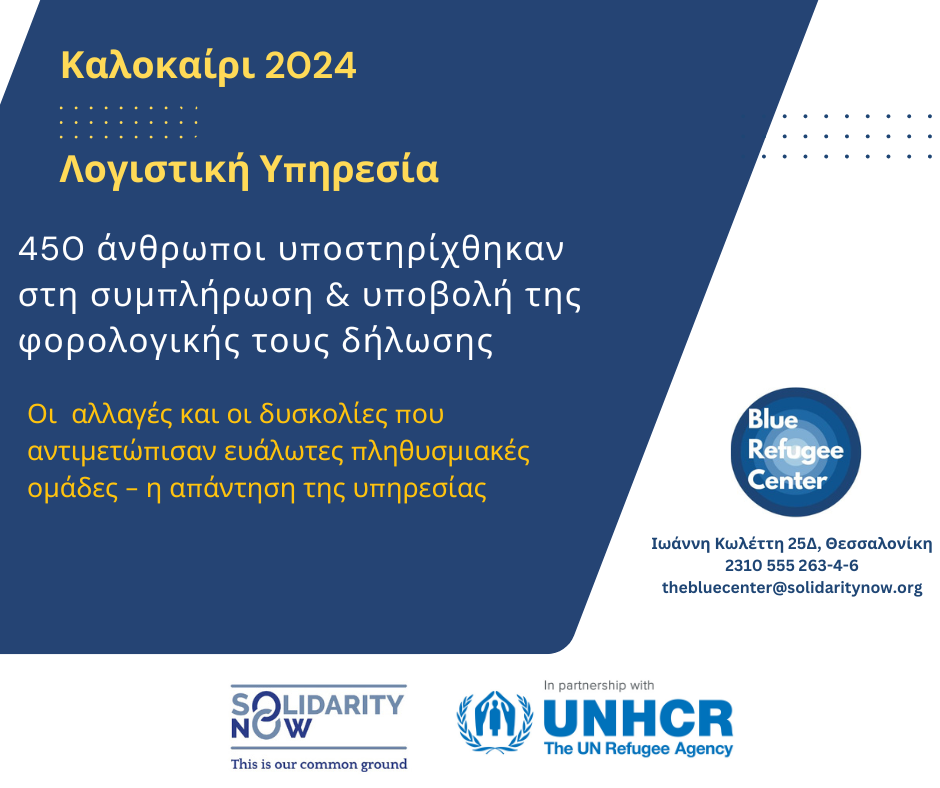
ARTICLE | Blue Refugee Center-summer of 2024: Accounting support to 450 people


More than 450 beneficiaries turned to the accounting service of the SolidarityNow Blue Refugee Center in Thessaloniki during the summer months of 2024, in order to receive support for the submission of their tax returns. The beneficiaries were successfully served and many of them requested also support for other similar issues, such as the management of their pension contribution stamps, debt adjustment etc.

In fact, in one case, the employer was found to have failed to pay the pension stamps, resulting in the referral of the person concerned to the Labour Inspectorate. However, not everything went smoothly! This is because the changes made this year to the submission of tax returns have significantly affected many beneficiaries who were unable to respond in time to what seem to be simple steps.

Initially, the use of a bank account was compulsory for the submission of the declaration, a requirement that was prohibitive for a part of the population that did not have and could not afford a bank account due to unemployment. This arrangement was eventually changed to voluntary, but this was done towards the end of the submission period, thus not allowing sufficient time for the excluded to be notified and to make their declarations.

Further difficulties were also created by the new automatic declaration system launched this year, due to non-updated contact details. As phone lines are discontinued after two (2) months without a package renewal, and phone devices are often lost or misplaced along with the numbers themselves and email access, the appropriate messages may have been sent to those served but were impossible to receive.

Also, the language barrier plays an important role, since even if the notification from the IAPR (Independent Authority for Public Revenue) reaches the beneficiaries’ device, it is often impossible to read it. Consequently, many beneficiaries were not informed about this and ultimately their declaration was submitted with incorrect data. Nevertheless, amended declarations were made where possible, and fines imposed by mistake were avoided, as benefits were taxed as tax-free.

Τέλος, το χρονικό διάστημα που δόθηκε για την υποβολή των δηλώσεων ανήλθε μόλις στις 100 ημέρες, περίοδος αρκετά περιορισμένη για την εξυπηρέτηση του συνόλου των ωφελούμενων, ειδικά για τη Βόρεια Ελλάδα, όπου το Κέντρο Υποστήριξης Προσφύγων στη Θεσσαλονίκη είναι η μοναδική υπηρεσία που παρέχει τη δυνατότητα δωρεάν φορολογικής δήλωσης, με αποτέλεσμα οικονομικά ευάλωτοι άνθρωποι να υποχρεωθούν να πληρώσουν ιδιώτη λογιστή.

Finally, the time given for the submission of the returns was only 100 days, a period limited to serve all beneficiaries, especially in Northern Greece, where the Blue Refugee Center in Thessaloniki is the only Center that offers free accounting services, resulting in financially vulnerable people having to pay a private accountant.

*SolidarityNow implements the project “𝗕𝗥𝗖 𝗟𝗶𝘃𝗲𝗹𝗶𝗵𝗼𝗼𝗱𝘀“, funded by UNHCR GREECE from April 2023. The aim of the project is the social and economic integration of asylum seekers and refugees through support for their integration into the labour market. Services are provided daily at the Blue Refugee Center in Thessaloniki.

PRESS RELEASE | SolidarityNow at the Athens Democracy Forum


Round table discussion on “The Difficult Search for Truth in Migration”

In the framework of the annual Athens Democracy Forum, on October 2nd, SolidarityNow organized a discussion on the challenging search for truth in migration.

The discussion was moderated by journalist Yannis Palaiologos, who facilitated a dynamic and thought-provoking dialogue among the panelists, focusing on how migration can be better understood and communicated in today’s polarized world.

The Founder and Chairman of the Board of Directors of SolidarityNow, Mr. Stelios Zavvos highlighted how migration is frequently exploited as a political tool by far-right parties to polarize societies, fueling fear and spreading misinformation: “Migration in Europe, and particularly in Greece, can address several issues such as labor shortages. From a demographic standpoint the management of migration can help sustain demographic balance. Migrants contribute to the economy and the social security system, and the data indicates that they can bring significant economic benefits to the country. Migration is not a crisis, it is an opportunity. At SolidarityNow, we focus on integrating migrants and refugees as productive members of society.”

Afterwards, Mr. Dimitris Kairidis, Member of the Hellenic Parliament and Professor of International Politics, criticized the harmful portrayal of migration as an “invasion” highlighting how such narratives fuel far-right ideologies. “We need realistic solutions and not promises and extreme rhetoric that only raises expectations and, thus, the despair of the citizen when these expectations are not met. This is especially important for a country like Greece, where, in contrast to what is happening in Sweden or Austria, the migrant population has gone down, not up. The problem in Greece is not that we have a rise of migrants; the problem is, to some extent, the exact opposite.”

Ms. Angeliki Dimitriadi, Head of the Migration Programme of ELIAMEP, criticized the narrative that smugglers decide who enters Europe, emphasizing that it is the lack of legal pathways that forces migrants and refugees to turn to smuggling. “People resort to smugglers because we don’t offer legal paths for those in need of protection. And we don’t have a lot of legal entry paths for low and medium skilled laborers who could otherwise be very useful for our economies. …this pushes people to smugglers and of course it produces further exploitation. We are overly focused on the regular component and far less focused on the legal component on which we should be really prioritize in the years to come, especially as we’re moving into a world that will face competition for labor.”

In addition, Ms. Stella Nanou, Head of Communications for UNHCR Greece highlighted the importance of using accurate and respectful terminology when discussing migration. She pointed out that the use of terms like “illegal arrivals” or metaphors such as “waves” and “tsunamis”, to describe human migration, dehumanizes people and fuels fear. “Words matter, they shape realities and mindsets. Especially in the migration debate, language isn’t just a tool, it’s a huge responsibility that affects human life. There are other ways to speak about migration in a very humane manner without giving to the public the notion that it’s something to be afraid of, a tactic that does not lead to solutions. This kind of language does not leave any space for workable solutions and that’s the real problem.” 

Mr. Alexander Rhodes, Partner and Head of Mishcon Purpose, Mishcon de Reya, addressed the issue of climate migration, stating “When one talks about people being forced to move because they have no choice through the lens of human rights, we are talking about the human rights of the communities from which they are moving, through which they are moving, and of course to which they are moving. And the challenge for our politicians in host countries is to respond to the human rights of our constituents and the needs of our constituents. And their job is to explain that countries to which migrants move benefit in net, as opposed to the communities from which these people are forced to move, who certainly don’t.”

The discussion was honored by the presence of the internationally renowned filmmaker and director, Michael P. Nash who reflected on his experiences making the documentary Climate Refugees in 2010: “There were so many questions that I asked back in 2008 and 2009, when we were traveling around documenting, but found no answers. And so, I think it’s incredibly important to participate in healthy discussions, in forums like this, about migration, because there’s so much data that needs to be analyzed to give a voice to all voiceless victims that are being forced to relocate for survival.”

INTERNATIONAL DAY OF DEMOCRACY: CIVIL SOCIETY ORGANISATIONS CALL THE EU TO FOSTER A VIBRANT CIVIC SPACE


This International Day of Democracy, September 15th, civil society calls on EU leaders to take decisive actions to foster a vibrant civic space, uphold democracy and safeguard fundamental rights. SolidarityNow co-signed the open letter alongside 416 organizations which outlines concrete actions to promote democracy, enable, support and protect civil society, strengthen civil dialogue and protect human rights amid growing concerns over the erosion of democracy in the EU.

Specifically, it calls for prioritising: 

  1. A European Civil Society Strategy
  2. A strong mandate for a Commission Vice President responsible for democracy, civic space and civil dialogue
  3. The adoption of a Civil Dialogue Agreement
  4. Empowering funding policies
  5. A European Democracy Semester
  6. A stronger role of the Fundamental Rights Agency

The open letter #EUCivicSpaceNow is addressed to the upcoming Polish, Danish, and Cypriot Presidencies of the Council of the European Union, as well as the Presidents of the European Commission and the European Parliament.

An Inverse Relation: Age and Job Pursuit

Copyright Odyssea

Looking for a job is a challenge for everyone and for some population groups it can involve additional difficulties. Oleg, a 62-year-old civil engineer from Ukraine, is one of the beneficiaries of the Athens Solidarity Center. Despite speaking Greek and having extensive experience in his field, as well as in other areas, he has yet to find a job in Greece. “I feel like they don’t see me as a person with skills and experience, but as someone ‘old’ that time has overtaken him“, confesses in frustration.

Oleg’s story is not the only one of course.

Recently, the Employability Service team has supported many men and women over 60 who are struggling to re-enter the labor market despite their knowledge and skills.

Challenges for those Over 60 in the Job Market

Age often acts as an invisible barrier, leading many people to feel like their professional life has reached a dead end. Employers frequently view age as a disadvantage, assuming that older workers may not be flexible enough or may have difficulties adapting to new technologies. In some cases, there is a bias that older workers won’t remain productive for many more years.

However, this mindset is not only unfair but also detrimental to society and the economy. Older workers possess experience, skills, and expertise that are often lacking in younger employees. Their inclusion in the workforce could be a significant asset for businesses.

How Employability Counsellors Support Inclusion

The Employability Team at the Athens Solidarity Center works daily to support people like Oleg in overcoming obstacles and re-entering the labor market. The employment advisors provide personalized support, including:

  • Training in Modern Technologies: Offering information on seminars and training programs related to acquiring digital skills, essential for meeting the modern demands of employers.
  • CV Adaptation and Improvement: Assisting with tailoring resumes, highlighting the skills and experiences most relevant for each job.
  • Empowerment and Interview Preparation: Preparing beneficiaries for job interviews, showcasing their strengths, and boosting their confidence.
  • Networking Opportunities: Helping to build professional networks and relationships that may lead to new employment opportunities.

Opportunities and Solutions

It is essential to support the inclusion of all age groups in the labor market. Education and training can play a crucial role. For example, specialized training programs for upskilling or promoting job mobility could provide those over 60 with the opportunities they need to re-enter the workforce.

Through the Employability Service, we continue to support everyone seeking employment, regardless of age. Because social cohesion and fair access to the labor market are the grounds of a healthy society.

ΔΕΛΤΙΟ ΤΥΠΟΥ | Το έργο «Τζαφ Ανγκλάλ» τιμά την Παγκόσμια Ημέρα Μνήμης του Ολοκαυτώματος των Ρομά στην Ευρώπη


Το νέο έργο της οργάνωσης σε συνεργασία με την ΑμΚΕ REVMA, πήρε το όνομά του από τη Ρομανί γλώσσα και σημαίνει “Πάμε Μπροστά!”. Μέσα από τις δράσεις του έργου επιδιώκεται η προώθηση του θεμελιώδους δικαιώματος για ίση πρόσβαση στην εκπαίδευση των παιδιών Ρομά. Ο δρόμος προς τα εμπρός όμως επιτυγχάνεται μόνο τιμώντας το παρελθόν.

Για αυτό, το SolidarityNow, η ΑμΚΕ REVMA και οι συμμετέχοντες και συμμετέχουσες στο «Τζαφ Ανγκλάλ» προσκαλούν τους κατοίκους της Θεσσαλονίκης, την Παρασκευή 2 Αυγούστου στις 19.00 στην πλατεία Αριστοτέλους, για να ενημερωθούν, να θυμηθούν και να τιμήσουν μαζί την 80η επέτειο από την Ημέρα του Ολοκαυτώματος των Ρομά.

Εκεί θα παρουσιαστεί η ιστορική διαδρομή ενός ξεχασμένου Ολοκαυτώματος, που στοίχισε τη ζωή περισσότερων από 500.000 Ρομά στην Ευρώπη, δημιουργώντας παράλληλα την ευκαιρία διαλόγου γύρω από ζητήματα που  αφορούν τις πολύμορφες τσιγγάνικες κοινότητες.

Σήμερα, 80 χρόνια μετά από την 2α Αυγούστου 1944, πόσα έχουν αλλάξει στην Ευρώπη σε σχέση με τους Ρομά;

Οι Τσιγγάνοι συνεχίζουν σε πολλές περιπτώσεις να ζουν κάτω από το όριο της φτώχειας σε πρόχειρα καταλύματα χωρίς ρεύμα και τρεχούμενο νερό, ενώ στερούνται την πρόσβαση στην πρωτοβάθμια πρόληψη υγείας, την εργασία, την εκπαίδευση. 80 χρόνια μετά, ελάχιστα έχουν αλλάξει σε θέματα στερεοτύπων και προκαταλήψεων για τους Ρομά. Αυτός είναι και ο λόγος που η έμφαση στην εκπαίδευση είναι επιτακτική μια και μπορεί να αποτελέσει τη λύση για τα πολλά και χρόνια ζητήματα που ταλανίζουν αυτή την κοινωνική ομάδα.

«Τζαφ Ανγκλάλ: Για την ενδυνάμωση της σχολικής φοίτησης των παιδιών Ρομά»

Η πρωτοβουλία αυτή έρχεται να απαντήσει στα παραπάνω μέσα από ανοιχτές δράσεις, ενώ θα εστιάσει στην ενίσχυση του ρόλου των γονέων και των εκπαιδευτικών με στόχο την υποστήριξη των παιδιών, ώστε να εξασφαλιστεί η παραμονή τους στο σχολείο και η ολοκλήρωση της βασικής (υποχρεωτικής) εκπαίδευσης. Ταυτόχρονα, με τις κατάλληλες ενέργειες ενημέρωσης και ευαισθητοποίησης για το ευρύ κοινό, θα παρουσιαστούν ιστορίες των Ρομά μέσα από τις οποίες θα καταρριφθούν στερεότυπα και προκαταλήψεις που κάνουν πολλές φορές αδύνατη την ένταξη των Ρομά στον κοινωνικό ιστό.

Οι δράσεις του έργου θα υλοποιηθούν σε τρεις κοινότητες Ρομά της Κεντρικής Μακεδονίας: Δενδροπόταμος-Δήμος Αμπελοκήπων Μενεμένης, Δήμος Παύλου Μελά και Πέλεκας στον Δήμο Κατερίνης, όπου έχει παρατηρηθεί ότι το δικαίωμα στην εκπαίδευση είναι εξαιρετικά περιορισμένο, λόγω μιας σειράς προκλήσεων που αντιμετωπίζουν σήμερα οι εκπαιδευτικοί καθώς και οι Ρομά γονείς και τα παιδιά.

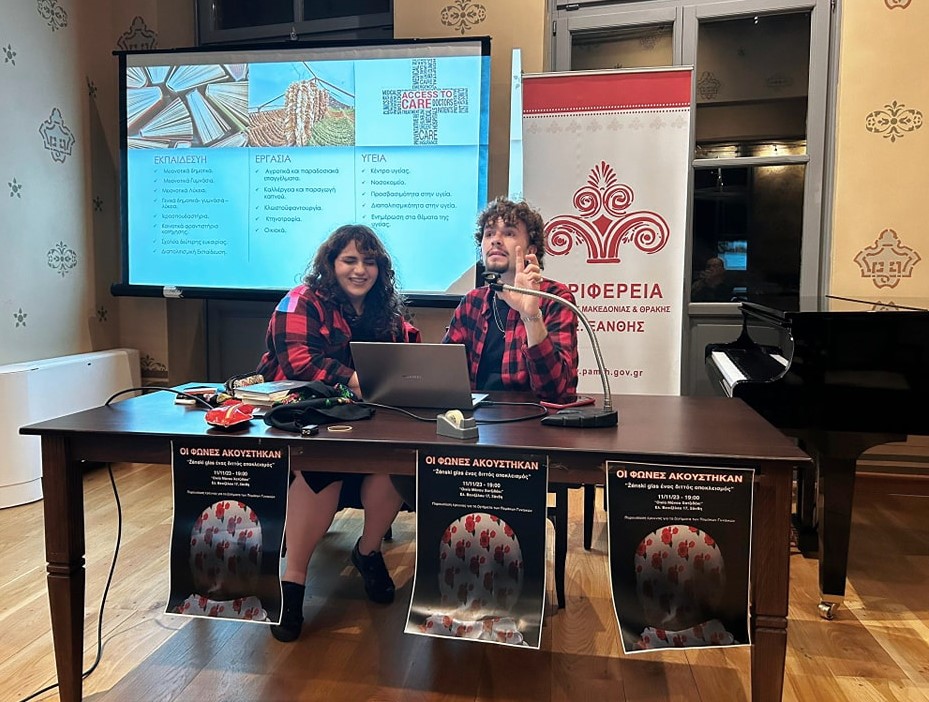
Ενημερωτικό φυλλάδιο Εκδήλωσης

*Το πρόγραμμα «Building a robust and democratic civic space» (BUILD) έχει ως στόχο την προστασία, την προώθηση και την ευρεία αναγνώριση των θεμελιωδών δικαιωμάτων και αξιών της Ε.Ε., μέσω της στήριξης οργανώσεων της Κοινωνίας των Πολιτών (OKοιΠ) στην Ελλάδα και την Κύπρο και της ενίσχυσης των ικανοτήτων και της βιωσιμότητάς τους. Το BUILD συγχρηματοδοτείται από την Ευρωπαϊκή ‘Ενωση, μέσω του προγράμματος Citizens, Equality, Rights and Values (CERV), το Ίδρυμα Μποδοσάκη και το Κέντρο Στήριξης ΜΚΟ Κύπρου με συνολικό ποσό επιχορήγησης €2,9 εκ. Συντονιστής του BUILD είναι το Ίδρυμα Μποδοσάκη (Ελλάδα) σε σύμπραξη με το Κέντρο Στήριξης ΜΚΟ (Κύπρος).

Με τη χρηματοδότηση της Ευρωπαϊκής Ένωσης. Οι απόψεις και οι γνώμες που διατυπώνονται εκφράζουν αποκλειστικά τις απόψεις των συντακτών και δεν αντιπροσωπεύουν κατ’ ανάγκη τις απόψεις της Ευρωπαϊκής Ένωσης, του Ευρωπαϊκού Εκτελεστικού Οργανισμού Εκπαίδευσης και Πολιτισμού (EACEA) ή του Ιδρύματος Μποδοσάκη. Η Ευρωπαϊκή Ένωση και ο EACEA δεν μπορούν να θεωρηθούν υπεύθυνοι για τις εκφραζόμενες απόψεις.

PRESS RELEASE | Original educational materials for Robotics, Inclusion, Language, School Dropout


Handbooks for empowering teachers & enriching the educational process

SolidarityNow announces the release of four comprehensive educational tools designed to support teachers and promote a more inclusive and effective learning environment. The manuals address critical issues in modern education-robotics, inclusion, dropout prevention, language-providing innovative tools for educators. The four manuals include the following:

1.The Challenges of Robot X

A Handbook of Educational Robotics & creative storytelling that allows all children to participate equally. Teachers will find practical tips and examples of successful robotics projects that they can adapt to their own classrooms.

2. Me, You, Us: Acceptance and Inclusion

The Handbook stresses the importance of creating an inclusive classroom environment and provides teachers with activities based on the principles of experiential learning that promote, among other things, collaboration and teamwork, the expression of children’s feelings, and the activation of critical thinking.

3. A guide to preventing truancy

This practical guide is aimed at teachers and addresses the issue of students’ absenteeism or dropping out of the school environment. The aim is to provide the knowledge and tools necessary to understand the phenomenon of truancy and to develop the skills necessary for early prevention and effective management.

4. Guide to Task-Based Language Teaching (TBLT)

The Task-Based Language Teaching methodology offers students the opportunity to use language in a meaning-focused, spontaneous and unconstrained way, improving their language fluency and boosting their confidence at the same time. The Guide offers practical examples and activities that teachers can implement to make language learning more engaging and relevant for their students.

Read and download the material from the links below:

Robot X Challenges (GR): https://shorturl.at/zZJiI 

Me, You, Us: Acceptance and Inclusion (GR): https://shorturl.at/QUFNh

School Dropout Prevention Guide (GR): https://tinyurl.com/282j7kgs

A Guide to Task-Based Language Teaching (TBLT) (GR): https://tinyurl.com/29e7vb8k

The original educational material was developed using practices implemented in the framework of the “All Children in Education” programme. The “All Children in Education” programme was an initiative of UNICEF Greece in collaboration with the Ministry of Immigration & Asylum and co-funded by the European Union and implemented by a number of partners, including SolidarityNow. The project ended 30.6.2024.