


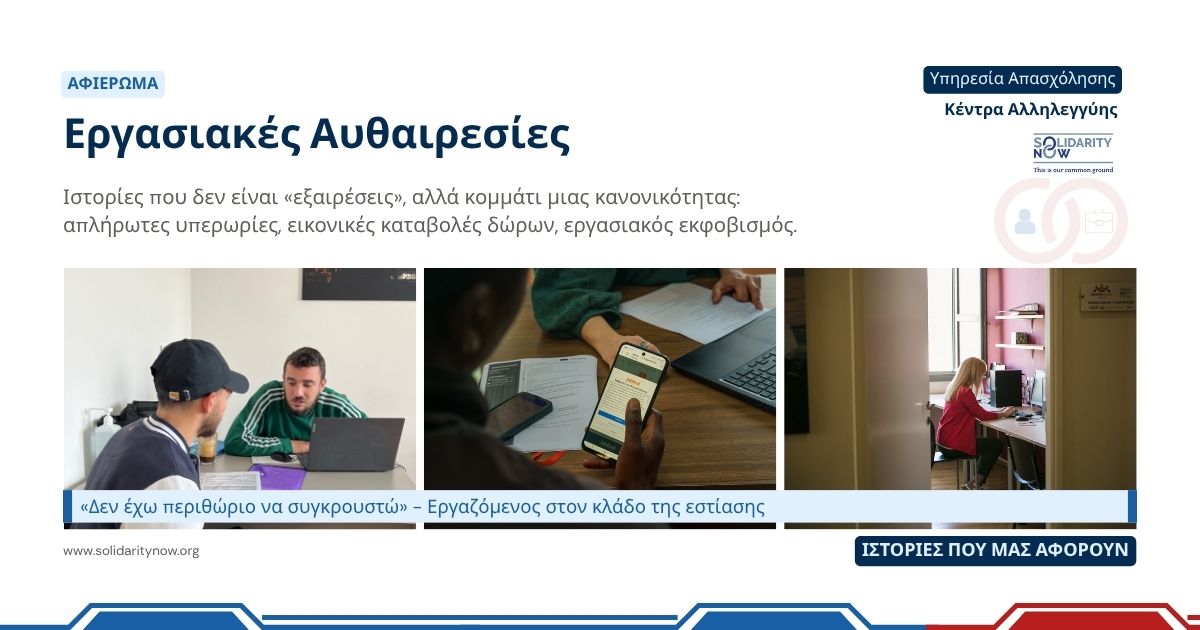
In today’s labor market, having a job is rarely “just a job.” For most people, employment is closely tied to survival, dignity and the pursuit of stability in an increasingly precarious environment. Workplace pressure and inequality are not isolated incidents, nor are they limited to specific ethnic or social groups. We need only recall the tragic case of the five Greek women who lost their lives while working the night shift at a factory in Trikala.
For third-country nationals, however, these pressures are often even greater. Employment is not only a source of income; it is also a pathway to social inclusion, visibility and belonging, all within a context of limited support networks and heightened vulnerability.
Through this series, the Employment Service of SolidarityNow sheds light on real cases of workplace abuse documented through the daily work of its employment counsellors, at the organization’s Solidarity Centers in Athens and Thessaloniki.
These are not isolated stories. They reflect a broader reality: unpaid overtime, deceptive payment practices, workplace intimidation and other forms of labor exploitation.
This feature series is not intended to evoke sympathy. Rather, it aims to illustrate how workplace precarity is created, how it shapes people’s choices and opportunities and why silence should not automatically be interpreted as acceptance. Often, it is the result of pressure, insecurity and fear. At the same time, these stories demonstrate that access to information and professional support can empower people to understand and claim their rights.
The article below is the first in a series that will be published over the coming months.
“The bonus is a right, not a gift”
L.S., a young man from Mali, first visited the Employment Service at the Athens Solidarity Center few months ago, seeking support in finding a job. A SolidarityNow employment counsellor assisted him in preparing his CV and applying for open positions. Shortly afterwards, he secured employment at a food service establishment. Throughout the recruitment process, he was informed about the hiring procedures, fulfilled every requirement diligently and actively sought information about his rights and responsibilities as an employee.
At some point, L.S. returned to the Employment Service because he suspected that he was not being paid correctly. During the counselling session, it became clear that he had fallen victim to a workplace practice that many employees in Greece, regardless of nationality or residence status, have experienced: the deceptive payment of the Christmas Bonus.
His employer presented a payment as compensation for overtime work. In reality, however, the overtime wages, including those for work performed during the holiday period, were never paid. Together with his employment counsellor, L.S. reviewed his pay slips and other relevant information, confirming the irregularity. They then contacted the employer, who effectively acknowledged that the payment had been handled improperly.
The counsellor informed L.S. about his legal rights and the options available to him, including free legal assistance and the possibility of filing a complaint with the Labour Inspectorate. Ultimately, however, L.S. decided not to pursue a formal claim.
Not because he did not know his rights. Not because he was not entitled to them. But because, for a refugee in employment, standing up for one’s rights is often perceived as a significant risk: the risk of losing a job, of being labelled as “difficult,” or of closing the door to future employment opportunities.
This fear is not a personal weakness. It is rooted in broader structural conditions.
It stems from precarious employment, inequality, the need for stability, limited support networks and the feeling that “I cannot afford to challenge my employer.” When workers remain silent, it is because they are unaware of their rights or have given up. More often, silence becomes a survival strategy within an unequal system.
The value of this intervention did not lie solely in whether L.S. chose to pursue legal action. Its real impact was that he gained the knowledge and support needed to make an informed decision about whether to exercise his rights.
Empowerment is not a single moment; it is a process.
The knowledge and support that L.S. received through the Employment Service have now become part of his journey, equipping him with the confidence and information he will need in future decisions and potential claims.
The operation of the Solidarity Centers in Athens and Thessaloniki is supported by the Swiss–Greek Cooperation Programme (Embassy of Switzerland in Greece) to reduce economic and social disparities in the EU and by the Ministry of Migration and Asylum.