


“There’s an employer on the phone looking for staff,” says the receptionist at the Thessaloniki Solidarity Center.
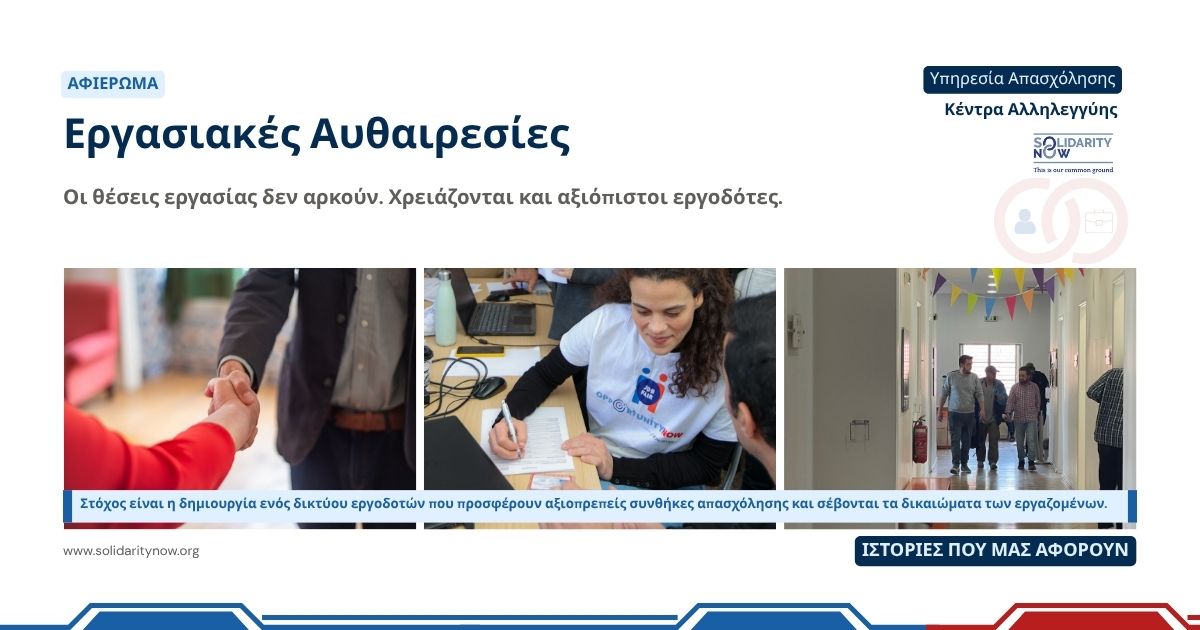
For the Employment Team, calls like this often mark the beginning of a new partnership. But not just any partnership. The goal is not simply to fill job vacancies, but to build a network of employers who provide decent working conditions and respect workers’ rights.
This is why every new employer is carefully assessed before joining SolidarityNow’s network of partner businesses. The availability of job openings is only the starting point. Equally important are compliance with labor legislation, the way a business operates, and above all the actual experiences of the people who work there.
At first, this employer appeared to be an excellent potential partner. The company was looking to recruit several employees, including women, offered both permanent and seasonal employment, was in an area easily accessible by public transport, and, according to the employer, already had experience working with refugees and migrants.
Even more encouraging was the employer’s response when the counsellors explained that a fundamental condition for cooperation was fully legal employment, including formal contracts and compliance with labor legislation. The employer not only agreed but also explained that they had chosen to approach SolidarityNow precisely because they were looking for a trustworthy organization that prioritizes legality, transparency, and respect for workers’ rights.
The first impression was highly positive.
For the Employment Team’s counsellors, every new job opportunity represents much more than a vacancy in a company. Behind every candidate there is a personal story, a family, financial challenges, dreams and aspirations. The counsellors know the people they support closely and work every day to create bridges between them and the labor market. Every trustworthy employer creates hope; perhaps this could be the opportunity that allows someone to rebuild their life and regain stability.
The positive impression was also confirmed during the in-person meeting. The employer appeared polite, cooperative and particularly aware of the challenges faced by people experiencing vulnerability.
However, the assessment process does not end with an initial meeting, nor is it based solely on an employer’s statements. As part of the Employment Team’s methodology, additional evaluation steps always follow, as the true picture of a workplace also emerges through the experiences of its employees. For this reason, a group interview was organized, allowing the employer and prospective employees to meet and discuss working conditions in detail.
That was when the first red flags appeared.
Many of the women invited to the interview had recently worked for the same company. They all described a reality that was entirely different from the one presented by the employer. They spoke about forced overtime, incidents of workplace intimidation, and unpaid social security contributions.
These accounts could not be ignored.
The Employment Team immediately informed all candidates about the findings that had emerged. Those who had experienced violations of labor legislation were also offered further information and support regarding the possibility of filing a complaint with the Labour Inspectorate.
The candidates were, of course, free to decide whether they wished to continue with the recruitment process. Ultimately, none of them accepted the job offer. The Employment Team also immediately ended any further cooperation with the company.
This outcome was undoubtedly disappointing. Two of the prospective employees, Fatima and Mareme, would continue to worry about whether they would be able to pay their next electricity bill. Their children would continue to grow up in conditions of financial insecurity. This was not the outcome anyone had hoped for.
However, this experience reaffirmed something equally important: protecting the people we support does not end with helping them find employment. It also requires ensuring, as far as possible, that the work they access takes place in an environment that respects workers’ rights and human dignity.
This is why employer assessment is an integral part of the Employment Team’s work. It is not enough for an employer to offer many job opportunities. They must demonstrate in practice that they are a trustworthy partner who respects the people they employ.
Success, therefore, is not measured only by the number of people hired. It is also measured by the number of times someone avoided entering an exploitative workplace because they had the information and support needed to recognize the risks and make a different choice.
Because the goal is not simply access to employment. It is access to decent work, as defined by the International Labour Organization (ILO) and recognized by the Charter of Fundamental Rights of the European Union and the Universal Declaration of Human Rights.
Decent work is not a privilege. It is a right for everyone.
The operation of the Solidarity Centers in Athens and Thessaloniki is supported by the Swiss–Greek Cooperation Programme (Embassy of Switzerland in Greece) to reduce economic and social disparities in the EU and by the Ministry of Migration and Asylum.