


Category: ΣΥΝΗΓΟΡΙΑ
Joint Statement on Article 5 of the EU Screening Regulation

The New Pact for Migration and Asylum is currently under the final negotiation stages in the EU institutions.
SolidarityNow along with 82 civil society organizations co-sign the statement asking for the deletion of article 5 from the EU Screening Regulation.
The adoption of this article carries the risk of increasing the racial profiling over the EU’s territory, the arbitrary detention of undocumented people and potential unlawful deportations in violation of the principle of non-refoulement.
JOINT STATEMENT – APPEAL | Even war has rules

Almost half of the dead are children: over 2,000 have already been killed and thousands more children will live with disabilities and mental health issues due to war-inflicted trauma. The blatant disregard for civilians’ right to life and protection cannot be accepted.
Child Rights Advocacy Network (CRAN) and the co-signatory Civil Society Organisations express their dismay at the killing, maiming and abduction of children, as well as attacks on schools and on essential civilian infrastructure such as hospitals, water and electricity and the denial – until recently – of humanitarian support to children and civilians in the war that is still raging in Gaza and Israel.
Thirty-four years since the adoption of the Convention on the Rights of the Child and seventy-four years since the Fourth Geneva Convention for the Protection of Civilian Persons in Time of War, recent images from Israel and Gaza demonstrate in the most brutal way that children remain the truly innocent victims on every side and in any case.
The bombing of the Al-Ahli hospital in Gaza on 17/10/2023, where hundreds of people, mainly children, were being treated or had taken refuge, the military-armed attacks on schools and places of worship, capturing of children, their forced participation in armed groups and forced displacement together with other illegal practices of regular and irregular military groups are undoubtedly violating children’s rights and the international law of war. Such a flagrant violation of the established rights of children stands against everything the international community and the representatives of states have agreed in international treaties, depriving children of their future.
We hereby appeal to the international community for immediate intervention to bring about an immediate ceasefire and to ensure peace in the region.
We also call on all parties involved in the conflict to act to fulfill their obligations to protect children and other civilians, regardless of their race, gender, nationality, religion, or political opinion (Article 3 of the 4th Geneva Convention), and in particular to ensure that:
- The wounded and sick are cared for
- The civilian population, in particular children and pregnant and nursing women, are protected, provided with medical care, adequate food, water and shelter
In addition, it is noted that:
- Blocking access to water, food, electricity, fuel, medicine, and other items necessary for the survival of civilians is prohibited by international humanitarian law
- Attacking essential civilian infrastructure constitutes a war crime
- The immediate dispatch of humanitarian aid based on the recommendations and needs identified by the UN bodies is urgent
- The maintenance and expansion of humanitarian channels for the protection of children and civilians, with the active involvement and assistance of the EU, is imperative.
Civil Society Organisations – CRAN members and other cosignatories CSOs:
- ARSIS Association for the Social Support of Youth
- Better Days Greece
- Changemakers Lab
- ELIX – Conservation Volunteers Greece
- Greek Council for Refugees
- Network for Children’s Rights
- Schedia (Raft) -Center for Artistic and Pedagogical Training
- SolidarityNow
- Safe Passage International AMKE
- Samos Volunteers
- Defence for Children International Greece (DCI Greece)
- World Without Wars and Violence
- HumanRights360
- Yoga and Sport with Refugees
- Greek Forum of Migrants
- Equal Rights Beyond Borders
- Action for Women
- Symbiosis-Council of Europe School of Political Studies in Greece
- Hellenic League for Human Rights
- Dråpen I havet / Σταγόνα
- Irida Women’s Center
- Diotima – Center for Gender Rights and Equality
- Jesuit Refugee Service Greece (JRS)
- Association of Greek Conscientious Objectors
Seven Priorities to Expand Resettlement and Safe Pathways to Europe

Ahead of EU Member States submitting their pledges for the EU resettlement scheme, we call on leaders to ambitiously expand safe pathways to international protection and better reflect Europe’s capacity to welcome.
Resettlement and other complementary pathways to protection offer a lifeline to people forced to flee – a way to reach safety without endangering their lives. For countries of first refuge, they represent a form of solidarity and support. While for receiving countries, they provide a structured and durable approach to welcoming people in need.
You can read more here.
Joint Statement: NGOs call on MSs and EP: Reject the Use of Legal Loopholes in EU Asylum Law Reforms

NGOs call on Member States and European Parliament:
Go no Lower: Reject the Use of Legal Loopholes in EU Asylum Law Reforms
SolidarityNow is among the organizations-members of the European Council on Refugees and Exiles (ECRE) that co-sign the call on the Member States and European Parliament, since the EU’s co-legislators, are moving forward with a reform of EU asylum law in the form of the Pact on Migration and Asylum which reduces protection standards and undermines human rights of asylum seekers in Europe. But not only.
You can read more here.
(Ελληνικά) ΚΟΙΝΟ ΔΕΛΤΙΟ ΤΥΠΟΥ | Ολοκλήρωση εκδήλωσης του Δικτύου Συνηγορίας για τα Δικαιώματα του Παιδιού «Παιδιά χωρίς χαρτιά – παιδιά σε αδιέξοδο;»

(Ελληνικά) ΔΕΛΤΙΟ ΤΥΠΟΥ: Παιδιά χωρίς χαρτιά – παιδιά σε αδιέξοδο;

JOINT STATEMENT: Children in Greece without documents, children still at risk

We, the undersigned, 16 organisations, members of the Child’s Rights Advocacy Network, working to support asylum-seeking and refugee children in Greece, wish to express our concerns about the proposed provisions for unaccompanied and separated children in a newly proposed Immigration Code and call on Greek authorities to reconsider Article 162 of this Code and amend it so that and updated version covers the serious legal gap currently facing unaccompanied children and ensures the rights of all unaccompanied children in practice, including once they have reached adulthood, or will soon reach adulthood, which is currently not the case.
Last week, we were both alarmed and disappointed to see that the newly proposed Immigration Code was suddenly published for an unrealistically short period of public consultation on 7 to 14 March 2023, without sufficient time provided for meaningful review and recommendations to ensure it aligns with what is best for unaccompanied children or that it addresses the significant gaps in legal status these children continue to face in Greece.
We are compelled to express our collective concern regarding not only the insufficient consultation provided, but also the content of the proposed new code, which does not offer solutions for the vast majority of unaccompanied children who remain outside the asylum system. Instead, the proposal seems set to create even more challenges for these children, increasing their barriers to gaining legal status in the country.
This comes despite the explicit commitment we received from the Deputy Minister of Migration and Asylum, Ms. Sofia Voultepsi, during the event “Children without documents, children at risk. Until when?” organized on July 12, 2022 by members of the Child Rights Advocacy Network. Both at that time and since, the Deputy Minister stated that there was a “clear political will” to address the gap in the legal status faced by unaccompanied migrant children in the country, before and after they reach adulthood.
And, yet the criteria stipulated in the new regulation of how adult citizens from third countries or stateless persons who entered Greece as unaccompanied minors can obtain a ten-year residence permit fail to reflect the reality on the ground.
With this legislative initiative, an important opportunity is lost; that of protecting and acknowledging unaccompanied and separated children who ultimately remain outside the asylum system. Absolutely no provision is included in the proposed bill for unaccompanied children whose request for international protection is rejected while they are minors. This is contrary to the best interests of the child, which should guide the decisions of all public authorities, but also contrary to public statements by these same relevant authorities. As a result, unaccompanied children are once again left without legal documents and exposed to all forms of exploitation, without substantial access to protection, health benefits or education.
As for unaccompanied children who become adults while in Greece, in order to receive the ten-year residence permit, the new Code requires them to have a permanent authorisation of stay in the country, i.e. a permanent residence permit. But, if these unaccompanied children who have just come of age had already secured such an authorisation, they would not even need the legislative intervention introduced by this article in the first place. This, in fact, despite the Prime Minister’s own statement on January 17, 2023 that “unaccompanied children turning 18 that have completed three (3) years of education should rightfully be given the possibility to remain in the country and to join the Greek state if they so wished.”
However, in addition to requiring that they already have a permanent residency permit, and already successfully completed at least three (3) grades of the Greek formal education, the potential beneficiaries of the ten-year residence permit must also have been accepted at either a Vocational Apprenticeship School of the Public Employment Service, a Vocational Training School, or a higher educational establishment.
This last requirement that they must have obtained admission to one of the above schools is particularly onerous since only a very limited number of unaccompanied minors who have reached adulthood can meet this condition. After all, experience in the field has shown us that, for unaccompanied children, even a 3-year “successful” attendance at the Greek school is a significant challenge. This is due to systemic and chronic issues impeding the effective inclusion of children with a migrant/refugee background in the Greek school system, causing a student population of “two speeds”.
Finally, we wonder why the second-generation children will now be left without a residency permit (see paragraph b of the above article). Previously, they were able to obtain one with the provisions of Law 4251/2014 regardless of their parents’ status, as long as they had established strong ties with the country (birth in Greece, school attendance, etc.).
The signatory organizations of the Children’s Rights Advocacy Network believe that a special residence permit should be granted to unaccompanied children solely based on the fact that they are children and that they are transitioning to adulthood, aiming to safeguard the best interest of each unaccompanied child in the country.
THE CO-SIGNING ORGANISATIONS
- ARSIS Association for the Social Support of Youth
- Better Days Greece
- ΕLIX
- Generation 2.0 for Rights, Equality & Diversity
- Greek Council for Refugees
- The HOME Project
- HumanRights360
- International Rescue Committee (IRC) Hellas
- INTERSOS Hellas
- Lighthouse Relief
- Mobile Info Team
- Network for Children’s Rights
- Safe Passage
- Schedia (Raft) -Center for Artistic and Pedagogical Training
- SolidarityNow
- Terre des hommes Hellas
(Ελληνικά) ΚΟΙΝΟ ΔΕΛΤΙΟ ΤΥΠΟΥ | Παιδιά χωρίς χαρτιά, παιδιά σε κίνδυνο, μέχρι πότε;

JOINT LETTER: 37 NGOs highlight their concerns relating to the situation of LGBTQI+ asylum seekers in Greece
Letter to: Mr Manos Logothetis, General Secretary of Reception of Asylum Seekers and Mr Patroklos Georgiadis, General Secretary of General Secretariat for Migration Policy.
Dear Manos Logothetis and Patroklos Georgiadis,
In light of information collected through input from numerous organizations and focus groups from the community, we are sending you this letter highlighting particular concerns relating to the situation of LGBTQI+ asylum seekers in Greece. We appreciate your reception to our feedback and hope we can continue to work with you on this matter further.
Shelter and Security
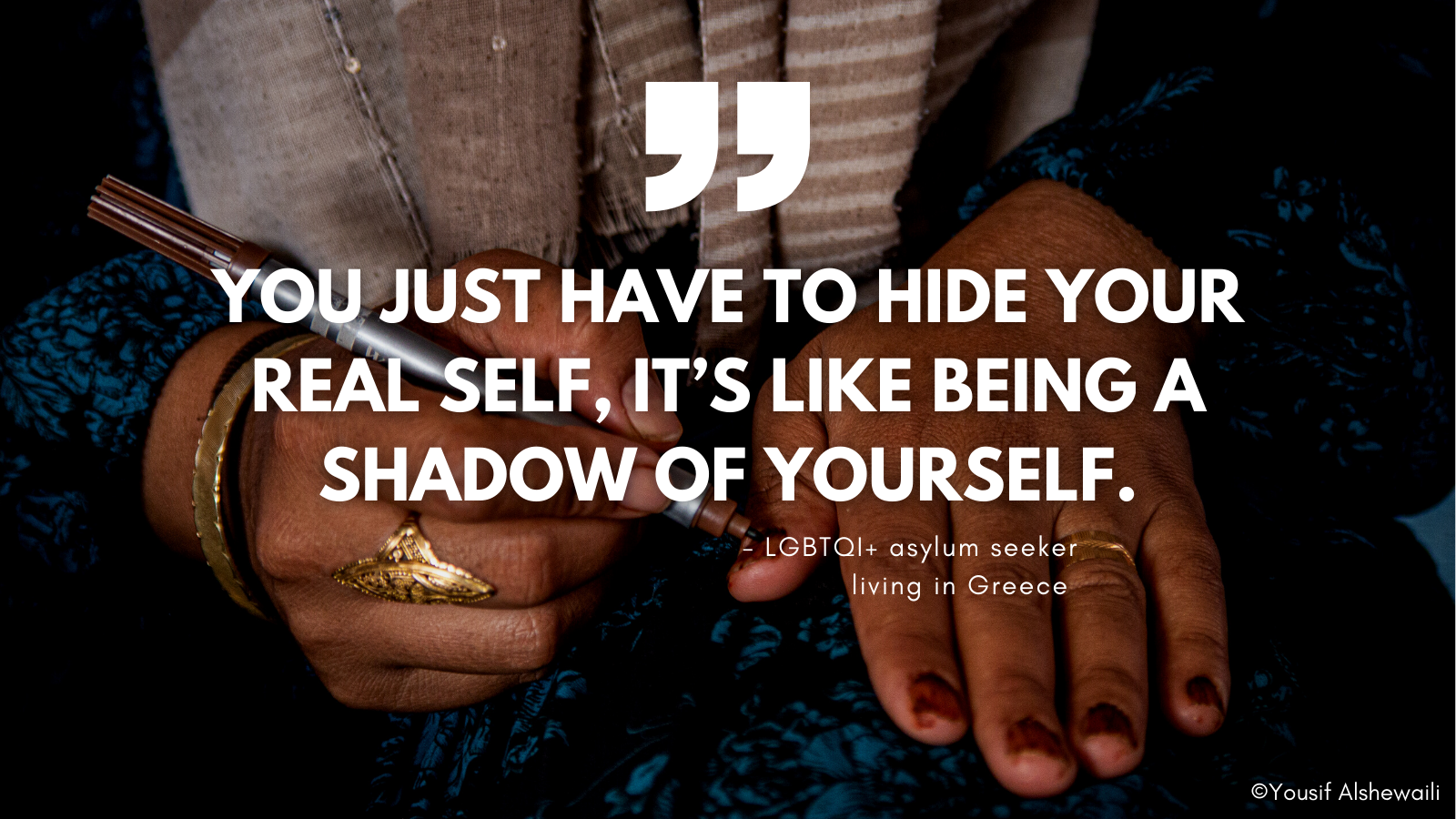
It is agreed that a specific dedicated area for LGBTQI+ people within the camps would not be appropriate as there is a risk of further isolation and stigmatization. Nonetheless, at present Greece is failing to provide appropriate reception conditions for LGBTQI+ applicants. Currently, LGBTQI+ asylum seekers are housed with non-LGBTQI+ people (hereafter ‘mixed housing’). It was widely agreed in the focus groups that mixed housing, particularly in camps, does not allow for the applicant to feel safe or comfortable to be open with their identity. Resultantly, people who have fled their countries are still having to hide and conceal their identity at all times. The following quotes are from LGBTQI+ individuals living in mixed housing:
“You just have to hide your real self, it’s like being a shadow of yourself.”
“Hiding in my country and hiding here, it’s no difference.”
The accommodation offers no respite from the discrimination, threat or stigma, which has potentially severe mental health implications.[1]
“[B]eing compelled to conceal one’s sexual orientation and/or gender identity may also result in significant psychological and other harms.” (European Court of Human Rights)
Expecting people to conceal their sexual orientation or gender identity to avoid harm is contrary to the applicants’ human rights, as recognized by the European Court of Human Rights, EU Court of Justice and the Greek Special Appeals Committee.[2]
It is therefore recommended that:
- Where the primary housing is a camp, there should be efforts to ensure that the relocation to a confidential and discreet LGBTQI+ specific housing in the local city or town is an available and accessible option.
- In cases where it is not possible to relocate LGBTQI+ individuals to specific housing, improvements within the camp setting are needed. For example, ensuring increased privacy or creating safe spaces in camp would be extremely helpful. In addition, accommodation with less people cohabiting in the same space can reduce the risk.
- Where the primary accomodation is shared housing in a town or city, it should be ensured discreet LGBTQI+ only housing should be available.
Services and Support
Through discussions with affected applicants, it has been revealed that very few of the LGBTQI+ asylum seekers know of, or have had the opportunity to speak with, an EODY psychologist. Those that have stated there were not enough psychologists for the number of applicants requiring support, and the support provided was not specialized in the issues that uniquely relate to LGBTQI+ persons.
It has been further noted that a focal point in RIS, GAS or elsewhere who could be approached if there was a problem, would contribute towards a safer space. The focal point should be discreet and sensitized to LGBTQI+ issues.
In line with these observations, it is recommended that:
- At minimum, training should be provided for all personnel working directly with asylum seekers on the particularities of LGBTQI+ asylum claims (including the Reception and Identification authorities and the designated EODY staff).
- Additionally, a dedicated focal point with information and referral services for psychosocial support for LGBTQI+ applicants be set up in each camp.
Asylum Process
The detailed process required to assess asylum cases on the grounds of sexual orientation, gender identity, gender expression or sex characteristics (SOGIESC) can be undeniably difficult for the applicant, particularly where a person may have to relive trauma. It is recognized and understood that a thorough process is necessary to fully assess the claim. Nonetheless, it is possible to conduct such an assessment without causing further traumatization.
On account of the personal and sensitive nature of the claim, LGBTQI+ applicants are afforded special protections under European and Greek law. The European Union, through case law at the EU Court of Justice[3] as well as the EU Directives,[4] provide clear and comprehensive standards for these assessments.
Unfortunately, it is currently being noted that these standards are not being adhered to. A review of the transcripts of LGBTQI+ applicants since 2021 has shown repeated examples of procedural violations and prohibited questions contrary to European Union law and international standards. The EUAA, European Commission, representatives of DG HOME and MEPs have also been contacted regarding these issues.
Prohibited Questions
Firstly, LGBTQI+ applicants have been asked questions which are expressly prohibited under EU and Greek law, in particular with regards to questions relating to sexual practices and behavior.[5]
Prohibited questions that have been asked include:
- “Did you have a sexual relationship with…?”
- “Did you get any stimuli to find out?”
- “Since you love it so much, what is the reason you haven’t practiced here in Greece?”
- “How did you feel when he was touching you?”
Training and competency
Secondly, the Asylum Procedures Directive states that applications should be examined and decisions taken, “individually, objectively and impartially”. Presumptive, collective decision making, often due to the application of the safe country of origin principle, combined with the potential vulnerabilities and trauma that prevent individuals from sharing certain details of their claim at first instance, prevents a proper individualized assessment from occurring.
Caseworkers conducting the interviews should be sufficiently trained in assessing, and competent in relation to, sexual orientation and gender identity.[6] However, the transcripts of LGBTQI+ applicants indicate they are routinely asked questions which demonstrate a lack of training or understanding with regards to sexual orientation and/or gender identity. LGBTQI+ applicants reported encountering skepticism and prejudice upon sharing their sexual orientation, to the extent it was described as similar to a “forced interrogation”. Questions that fail to adhere to European standards include:
- “Before proceeding to this sexual choice, have you been aware of the difficulties you’d have to face?”
- “Since you felt pain, why did you choose this lifestyle?”
- “You are an educated man. Weren’t you aware that homosexuality is a crime in [Country of origin]?”
- “Didn’t that [traumatic] event make you consider your choice?”
The use of stereotypes
Finally, the reliance on stereotypes is of serious concern. Following a judgment at the EU Court of Justice, decisions on credibility cannot be based on stereotypical notions.[7] The judgment further clarified that a decision based on a person’s (lack of) knowledge of LGBTQI+ organizations suggests that the authorities have relied on stereotypes in making their decision. In addition, the UNHCR Guideline no. 9 on international protection states:
“Interviewers and decision makers need to maintain an objective approach so that they do not reach conclusions based on stereotypical, inaccurate or inappropriate perceptions of LGBTI individuals… There are no universal characteristics or qualities that typify LGBTI individuals any more than heterosexual individuals. Their life experiences can vary greatly even if they are from the same country”.[8]
Nonetheless, there are transcripts which are dominated with stereotypical questions, such as:
- “You have a daughter, can you explain that since you are a homosexual?”
- “Did you ever have a relationship with a [man/ woman]?”
- “Did you ever have a heterosexual relationship?”
- “LGBT stands for lesbians gay bisexual and transsexual people. How is it possible to be a homosexual and not being aware of how the community sexual minorities is called?”
More worryingly, contrary to the ABC judgment,[9] applicants have been rejected on the basis of stereotypical notions, including on the grounds of a lack of knowledge of LGBTQI+ organizations.
On account of the above, it is recommended that:
- The Greek Asylum Service issues clear, updated, and publicly available internal guidelines on how to conduct personal interviews for applicants with LGBTQI+ asylum claims in line with European and Greek law to overcome institutionalized practices that result in procedural violations.
- The guidelines should cover the standards set out by the ECHR, the CJEU and the EU Directives on assessing LGBTQI+ claims and should include a shift in the terminology that is respectful of the diversity and individuality of each person.
- The guidelines should acknowledge the intersectional identity of SOGIESC applicants and provide a background understanding of SOGIESC identities in a cross-cultural context to avoid Eurocentric expectations and reliance on stereotypical notions.toga
- The template of questions used by caseworkers in the credibility assessment should be updated to adhere to international, EU, and domestic standards and exclude prohibited or problematic questions such as those mentioned above.
- Caseworkers are provided regular and up-to-date training on the particularities and vulnerabilities of SOGIESC asylum claims (in line with the Asylum Procedures Directive), the legal standards, and practical information on conducting assessments with a respectful and well-informed approach.
We thank you for your continued attention to this matter. We remain at your disposal for any further clarifications and continued discussions.
*The letter can be downloaded by clicking here.
Signatures
- ARSIS – Association for the Social Support of Youth
- Asylum Seekers Information Services Team (A.Ss.I.S.T.)
- Colour Youth – Athens LGBTQ Youth Community
- Changemakers Lab
- Choose Love
- Danish Refugee Council, Greece
- Diotima Centre for Gender Rights & Equality
- ECHO100PLUS
- Emantes – International Lgbtqia+ Solidarity
- European Lawyers in Lesvos (ELIL)
- Fenix Humanitarian Legal Aid
- Greek Council for Refugees (GCR)
- HIAS Greece
- Human Rights Legal Project
- HumanRights360
- I HAVE RIGHTS. (IHR)
- International Rescue Committee (IRC)
- INTERSOS
- Irida Women’s Center
- Jesuit Refugee Service Greece (JRS Greece)
- Just Action
- Legal Centre Lesvos
- Lesvos LGBTIQ+ Refugee Solidarity
- Lgbtqia+ Refugees Welcome
- Lighthouse Relief
- Mobile Info Team
- Network for Children’s Rights
- Northern Lights Aid
- Positive Voice
- Refugee Legal Support (RLS)
- SafePlace International
- SolidarityNow
- Samos Advocacy Collective
- Samos LGBTQI+ Group
- Samos Volunteers
- Τerre des hommes Hellas
- Yoga and Sport With Refugees
[1] B and C v Switzerland (Applications nos. 889/19 and 43987/16) (ECtHR, 2020); James Michael Brennan (2021), ‘Hiding the Authentic Self: Concealment of Gender and Sexual Identity and its Consequences for Authenticity and Psychological Well-being’, Available at: https://scholarworks.umt.edu/cgi/viewcontent.cgi?article=12892&context=etd; B and C v Switzerland (Applications nos. 889/19 and 43987/16) (ECtHR, 2020).
[2] X, Y, Z v Minister voor Immigratie en Asiel (2013, CJEU); B and C v Switzerland (Applications nos. 889/19 and 43987/16) (ECtHR, 2020); Greece, Special Appeal Committee (A.G. v. the General Secretary of the former Ministry of Public Order, No. 95/56266) (Special Appeals Committee, 2012).
[3] Joined Cases C-148/13 to C-150/13, A, B, C v Staatssecretaris van Veiligheid en Justitie, (2014 ) (ABC decision); Joined Cases C-199/12 – C-199/12 – C-201/12, X, Y, Z v Minister voor Immigratie en Asiel (2013) (XYZ decision).
[4] See European Parliament and Council Directive 2013/32/EU of 26 June 2013 on common procedures for granting and withdrawing international protection (recast), OJ L 189 (Asylum Procedures Directive).
[5] Joined Cases C-148/13 to C-150/13, A, B, C v Staatssecretaris van Veiligheid en Justitie, (2014, CJEU) (ABC decision); Applicant (Iran) v Asylum Office (Greece). Case no: 16937/2019.
[6] Asylum Procedures Directive, Article 4(3) and 15(3).
[7] Joined Cases C-148/13 to C-150/13, A, B, C v Staatssecretaris van Veiligheid en Justitie, (2014, CJEU) (ABC decision).
[8] United Nations High Commissioner for Refugees (UNHCR), ‘Guidelines on international protection no. 9: Claims to Refugee Status based on Sexual Orientation and/or Gender Identity within the context of Article 1A(2) of the 1951 Convention and/or its 1967 Protocol relating to the Status of Refugees’ HCR/GIP/12/09, 23 October 2012.
[9] Joined Cases C-148/13 to C-150/13, A, B, C v Staatssecretaris van Veiligheid en Justitie, (2014, CJEU) (ABC decision).