PRESS RELEASE | Summer Cinema Night at PYXIDA Center Ioannina


Summer Cinema Night at PYXIDA Center Ioannina

SolidarityNow invites children, young people, families, and members of the local community to a summer cinema evening at the PYXIDA Center in Ioannina on Thursday, July 2, at 20:30, at the Center’s premises (24 Olympiados Street, Kardamitsia, Ioannina).

The screening is part of the Center’s activities aimed at fostering connection, participation, and shared experiences among people of different cultural backgrounds and age groups.

Taking advantage of the warm summer evenings, the PYXIDA Center opens its doors to create a welcoming space for entertainment, social interaction, and community engagement, strengthening bonds among community members.

Admission is free.

We look forward to welcoming you for a wonderful movie night!


SolidarityNow participates as a partner in the implementation of the project “PYXIDA – Complementary Support Mechanism to the National Strategy for the Protection of Unaccompanied Minors in Greece.” The project is funded by the European Union through the “Program Greece – Asylum, Migration and Integration Fund 2021-2027″.

ARTICLE | Panhellenic Exams: An opportunity to strengthen our bond with our children


Every year, thousands of young people prepare for the Panhellenic Exams, the national university entrance examinations in Greece, a period often accompanied by stress, uncertainty and intense emotional pressure. Although the Panhellenic Exams are a familiar and recurring process within Greek society, the experience does not seem to become any easier for the young people who go through it.

These exams represent an important milestone, not because they determine a young person’s future on their own, but because they are often experienced as a high-stakes challenge. For many teenagers, the feeling that “my whole life is decided within three hours” is not an exaggeration; it is the way they have learned to perceive this process.

And, quite often, this perception is reinforced by the environment around them.

“We are taking the exams this year!”

“Have you studied enough?”

“You have to succeed!”

“Your future depends on this!”

“What will you do if you don’t pass?”

Phrases that are often expressed with the intention of encouragement or concern can, unintentionally, increase the pressure an adolescent is already experiencing. When success is presented as the only possible path, or when failure appears catastrophic, the emotional burden can become overwhelming.

While most young people will manage this period by drawing on their own strengths and support systems, for some the emotional strain can become deeply painful, even unbearable. This is why it is important to recognize that exam-related stress is neither an exaggeration nor a weakness. It is a real experience that deserves understanding and support.

Stress, after all, is a natural response of the body to demanding situations. It does not need to disappear or be suppressed. It needs space, recognition and safe people around the child who can help them manage it and make use of their own strengths and coping skills.

Perhaps this is why one of the most common phrases heard during this period, “Don’t stress!”, often has the opposite effect. Stress does not work like a switch. A teenager who is already under pressure does not stop feeling anxious simply because someone asks them to; instead, they may feel that something is wrong with them because they are experiencing stress. 

The role of parents

During this demanding period, parents can play a crucial role. Not as an additional source of pressure, but as a source of stability and security.

Positive Parenting does not mean being indifferent to a child’s effort or removing all boundaries. It means offering guidance and support, showing understanding without unrealistic expectations or comparisons.

“You are taking the exams; we are here by your side”

The phrase “we are taking the exams” has become almost a shared experience in Greek families. It often expresses involvement and care; however, it can also create the feeling that a child’s success or failure belongs to the whole family.

The child is the one taking the exams. Parents do not need to enter the challenge themselves; they need to stand beside their child throughout it.

Instead of control, connection

Repeated questions such as “Have you studied?” or “Are you ready?” usually come from a place of care and concern. However, when they are repeated constantly, they may increase the feeling of pressure or turn the home environment into a place of continuous evaluation.

More supportive questions might be:

“How are you feeling today?”

“Is there something you need from me?”

“Would you like us to take a break together?”

Emotional availability often provides greater support than reminders about responsibilities and obligations. At the same time, it sends children the message that we trust their effort and their ability to take responsibility for their own preparation.

Comparisons do not help

“Your cousin studied more.”
“Your friend seems more prepared.”

Comparisons rarely motivate in a meaningful way. On the contrary, they often reinforce feelings of inadequacy. Every child has their own pace, different needs, abilities, and personal journey.

What works for one teenager will not necessarily work for another. Recognizing each child’s individual strengths and personal path contributes much more to building their confidence and self-esteem.

A child’s value cannot be measured by a grade

The Panhellenic Exams are important, but they do not represent the whole of a person’s life. They are not the only opportunity, nor the only path towards a future full of possibilities. Young people can achieve their goals through different routes and opportunities that they encounter throughout their lives.

What matters most for a young person to hear during this period is that their value is not measured by grades, performance, or results. That acceptance, support, and love are not dependent on achievement.

Perhaps the most important thing a parent can offer during the Panhellenic Exams period is not more pressure or more advice, but the reassurance that:

“Whatever happens, I am here with you. I see your effort and your struggle, and I want you to know that my love and support do not depend on any grade or result. You are so much more to me than an exam.”

Good luck to all students!

*This article is based on the principles of the Triple P – Positive Parenting Program, that was implemented in Greece within the framework of the National Action “Promoting of Family and Child Health”, carried out by the Ministry of Health in cooperation with UNICEF Greece and a number of partners, including SolidarityNow. The program is funded by the Recovery and Resilience Facility – NextGenerationEU.

Κοινή Δήλωση Δικτύου Συνηγορίας για τα Δικαιώματα του Παιδιού


Με ιδιαίτερη ανησυχία παρακολουθούμε τη συνεχή αποδυνάμωση και υποβάθμιση των υπηρεσιών και προγραμμάτων που παρέχονται σε ασυνόδευτα παιδιά στην Ελλάδα.

Θα θέλαμε να υπενθυμίσουμε ότι η προστασία των ασυνόδευτων παιδιών αποτέλεσε σαφή και δημόσια πολιτική δέσμευση της ίδιας της Ελληνικής Πολιτείας και προσωπικά του Πρωθυπουργού, με τη δημιουργία αρχικά της Ειδικής Γραμματείας Προστασίας Ασυνόδευτων Ανηλίκων και στη συνέχεια της Γενικής Γραμματείας Ευάλωτων Πολιτών και Θεσμικής Προστασίας, η οποία εντάχθηκε στο Υπουργείο Μετανάστευσης και Ασύλου.

Στο πλαίσιο αυτής της πολιτικής αναπτύχθηκε, τα προηγούμενα χρόνια, ένα σημαντικό πλέγμα υπηρεσιών παιδικής προστασίας, με τη συμβολή οργανώσεων της Κοινωνίας των Πολιτών και διεθνών οργανισμών. Υλοποιήθηκαν κρίσιμες δράσεις, όπως η εφαρμογή του θεσμού της Επιτροπείας, η φιλοξενία σε Κέντρα Φιλοξενίας Ασυνόδευτων Ανηλίκων (Κ.Φ.Α.Α.), η λειτουργία Δομών Επείγουσας Φιλοξενίας Ασυνόδευτων Ανηλίκων (Δ.Ε.Φ.Α.Α.), καθώς και καινοτόμες μορφές προστασίας που εφαρμόστηκαν για πρώτη φορά στην Ελλάδα, όπως τα Εποπτευόμενα Διαμερίσματα Ημιαυτόνομης Διαβίωσης (Ε.Δ.Η.Δ.) και ο Εθνικός Μηχανισμός Επείγουσας Ανταπόκρισης (Ε.Μ.Ε.Α.), σε συνεργασία με την Ύπατη Αρμοστεία του ΟΗΕ για τους Πρόσφυγες και το αρμόδιο Υπουργείο.

Ωστόσο, το τελευταίο διάστημα διαπιστώνεται σοβαρή συρρίκνωση αυτού του πλαισίου προστασίας. Σύμφωνα με δημοσιεύματα και ανακοινώσεις σε μέσα μαζικής ενημέρωσης αλλά και ενημερώσεις μεταξύ των οργανώσεων του Δικτύου Συνηγορίας για τα Δικαιώματα του Παιδιού, το αρμόδιο Υπουργείο προχωρά στον τερματισμό λειτουργίας τουλάχιστον της Δ.Ε.Φ.Α.Α. στο Χαλάνδρι, ενώ σύμφωνα με πληροφορίες αναμένεται και η σταδιακή διακοπή των Ε.Δ.Η.Δ. το επόμενο διάστημα.

Παράλληλα, το Δίκτυο για τα Δικαιώματα του Παιδιού, ως εταίρος του Ε.Μ.Ε.Α. στην Αθήνα, αναγκάστηκε να προχωρήσει στην αναστολή λειτουργίας των υποστηρικτικών δράσεων της Μονάδας Παιδικής Προστασίας προς ασυνόδευτα παιδιά, λόγω της λήξης και μη ανανέωσης της σχετικής σύμβασης συνεργασίας, χωρίς καμία επίσημη ενημέρωση από το Υπουργείο σχετικά με τη συνέχιση του προγράμματος, αλλά και εξαιτίας σοβαρών καθυστερήσεων στην καταβολή της προβλεπόμενης χρηματοδότησης.

Η εξέλιξη αυτή προκαλεί έντονο προβληματισμό, δεδομένων των υποχρεώσεων της Ελλάδας που απορρέουν από τη Διεθνή Σύμβαση για τα Δικαιώματα του Παιδιού (Ν. 2101/1992), καθώς και από το ευρωπαϊκό και διεθνές δίκαιο προστασίας των παιδιών. Ιδιαίτερη σημασία έχει το Γενικό Σχόλιο υπ’ αριθμ. 6 της Επιτροπής του ΟΗΕ για τα Δικαιώματα του Παιδιού, με τίτλο «Μεταχείριση των ασυνόδευτων και των χωρισμένων από την οικογένειά τους παιδιών που βρίσκονται εκτός της χώρας καταγωγής τους», το οποίο εξειδικεύει τις υποχρεώσεις των κρατών απέναντι στα ασυνόδευτα παιδιά.

Κάθε ενέργεια που περιορίζει ή αποδυναμώνει το πλαίσιο προστασίας των ασυνόδευτων παιδιών αντιβαίνει στην αρχή του βέλτιστου συμφέροντος του παιδιού, όπως προβλέπεται στο άρθρο 3 της Σύμβασης. Παράλληλα, η αρχή της μη διάκρισης, όπως κατοχυρώνεται στο άρθρο 2, επιβάλλει ίση και ουσιαστική προστασία για όλα τα παιδιά, ανεξαρτήτως καθεστώτος ή καταγωγής.

Όπως επισημαίνει και το Γενικό Σχόλιο 6 (παρ. 44), «τα κράτη οφείλουν να διασφαλίζουν στα ασυνόδευτα και στα χωρισμένα από την οικογένειά τους παιδιά κατάλληλο επίπεδο ζωής για τη σωματική, πνευματική, ψυχική, ηθική και κοινωνική ανάπτυξη». Αυτό προϋποθέτει σταθερή πρόσβαση σε υπηρεσίες προστασίας, υγείας, εκπαίδευσης και ψυχοκοινωνικής υποστήριξης.

Τα ασυνόδευτα παιδιά αποτελούν μία από τις πλέον ευάλωτες ομάδες. Η εμπειρία των τελευταίων ετών έχει καταδείξει ότι η απουσία οργανωμένου και λειτουργικού πλαισίου προστασίας αυξάνει σημαντικά τον κίνδυνο έκθεσής τους σε κακοποίηση, εκμετάλλευση, εμπορία ανθρώπων και άλλες σοβαρές παραβιάσεις δικαιωμάτων.

Παράλληλα, θεωρούμε κρίσιμο να υπογραμμιστεί ότι η προστασία των ασυνόδευτων παιδιών δεν μπορεί να αντιμετωπίζεται ως μια περιστασιακή ή συγκυριακή ανάγκη που εξαρτάται αποκλειστικά από τον εκάστοτε αριθμό αφίξεων. Η ύπαρξη ενός σταθερού, λειτουργικού και επαρκώς χρηματοδοτούμενου συστήματος παιδικής προστασίας αποτελεί διαρκή υποχρέωση της Πολιτείας και βασική προϋπόθεση ετοιμότητας απέναντι σε πιθανές μεταβολές των μεταναστευτικών και προσφυγικών ροών. Η εμπειρία των προηγούμενων ετών έχει αποδείξει ότι οι συνθήκες μπορούν να αλλάξουν αιφνίδια και ότι η αποδυνάμωση ή διάλυση υφιστάμενων δομών και υπηρεσιών οδηγεί σε σοβαρά κενά προστασίας όταν αυξάνονται οι ανάγκες. Η δημιουργία τεχνογνωσίας, εξειδικευμένου προσωπικού και αποτελεσματικών μηχανισμών απαιτεί χρόνο, συνέπεια και συνέχεια· δεν μπορεί να επανασχεδιάζεται και να επαναδημιουργείται κάθε φορά από την αρχή.

Για όλους τους παραπάνω λόγους, καλούμε τις Ελληνικές Αρχές να διασφαλίσουν άμεσα τη συνέχιση και ενίσχυση των υπηρεσιών προστασίας για τα ασυνόδευτα παιδιά και τα παιδιά που είναι χωρισμένα από την οικογένειά τους, σύμφωνα με τις υποχρεώσεις που απορρέουν από τη Σύμβαση για τα Δικαιώματα του Παιδιού και το διεθνές δίκαιο. Παράλληλα, ζητούμε την άμεση και απρόσκοπτη χρηματοδότηση των φορέων που παρέχουν κρίσιμες υπηρεσίες παιδικής προστασίας, ώστε να διασφαλιστεί η συνέχεια και η ποιότητα της υποστήριξης προς τα παιδιά.

Η σημαντική επένδυση που πραγματοποιήθηκε τα προηγούμενα χρόνια για τη δημιουργία δομών, υπηρεσιών, τεχνογνωσίας και καλών πρακτικών στον τομέα της προστασίας των ασυνόδευτων παιδιών κινδυνεύει σήμερα να υπονομευθεί. Αυτό δημιουργεί εύλογη ανησυχία και σοβαρά ερωτήματα σχετικά με το μέλλον του συστήματος παιδικής προστασίας και το επίπεδο φροντίδας που θα παρέχεται σε μια τόσο ευάλωτη ομάδα παιδιών στην Ελλάδα.

Οι υπογράφουσες οργανώσεις του Δικτύου Συνηγορίας για τα Δικαιώματα του Παιδιού (CRAN):

  1. Δίκτυο για τα Δικαιώματα του Παιδιού
  2. ΕΛΙΞ – Προγράμματα Εθελοντικής Εργασίας
  3. Ελληνικό Συμβούλιο για τους Πρόσφυγες (ΕΣΠ)
  4. Σύλλογος Μερίμνης Ανηλίκων και Νέων
  5. “Σχεδία” Κέντρο Παιδαγωγικής και Καλλιτεχνικής Επιμόρφωσης
  6. Changemakers Lab
  7. Equal Rights Beyond Borders
  8. Human Rights Legal Project (HRLP)
  9. International Rescue Committee
  10. INTERSOS HELLAS
  11. Solidarity Now
  12. Terre des hommes Hellas

ARTICLE | COMPASS: Creating Pathways to Inclusion


From Career Guidance to Inclusion

In a journey that began in February 2025, a group of children living in Shelters for Unaccompanied Minors took their first steps toward career orientation and social inclusion.

Following a request from the General Secretariat for Vulnerable Persons & Institutional Protection, a targeted career guidance intervention was designed for children who share a common experience: a life marked by displacement, challenges, and the need for stability.

The initiative began with individual sessions and the creation of personal Work Portfolios. Ten children initially participated in the pilot phase, working both remotely and through in-person group workshops. Through this process, they started developing a clearer understanding of themselves, their skills, and their professional aspirations.

The initiative was later expanded through vocational terminology workshops involving children from six different shelters in Epirus, Patras, and Kalavryta. This approach emerged as good practice, as it successfully combined language empowerment with career guidance.

In December 2025, the initiative took on a more specific direction: preparing the children for employment in the dairy and cheesemaking sector. Specialized educational material was developed, bringing the participants closer to a real and dynamic sector of the Greek economy.

The idea found fertile ground in Ioannina, a region with a strong presence of dairy businesses and genuine employment opportunities. Local shelters, as well as the children themselves, responded positively and expressed strong interest in participating.

A key milestone was the collaboration with the Dairy Vocational School of Ioannina. Through educational visits, the children were introduced to a professional pathway that goes beyond theory, leading to concrete skills and employment prospects. The school’s two-year training program leads to a recognized profession while also connecting graduates with the labor market through internships in cooperation with local companies.

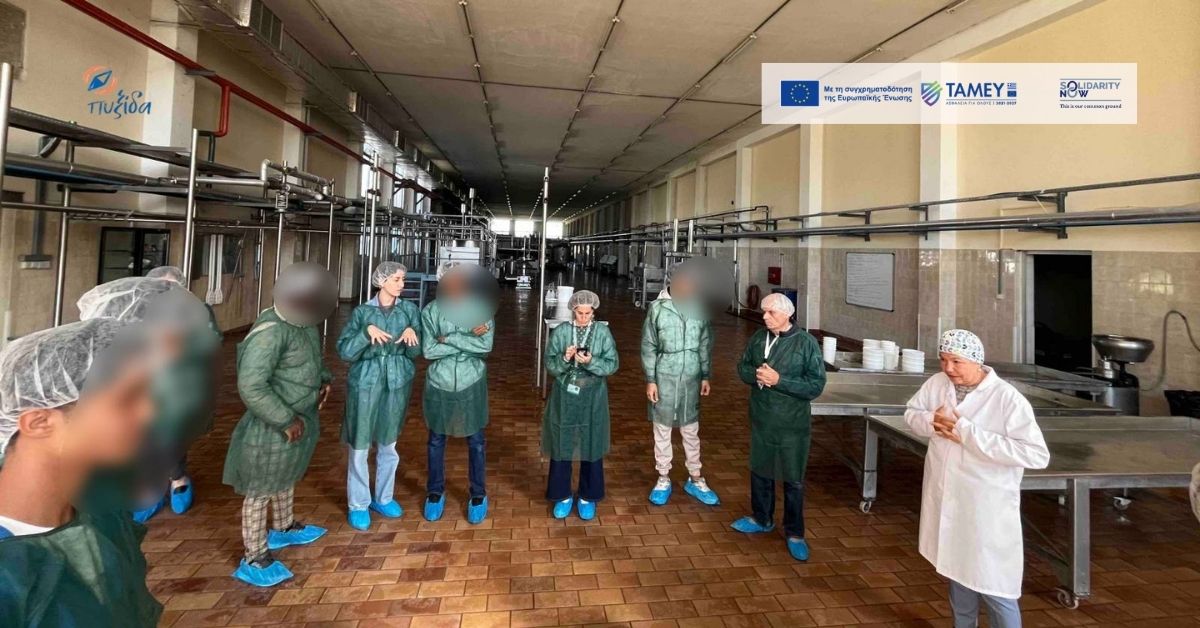
The initiative concluded with a visit to a local production facility of “Dodoni”, where the beneficiaries had the opportunity to observe the operation of a modern cheese production unit in real working conditions. During the visit, they interacted with industry professionals, observed the organization of the production process, the use of machinery, and hygiene and safety procedures, while also recognizing in practice much of the professional terminology they had learned during the workshop.

This initiative is not only about vocational training. It is about building bridges: between education and employment, between shelter and inclusion, between the children’s past experiences and their future opportunities.

For the children participating in the program, the question is no longer only “What can I do?”, but also “Where can I belong?”

And perhaps the answer lies exactly there: in a real opportunity, in a skill that can be acquired, in a community that makes space for them.

*SolidarityNow participates as a partner in the implementation of the project “COMPASS-Complementary Support Mechanism to the National Strategy for the Protection of Unaccompanied Minors in Greece.” The project is funded by the European Union through the “Program Greece – Asylum, Migration and Integration Fund 2021-2027″.

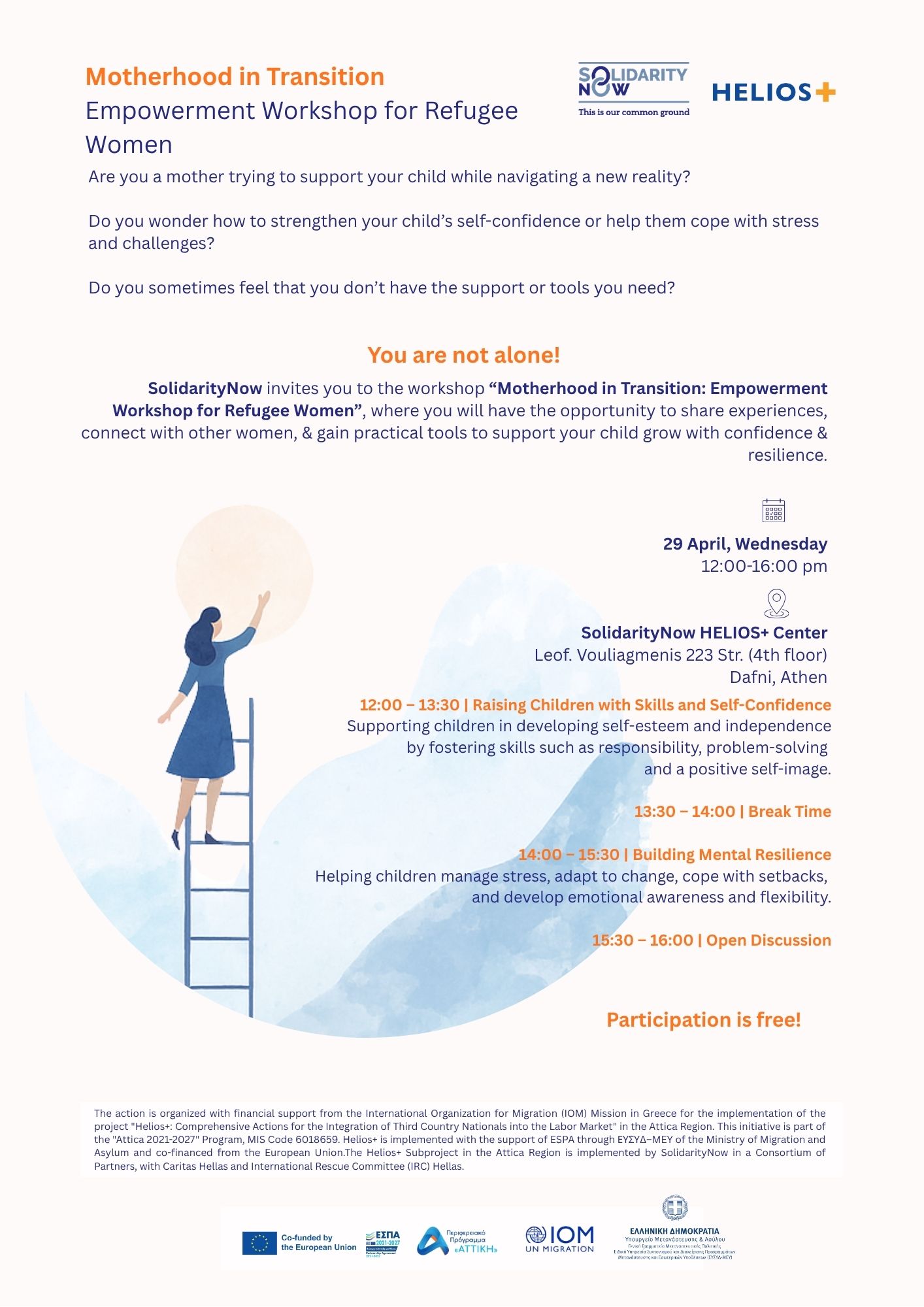
INVITATION | “Motherhood in Transition”: An empowerment workshop for refugee women


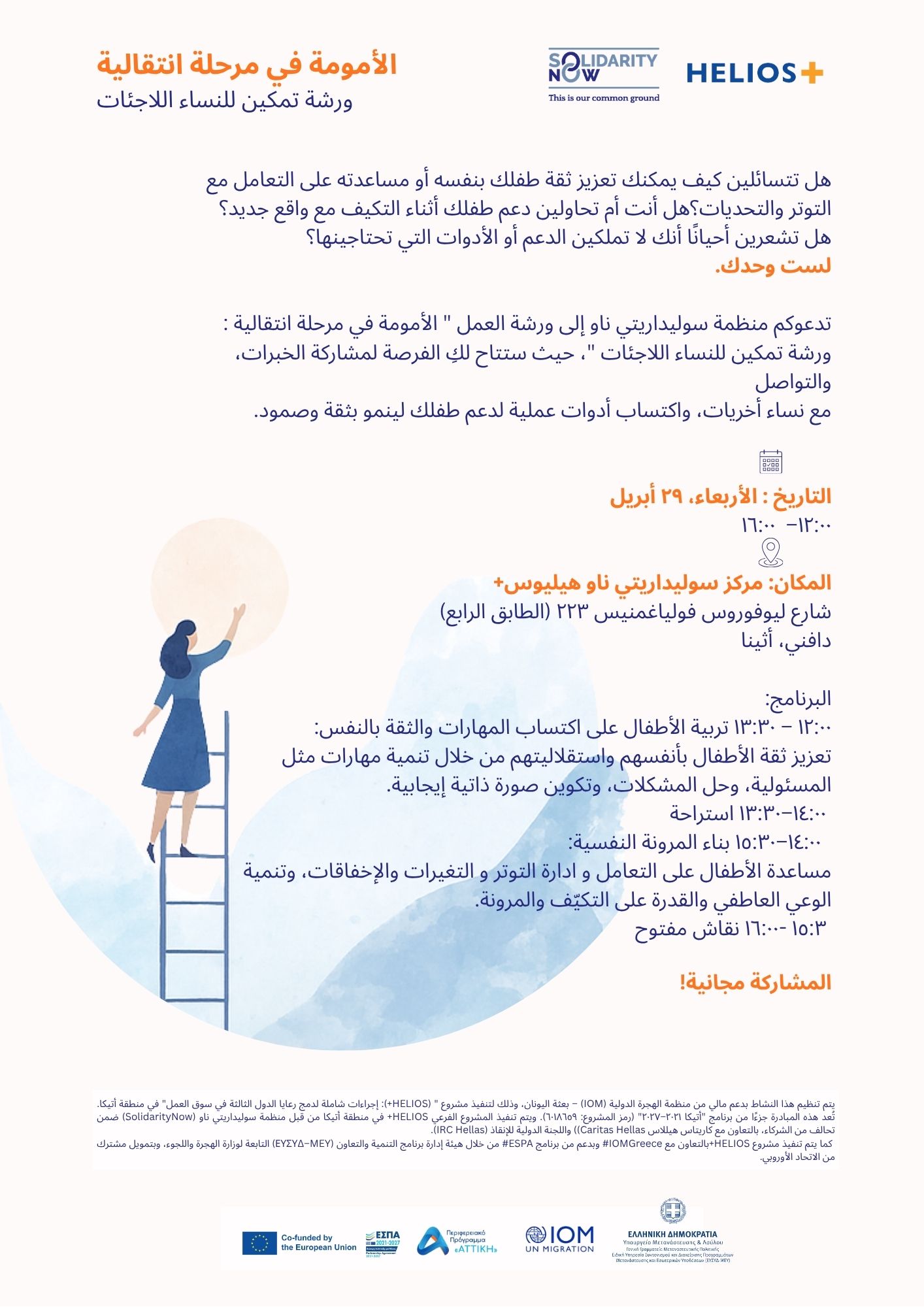
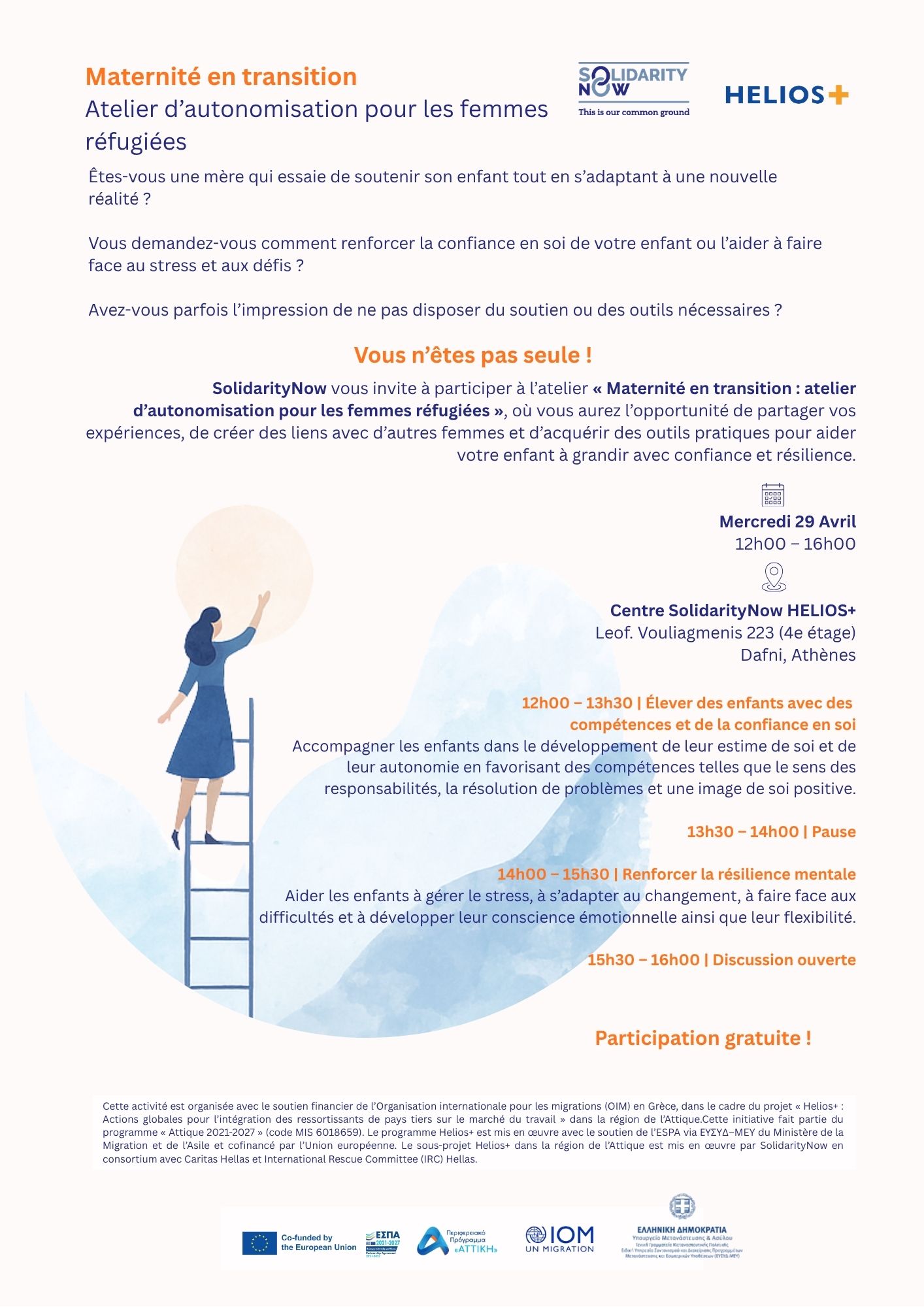
Are you a mother trying to support your child while navigating a new reality?

Do you wonder how to strengthen your child’s self-confidence or help them cope with stress and challenges?

Do you sometimes feel that you don’t have the support or tools you need?

You are not alone!

SolidarityNow invites you to the workshop “Motherhood in Transition: Empowerment Workshop for Refugee Women”, where you will have the opportunity to share experiences, connect with other women, and gain practical tools to support your child grow with confidence and resilience.

The workshop will take place on Wednesday, April 29th, 12:00-16:00 pm, at the organization’s HELIOS+ Center (Leof. Vouliagmenis 223 Str. (4th floor), Dafni, Athens).

Participation is free.

The action is organized with financial support from the International Organization for Migration (IOM) Mission in Greece for the implementation of the project “Helios+: Comprehensive Actions for the Integration of Third Country Nationals into the Labor Market” in the Attica Region. This initiative is part of the “Attica 2021-2027” Program, MIS Code 6018659. Helios+ is implemented with the support of ESPA through ΕΥΣΥΔ–MEY of the Ministry of Migration and Asylum and co-financed from the European Union. 

The Helios+ Subproject in the Attica Region is implemented by SolidarityNow in a Consortium of Partners, with Caritas Hellas and International Rescue Committee (IRC) Hellas.


Δωρεάν Σεμινάρια για Γονείς και Εκπαιδευτικούς: #ΡΙΣΠΕΚΤ στο σώμα σου. Μιλάμε ανοιχτά για την περίοδο.


#ΡΙΣΠΕΚΤ στο σώμα σου. Μιλάμε ανοιχτά για την περίοδο.

Το #SolidarityNow διοργανώνει δωρεάν σεμινάρια για εκπαιδευτικούς/σχολικό προσωπικό και γονείς/κηδεμόνες.

Στόχος των σεμιναρίων είναι να συμβάλλουμε ώστε οι ενήλικοι να αποκτήσουν πρακτικά εργαλεία για ουσιαστικό και ενημερωμένο διάλογο με τα παιδιά.

  • Online σεμινάρια για εκπαιδευτικούς:

    17/04 | 11:00 – 13:30
    23/04 | 08:30 – 11:00
    30/04 | 08:30 – 11:00

👉Δηλώστε συμμετοχή εδώ: https://shorturl.at/v9JQM

  • Online σεμινάριο για γονείς:

    28/04 | 08:30 – 11:00

👉Δηλώστε συμμετοχή εδώ: https://shorturl.at/9mIdP

  • Δια ζώσης (Αθήνα – Κέντρο Αλληλεγγύης), Σάββατο 18 Απριλίου 2026:

  1. 11:00 – 13:30 (γονείς) 👉Δηλώστε συμμετοχή εδώ: https://shorturl.at/tMETi
  2. 14:30 – 17:00 (εκπαιδευτικοί) 👉Δηλώστε συμμετοχή εδώ: https://shorturl.at/QB1Nq

Πληροφορίες: Μαργαρίτα Καραβασίλη ✉️ mkaravasili@solidaritynow.org


*Το πρόγραμμα Yγείας και Υγιεινής Περιόδου υλοποιείται από το Υπουργείο Υγείας σε συνεργασία με την UNICEF Greece και μία σειρά εταίρων, μεταξύ των οποίων και το SolidarityNow, στο πλαίσιο της Εθνικής Δράσης Προαγωγής Υγείας Παιδιού & Οικογένειας και χρηματοδοτείται από το Ταμείο Ανάκαμψης και Ανθεκτικότητας Ελλάδα 2.0. της Ευρωπαϊκής Ένωσης – NextGenerationEU. Μάθετε περισσότερα εδώ.

PRESS RELEASE | Giving Roma children access to sports and new opportunities through the RoMove project


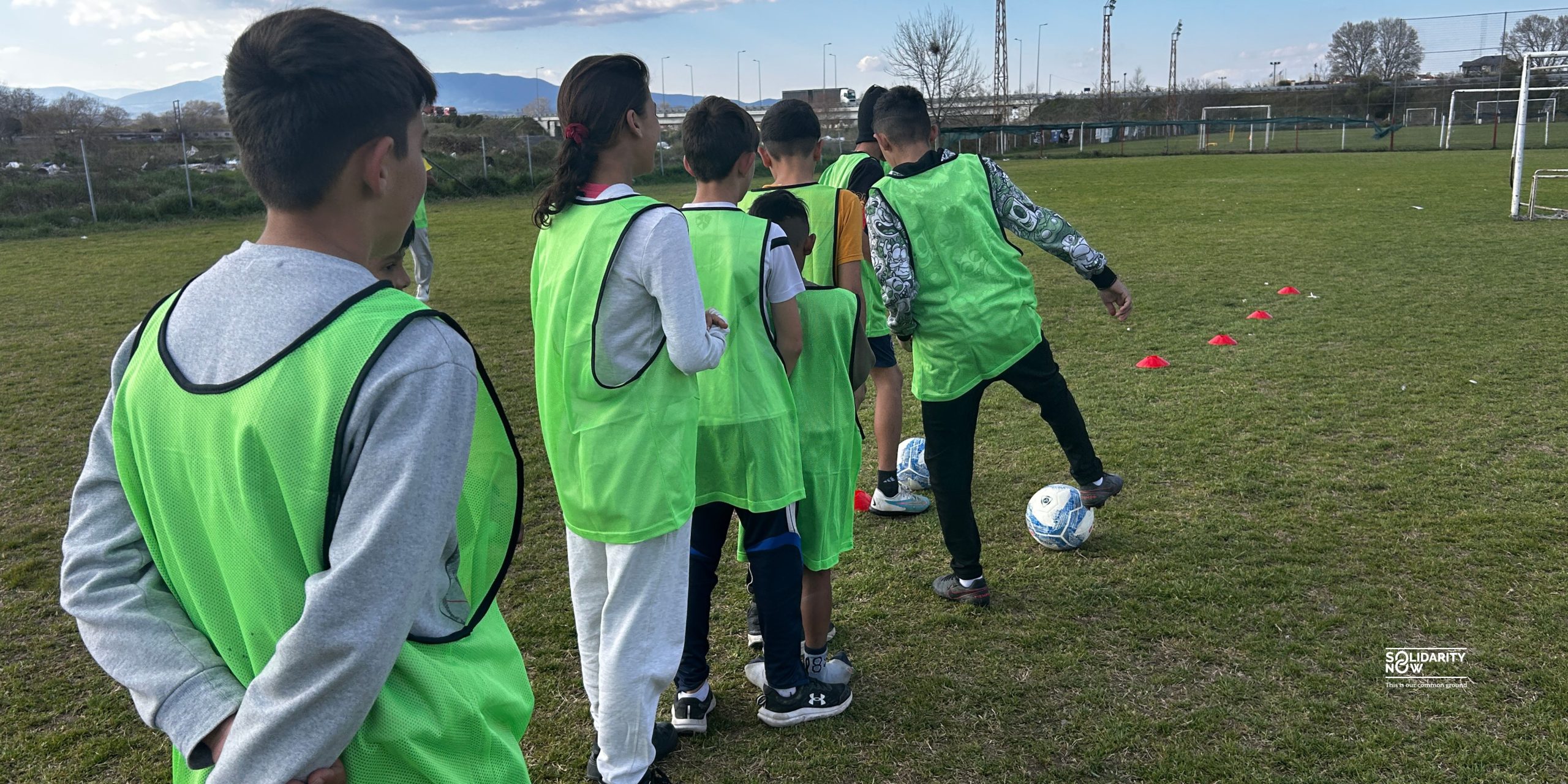
In a settlement outside the urban fabric, with limited access to basic services and opportunities, children from the Roma community in Pelekas, Katerini gain access to sports and new prospects through the RoMove project. On the occasion of today’s International Roma Day, we highlight the importance of equal access to sports for all children.

RoMove is implemented by SolidarityNow with the support of the NIKE DIRECT STORE Fund, managed by the King Baudouin Foundation, and aims to empower Roma children and adolescents aged 10 to 17 through regular participation in sports activities.

Sports are used as a tool for social inclusion, enhancing self-confidence, teamwork, and a sense of belonging, while also promoting health and cooperation. Through the project, children are also informed about the importance of balanced nutrition and discover alternative creative ways to spend their time.

The Pelekas settlement, where SolidarityNow has been consistently active since 2021 in cooperation with the Roma Annex of Katerini, faces significant challenges, such as high rates of school dropout, illiteracy, and limited opportunities for young people.

The project’s launch included an informational event for parents and children, followed by cardiac screening to ensure the safe participation of children in sports activities. At the same time, sports equipment, water bottles, and balls were purchased and distributed to all children. Activities are carried out on a weekly basis, with steady participation and growing interest from the children.

RoMove will continue until June 2026, aiming to ensure the sustainability of its actions and the continued inclusion of children in organized sports activities. Initial connections have already been made to enable older adolescents to join sports clubs in Katerini. More information here.

ARTICLE | Exploring Support Networks through an Experiential Activity-Game


Vasilina-Vallina Papanikolaou, Psychologist – Activity Coordinator

During my voluntary work as a psychologist at SolidarityNow, I undertook the implementation of an experiential activity aimed at exploring participants’ support networks, as well as the personal experiences and characteristics that help them cope with difficulties, ultimately fostering their empowerment through this process. This intervention became a unique experience for me, both professionally and personally, as it combined psychosocial objectives with deeply human narratives.

Participants mainly came from refugee communities and had experienced extensive traumatic events, including displacement, loss of loved ones, disruption of social bonds, and prolonged uncertainty. Within this context, and due to language barriers, a purely verbal approach would have been limited. For this reason, the experiential activity that was selected, allowing expression through symbols and colors, proved particularly appropriate.

Play as a tool for expression

At the core of the activity was the identification of people, relationships, or experiences that function as sources of support during times of crisis.

Through the process, many participants shared stories that highlighted both the strength of social bonds and their absence. Family ties, friendships, internal resilience resources, as well as ongoing losses, emerged as central elements in many narratives.

What emerged through the process

More than half of the participants identified family as their primary support network, even when geographically distant. At the same time, a significant number of individuals reported that they did not have any person or system they perceived as supportive.

Additionally, many participants identified sources of inner strength such as:

  • thinking about their family
  • prayer
  • the hope for a stable daily life.

Goals such as returning to education or securing permanent housing were frequently mentioned as key aspirations.

The process was often emotionally intense, as many participants shared traumatic experiences.

As the psychologist facilitating this activity, I experienced the challenge of both setting boundaries and honoring what participants chose to share.

There were moments of deep admiration and emotional resonance in witnessing how individuals narrated their stories. At the same time, there were instances of emotional fatigue, resulting from repeated exposure to traumatic narratives.

Impact on professional identity

This experience acted as a mirror for my professional identity. It brought forward:

  • the limits of my role
  • the need to balance empathy with professional positioning
  • the importance of self-care.

At the same time, it highlighted the value of supervision and collective processing of emotionally demanding interventions, particularly within humanitarian settings.

A brief intervention with meaningful impact

This experiential activity demonstrated that even brief interventions can act as catalysts for deeper self-understanding and awareness of one’s needs.

In environments where verbal expression may be limited, creating alternative pathways for communication can open meaningful spaces for connection, empowerment, and care.


*Since August 1st, 2023, the operation of the Athens Solidarity Center by SolidarityNow is supported by the Swiss-Greek Cooperation Programme (Embassy of Switzerland in Greece) to reducing economic and social disparities in the EU and by the Ministry of Migration and Asylum.
**The Athens Solidarity Center is also supported by the Municipality of Athens.