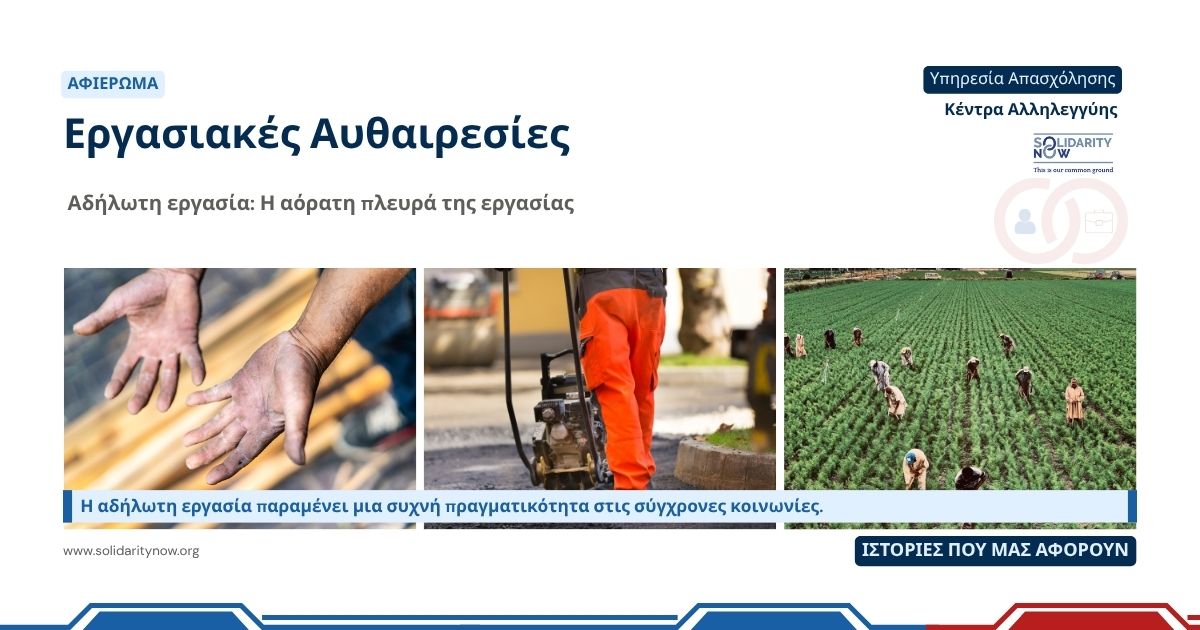
For many people living in conditions of social exclusion, undeclared work is not a choice but the only available means of survival, often accompanied by a heightened risk of exploitation.
No one wakes up one morning and decides to work without social insurance in a physically demanding job, risking not being paid or suffering an accident, for a daily wage that is not even enough to cover basic needs. Undeclared work remains a reality in contemporary societies and is more frequently found in certain sectors where monitoring by the competent authorities is particularly difficult, if not impossible.
This article summarizes the experience of the Employment Team regarding sectors where violations of the rights of workers from other countries are more likely to occur and presents real cases that reveal this “invisible” side of work.
Agricultural Sector
“A red agricultural vehicle stops outside an accommodation site for asylum seekers. A man wearing a hat and dusty clothes gets out and approaches you. In broken English, he explains that he is looking for 10 workers for olive harvesting for a few days. Payment by the crate, he says. What do you do?”
This is a typical hypothetical scenario used by the Employment Team’s counsellors during information and empowerment sessions with people looking for work. Participants’ responses vary; however, the purpose of the question is primarily to open a discussion about undeclared work.
Over time, various cases involving agricultural workers have reached the Employment Team’s offices. When M. first came to the Thessaloniki Solidarity Center, he had already been living in Greece for seven years. He was staying in makeshift accommodation in rural areas while working for different agricultural producers. He approached the Centre seeking information about “what the tax number (AFM) that a friend of mine has actually is.”
A particularly characteristic case involved a group of agricultural workers who contacted the Employment Team in a state of severe distress, reporting the living conditions they experienced in a rural area of Northern Greece, where they were working in olive harvesting. The photographs they sent of their accommodation showed conditions unsuitable for human living, with serious shortages in basic infrastructure and elementary hygiene facilities. This incident highlighted, in a particularly clear way, the extreme forms of exploitation and the erosion of human dignity that some agricultural workers continue to experience.
When Mr M. started working on a farm in Fthiotida in April 2020, he quickly realised that the terms that had been verbally agreed would not be respected. For two consecutive months, he worked without days off and without receiving the agreed salary. Even his basic personal needs were covered through small amounts of money that the employer recorded as “advances”, later deducting them from his wages. At the same time, he faced systematic threats and severe verbal abuse.
When he requested payment of his unpaid wages, the employer attempted to force him to sign a document stating that it was the worker himself who owed money to the employer. Having reached his limits, Mr M. left the farm and sought assistance.
Following his complaint, the competent authorities, the organizations A21 and SolidarityNow became involved. After a complex and demanding process, carried out during the COVID-19 pandemic, his safe return to Thessaloniki was made possible.
Automotive Sector
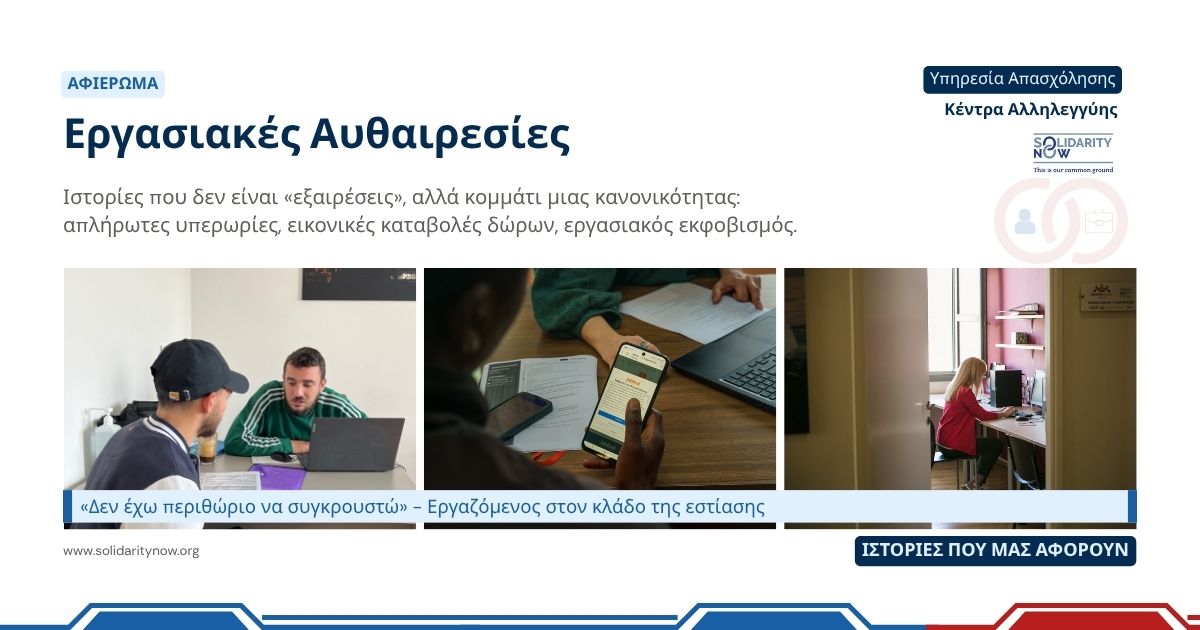
“And how do you move around without documents?” the employment counsellor asked the person who had visited the Employment Service to prepare his CV. “What happens if the police stop you?”
This is not an isolated case. The Solidarity Centers have repeatedly documented testimonies from people working informally in car washes and related businesses, without employment contracts and without social insurance coverage. Among them are also people without legal documentation who, due to their particularly vulnerable position, accept extremely unfavorable working conditions.
Particular concern is raised by cases involving unaccompanied minors, who leave or neglect their schooling to work in this sector for extremely low daily wages. According to the testimonies collected, work often involves 12-hour shifts, without compliance with labor legislation, or part-time contracts that conceal the actual duration of employment. Wages usually range between €20 and €30 per day.
Construction Sector
The construction sector has historically been one of the areas where undeclared or under-declared work, violations of labor legislation and risks to workers’ health and safety appear with intensity. Pressure to complete projects quickly, complex subcontracting chains and insufficient oversight can, in many cases, create conditions that facilitate labor exploitation and weaken protective measures.
Workers in the construction sector frequently turn to the Solidarity Centers seeking information or support. Some work without legal documents and without any labor protection; others have the necessary documents but are employed without contracts or insurance coverage. Many simply seek information about their basic rights before accepting a job offer.
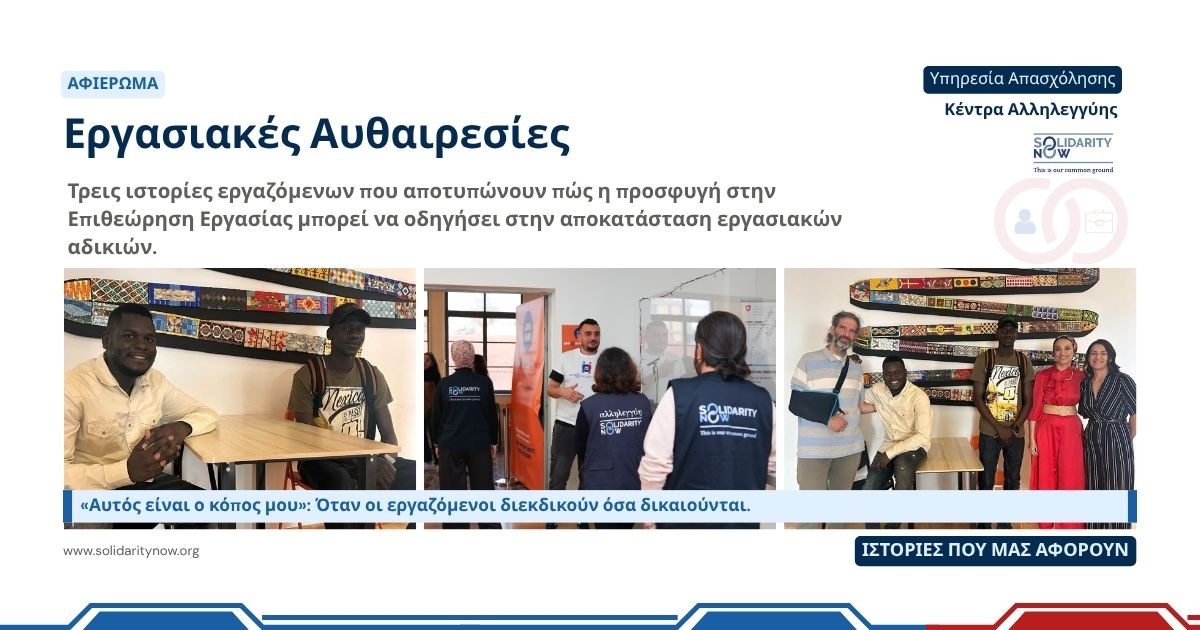
A characteristic case concerns a worker who came to the Employment Service carrying a formal declaration that he had been asked to sign before starting work in construction. The document stated that the employer would bear no responsibility in the event of a workplace accident. The nature of the work itself indicated undeclared employment, while such a declaration can in no way release an employer from the obligations imposed by labor legislation. The worker was informed about his rights and advised not to sign the document.
Whether he ultimately signed it remains unknown. However, this case highlights the dilemma faced by many workers when the need for income is directly linked to their survival. Under these circumstances, the ability to freely negotiate or refuse unfavorable working conditions is, in practice, extremely limited.
Responsibility for monitoring compliance with labor legislation and health and safety regulations lies with the Labour Inspectorate. According to data from the Association of Labour Inspectors for Health and Safety and Labour Inspection Employees, the service has only 233 employees nationwide, who are responsible for monitoring approximately 2.5 million workers and more than 351,000 businesses.
The protection of labor rights cannot depend solely on an individual worker’s initiative to report a violation. Effective enforcement of labor legislation requires adequate and functional inspection mechanisms, as well as an environment in which workers can claim their rights without fear of losing their only means of livelihood.
As long as job insecurity remains high and significant gaps continue to exist in the enforcement of legislation, undeclared work and workplace abuses will continue to find fertile ground in which to persist.
The operation of the Solidarity Centers in Athens and Thessaloniki is supported by the Swiss–Greek Cooperation Programme (Embassy of Switzerland in Greece) to reduce economic and social disparities in the EU and by the Ministry of Migration and Asylum.