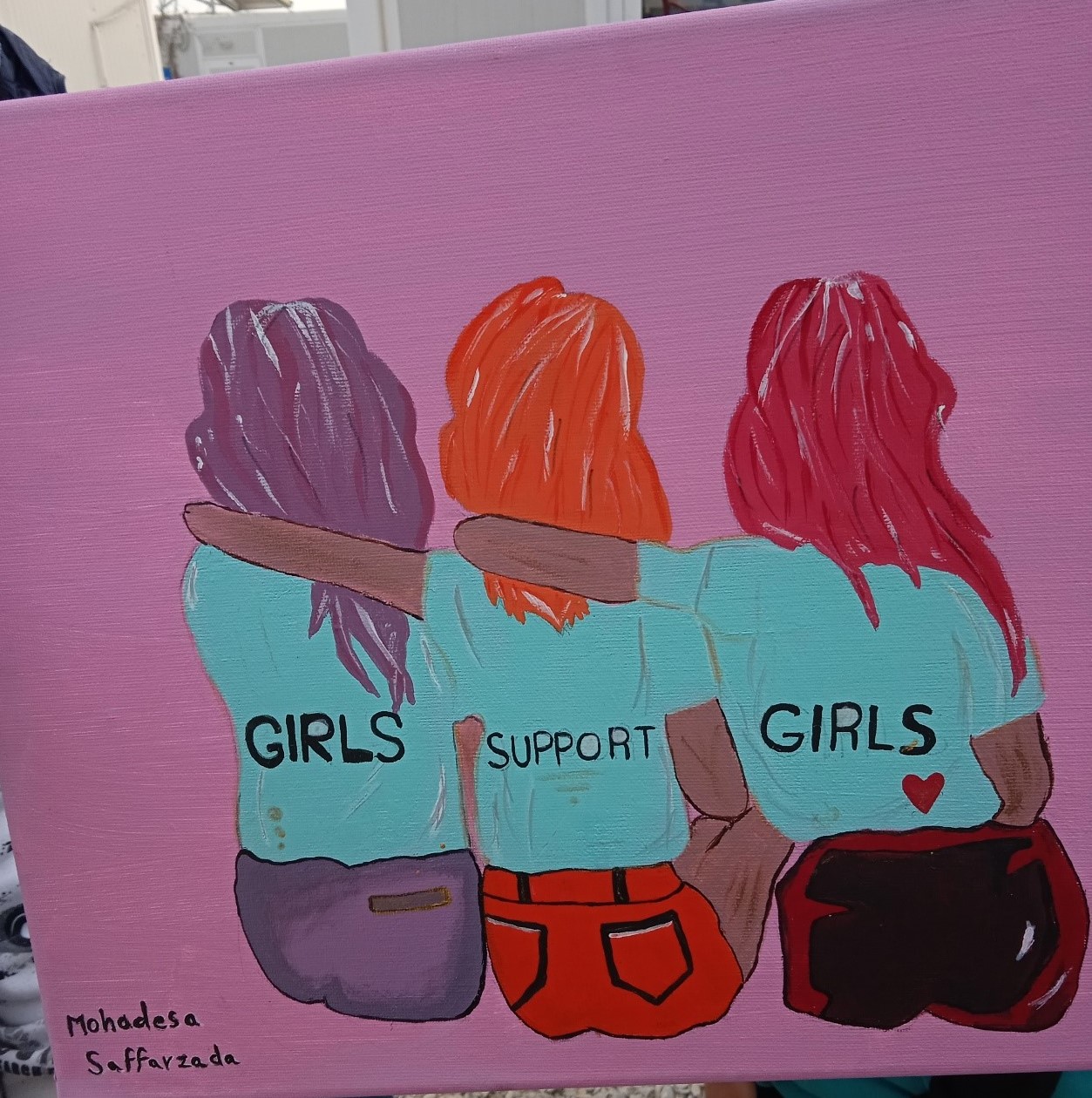
The SolidarityNow tribute on the 16 Days of Activism Against Gender-Based Violence


SolidarityNow honored the 16 Days of Activism Against Gender-Based Violence with a series of awareness raising activities organized by the facilitators of the Female Friendly Spaces at the Child & Family Support Hubs operating by the organization, in 14 open accommodation sites for migrants and refugees across Greece.

Through these actions, the women living in the camps took part in awareness raising discussions, shared information material and through arts they captured the forms of gender-based violence as well as strong messages against violence and in favor of support among women.

The 16 Days of Activism Against Gender-Based Violence began on November 25th –International Day for the Elimination of Violence against Women-, and were completed on December 10th, Human Rights Day.

* The “Child & Family Support Hubs” program is jointly supported by UNICEF Greece and IOM Greece with funding by the European Union.

“Days of lockdown, days of the pandemic”


10.12.2020 | Human Rights Day

“Days of lockdown, days of the pandemic”

By Thodoris Zeis, Lawyer

Legal Service Athens Solidarity Center

Days of lockdown, days of the pandemic. Equal for everybody? Of course not.

A young man from Guinea has been forced to travel by train from Thessaloniki, the city of the hundreds of Covid-19 cases, to Athens to have his interview according to the schedule of the Regional Asylum Office of Attica.

Indeed, text messages are compulsory even for the supermarket next door, but for the interview required so that the asylum procedures are carried on smoothly, those young people are obliged to travel across the quarantined country at the risk of getting ill or spreading the virus. The same applies to their lawyers, although, if they cannot be present, the interview may take place in their absence according to the Law…

Still, the lawyer was present. Even though he had just been tested, because a positive case had been detected in his work team – luckily, the result was negative. The Athens Solidarity Center is at the forefront.

– Maître*, I have no money to take the train.

– I will suggest that we pay for your ticket.

Everything happened rapidly. We came up with the solution, even though it was late in the afternoon. The next day we were worried…would he arrive safely?

– Are you Ok?

– Ok Maître.

– I have not asked you, where did you spend the night?

– Somehow, I managed, Maître…

The morning of the interview he was strong and calm. He had been up and about all night trying to put in order what we had discussed about this day.  All his anxieties. Everything. What he left behind a few years ago, his youth, an entire life that was about to be judged in a few hours.

We entered the interview room. Four people with masks on and a wall of plexiglass separating them. A suffocating, narrow space like the kitchen of my student apartment in the past. Being highly sensitive to the conditions, I complained to the operator. I talked about the rights of the “vulnerable” who are considered expendable. About the loss of dignity. The operator and the interpreter listened to me understandingly. For a moment, one tiny moment, I thought I heard us heavily breathing through the mask.

The first question asked, the interviewee’s answers poured on endlessly, breathlessly, it was impossible to interrupt him. All his feelings bottled up for so long, came out in a torrent of words. He forgot nothing in the flow of the narrative. Half an hour later, he concluded saying, “and now that I live in Thessaloniki, I enrolled and attend high school”. In the end, when it was my turn to ask questions, I could not help but asking: “Please tell me, how did it occur to you to enroll in high school? Did any organization help you?”, “No, Maître. The idea was mine. I wanted to do something for me.”

We parted at the traffic lights of Katehaki avenue. I suggested taking him to Larissa Station by taxi. But he still had some spare time and wanted to walk a little. Suddenly he turned and looked at me. His eyes were red. From fatigue, tension, emotion. He gave me his hand.

– Maître… I thank you and your organization for helping me. It meant a lot to me.

– Have a safe journey kiddo!

Days of “social distancing”? Not quite…

(This was a current incident from the work of the Legal Service’s team at the Athens Solidarity Center)

* Maître: Lawyer for French speakers

Since May 2019 the Athens Solidarity Center is financed by EEA and Norway Grants, with HumanRights360 and CROWE Greece as the fund operator. The Center is also supported by the Municipality of Athens.

INTERNATIONAL TEACHER’S DAY_“The aim is one, actual integration”


Fotini, teacher, Integration Learning Center, Athens

 Fotini has been working for Civil Society’s organizations since 2016. She is a philologist and teaches Greek to refugees and migrants. Since 2019, she is one of the teachers at the SolidarityNow Integration Learning Center for the “HELIOS” program*, teaching the Greek language to recognized adult refugees living in Greece.

During all this time, being close to the people and the daily effort of the organizations and their employees to comfort and strengthen them to continue their lives, her goal is obvious: “the aim is one; actual integration, achieved only through education”.

With this in mind and heart, Fotini teaches the Greek language every day to people who live in Greece but are not Greeks, but then are equal to everyone and deserve getting the same opportunities – “It is not just the strictly cognitive part“, she says, “but it is the knowledge provided through the program that is applicable in the people’s everyday life. We give them the opportunity to acquire the basic knowledge of Greek, but we also teach them several other skills, related to social behavior, communication, organization and time management”.

Fotini describes many assets of the “HELIOS” program, which, as she tells us, are reflected in people’s lives. Thus, she admires her student who started attending classes without any motivation apart from accepting its mandatory character, and today he has become an interpreter and his classmates’ inspiration! Respectively, she is proud of her student who works hard for a living, but also is meticulous and consistent with his lessons while always expressing his gratitude for his progress – “we have become his point of reference“, Fotini explains with a smile.

“The appropriate structure and curriculum of the educational program, the specific book, the classroom culture and the connection with work counselors, are elements of “HELIOS” that facilitate our work and mainly enhance the healthy multicultural exchange, collaboration, and tolerance. In addition, a positive and optimistic observation is that there is a sizeable participation of women also in the program – there is no exclusion, and that is promising“. For Fotini, this is her crowning achievement, the success of education which is what she loves doing in her life. “When my mind is occupied doing the same thing for a long time, I get tired and search for something challenging and new“, says Fotini, a young woman, fan of lifelong learning.

—————————————–

The HELIOS program

SolidarityNow in collaboration with the International Organization for Migration (IOM), and in the framework of the implementation of the HELIOS program organizes integration and information classes within its Integration Learning Centers established across Greece (Athens, Thessaloniki, Ioannina).

* SolidarityNow is a key implementing partner of the International Organization for Migration, in the framework of the “HELIOS” program, which is funded by the European Commission – Directorate General for Migration and Home Affairs (DG HOME).

  • Watch IOM’s new awareness campaign at the link below:

https://greece.iom.int/en/helios-national-sensitization-campaign

INTERNATIONAL TEACHER’S DAY_“What I wish for my students is to never stop trying and never feel alone”


Maria Ninou, teacher, Integration Learning Center, Ioannina

 Αt the other end of the telephone, Maria Ninou, language teacher, talks about the Greek lessons she gives to recognized adult refugees, at SolidarityNow’s Integration Learning Center (ILC) in Ioannina. “I will not talk about the course context” she tells us at the beginning of our discussion; indeed she prefers to talk about her students, her favorite B1 class where people are preparing to take Greek language exams in mid-October and about the large number of students who were forced to drop out of school.

Maria started working at SolidarityNow in January 2020 and begun her first language courses just before the quarantine caused by the new coronavirus. The classes were “continued” through social networks, where teachers shared educational material with their students. After this difficult but at the same time creative period, students and teachers returned to the classrooms. There, however, the teachers confronted a harsh truth. “Students with great potential, who would have succeeded in the exams, left the country”, Maria stresses and adds “that discourages us“. On the other hand, there are students who did not leave, who stayed here and are preparing to take exams. They are 3 brothers from Syria, a boy and two girls, who are also studying at the vocational school, and who in a short period of time covered a large and quite difficult part of the exam material. “They have made an excessive effort not only now, but from the first day they came to Greece. They are very dutiful and have great will”.

What Maria likes most about her job is “to motivate my students not to give up,” while what frustrates her are “the dropouts”.  She prefers to teach older students because there is another type of interaction. She tells us about one of her students, who is from Iraq and although he is very clever, he caused a lot of problems in the classroom with his behavior. “At the beginning he was disturbing us but has progressively changed; he has a tremendous development and he will definitely pass the A2 exam”, she notes. “What I wish for my students is to never stop trying and never feel alone. I want to tell my colleagues to do their job with love because students understand if you really care about them”, she concludes.


The HELIOS program

SolidarityNow in collaboration with the International Organization for Migration (IOM), and in the framework of the implementation of the HELIOS program organizes integration and information classes within its Integration Learning Centers established across Greece (Athens, Thessaloniki, Ioannina).

* SolidarityNow is a key implementing partner of the International Organization for Migration, in the framework of the “HELIOS” program, which is funded by the European Commission – Directorate General for Migration and Home Affairs (DG HOME).

  • Watch IOM’s new awareness campaign at the link below:

https://greece.iom.int/en/helios-national-sensitization-campaign

INTERNATIONAL TEACHER’S DAY_“What I try to convey to my students from all over the world is my love for learning”

SolidarityNow

Emmanouela, teacher, Integration Learning Center, Athens

She has just finished her course at the “HELIOS” Integration Learning Center* in Athens, and during her break she is happy to talk about her work and experience in this program, which in her opinion is indeed “a second sun”** for its beneficiaries.

Emmanuela is a language professor who teaches Greek to recognized adult refugees living in Greece. Her theoretical knowledge in teaching Greek as a second / foreign language was the means that led her to work in this field of education, but not only: “I always wanted to help people communicate. I also like the different cultures, customs, and traditions, and I always observed these differences that nonetheless make the lives of all of us so much more interesting. And the most important thing for me is that the more you observe and comprehend the differences, the more likely it is to find similarities among people” – this is how Emmanuela describes herself and answers to the question why she teaches Greek to refugees/migrants, choosing a professional path that is more difficult than the established one.

She shares many everyday stories of multicultural interaction, most of them enjoyable and funny. After all, whatever the composition of the class, in the end everyone laughs at the same things, even when they do not speak a common language. This is what moves her. She is very happy to belong to a group of people, such as that of “HELIOS”, and recognizes that “the contribution of all is essential for what we ultimately offer to our beneficiaries-students. For example, we learn a lot of interesting and especially useful tips of how to approach our students effectively, through our interaction with the interpreters. Thus, we all become a strong team, all carriers of distinct knowledge, which when combined offers the appropriate knowledge and guidance to people who need it.

Emmanuela smiles when asked to tell us about a special moment and remembers one of her students who “during the lesson, her phone rang, and she found out that she has just been fired. Her psychological collapse in the classroom upset all the students and I immediately referred her to the IOM work counselor, who is in the same working space. She then received advice from an accountant to get to know her rights; the whole process was followed as for her to be able to immediately look for another job and the entire situation altered. She continued attending classes, she calmed down and managed to continue”. According to Emmanuela, the above successful example became possible due to the well-organized and structured program that includes different and distinct directions. The cooperation of both educational and employment counselors, provides people with a supportive framework necessary to continue in the educational process, directly seeing the positive impact on their everyday life.

Emmanuela, is a happy teacher of many students from around the world and a lifelong learner – she is now learning Farsi, the fourth foreign language after English, Italian and French: “I love being a teacher. But what I try to convey to my students from all over the world is my love for learning. And maybe they become learning lovers too and understand that through education and knowledge they can improve their own lives and the lives of the people around them”.

—————————————–

The HELIOS program

SolidarityNow in collaboration with the International Organization for Migration (IOM), and in the framework of the implementation of the HELIOS program organizes integration and information classes within its Integration Learning Centers established across Greece (Athens, Thessaloniki, Ioannina).

* SolidarityNow is a key implementing partner of the International Organization for Migration, in the framework of the “HELIOS” program, which is funded by the European Commission – Directorate General for Migration and Home Affairs (DG HOME).

** “Education is the second sun for people”, Plato.


Watch IOM’s new awareness campaign at the link below:

https://greece.iom.int/en/helios-national-sensitization-campaign


INTERNATIONAL TEACHER’S DAY_”Education will help them have a better life”


INTERNATIONAL TEACHER’S DAY_5 OCTOBER

#education=integration

“Education will help them have a better life”

Chrysa Zizopoulou, teacher, Integration Learning Center, Thessaloniki

In one of the classrooms of SolidarityNow’s Integration Learning Center (ILC) in Thessaloniki, 33-year-old Chryssa Zizopoulou, language professor, teaches Greek to recognized adult refugees. Due to the pandemic the number of students in the class is now limited. Chryssa started working at the Center in February 2020 and she is responsible of the A1 class, for people who are learning Greek, as well as for illiterate persons.

We talk with Chryssa about the challenges she is called to face in her work. Men and women aged 19 to 48 years old from different countries, most of them parents, who have not any connection with the learning process – these are her students. “Adult students, compared to minors, are stiffer, they have a sense of shame, they have difficulties to open up. However, they are more consistent in their obligations. On the contrary, children create a social circle easily and as a result they practice Greek more“, Chryssa explains. Teaching adults, especially refugees, in addition to challenges, has many pleasant surprises. Chryssa tells us about the strong will of a single parent woman to learn Greek, as she comes to the class with her 2-year-old daughter. Her classmates without any resentment have welcomed her and her child. Besides that, another man who is illiterate has managed after a lot of effort to read the street signs, and the product labels in the supermarket.

“I love this job. When I’m in the classroom I feel a sense of belonging. And then the real reward is when you see the progress of these people, who in a short time articulate their first words. You build real relationships with these people,” Chrysa tells us and adds, “what I wish them is to understand how important education is for themselves and their children. Education will help them have a better life”. As for her fellow teachers, she would like to remind them “not to lose their motive and not to stop having expectations; do not be disappointed because the obstacles are many. They must have empathy, which is necessary in the classroom”.


The HELIOS program

SolidarityNow in collaboration with the International Organization for Migration (IOM), and in the framework of the implementation of the HELIOS program organizes integration and information classes within its Integration Learning Centers established across Greece (Athens, Thessaloniki, Ioannina).

* SolidarityNow is a key implementing partner of the International Organization for Migration, in the framework of the “HELIOS” program, which is funded by the European Commission – Directorate General for Migration and Home Affairs (DG HOME).

INTERNATIONAL DAY FOR OLDER PERSONS* | OCTOBER 1st_An 81-year-old fighter of life, Mr. Ali.


“Older yes, stronger though. As long as we live, we must move forward. I have always fought in my life and I will continue to do so, as long as I’m alive”.

On the International Day for Older Persons, we celebrate the 81-year-old Mr. Ali from Syria. He had to reach 78 to add one more property in his life; that of the refugee.

Mr. Ali followed his daughter’s family on their long trip away from Syria, which began shortly after a bomb exploded in the kitchen of the family while they were having lunch. He never thought doing otherwise – “I have no one else and I would do everything to protect my grandchildren. I don’t care where I will die”.

So, it happened. After Turkey and their temporary residence in the camp of Moria in Lesvos, the family moved to a SolidarityNow apartment in Athens, as part of the ESTIA** accommodation program. “I had heard that Greece is beautiful, and its people are friendly”, he says, and while smiling like a child behind his red presbyopia glasses, he adds: “Besides, I had never travelled outside Syria”.

Mr. Ali, a widower, and father of a daughter struggled to reach Greece. But even before that, he did not have an easy life. He is a man who worked hard and literally his hands eventually made him a successful businessman. These hands that from an early age seemed to have a talent for sewing. Thus, Mr. Ali escaped from his destiny of working as a servant, a fate determined in those years by his poor family.

Luck smiled on him and a friend suggested he worked with him on sewing handkerchiefs. He did it and with their hard work, they managed to become partners and eventually create together an industry exporting handmade silk products. While working he learned to read and write. His work enabled his family to live comfortably, something that was violently interrupted by the war.

Mr. Ali never lost his courage and still supports his daughter and her family in any way he can – emotionally, morally, financially. Today, he and the rest of the family are in Germany, where they managed to reunite with the family’s sixth child, the 17-year-old Sehrazat.

Ali is a living proof of the active role of the older persons by providing -among others- support to their children by taking care of their grandchildren. They are the ones who carry valuable experience and knowledge and help and encourage, in so many tangible and intangible ways the youngers.


* The International Day of Older Persons is observed on October 1 each year. On December 14, 1990, the United Nations General Assembly voted to establish October 1 as the International Day of Older Persons. It is a day to appreciate the contributions that older people make to society and to raise awareness about issues affecting the elderly.

**Mr. Ali and his family were beneficiaries of the SolidarityNow accommodation program as part of the ESTIA program implemented by the UNHCR and funded by the Asylum, Migration, and Integration Fund of the European Union.

A Story about World Refugee Day_Despite the adverse conditions, M. does not lay down arms; he has a plan and tries to implement it step by step


M. comes from Syria and lived with his family in Northern Greece, in an apartment rented by SolidarityNow, as part of the *ESTIA program. The social workers, who were responsible for M. and his family, tell us that he is a role model! They use his case as an example to the program’s beneficiaries, who are now trying to take the first steps and stand on their feet without depending on an organization or the state’s support.

From the first moment they entered the apartment, back in 2018, 27-year-old M. requested for a larger apartment for his family. They were transferred to the new apartment and then M. started seeking for a job. Together with a friend, they started working in flea markets selling fruits and vegetables. The nature of the work and the communication with the customers was an opportunity for him to learn Greek. And as things slowly got better, one of his children got sick. M. never stopped believing that everything would go well and strive for it. SolidarityNow arranged and organized visits to doctors and hospitals. In the midst of these challenges, another one was added; the announcement of the family’s exit from the ESTIA program at the end of May 2020.

The fear lasted for a while in the case of M. as he had to think logically and find a solution immediately. The appointment with the doctor for his child was scheduled after the end of the quarantine; now the issue of the house remained. He was informed by his social worker about the HELIOS** accommodation program and visited the International Organization for Migration offices alone; there he got informed about the rental apartments. M. called and found an apartment where it could meet his family’s needs. In order to convince the owner of the apartment, he referred him to SolidarityNow. Eventually, M. gained the trust, but also the admiration of the owner who wanted to offer both him and his wife a job in his restaurant, that due to Covid had remained closed.

Despite the adverse conditions, M. does not give up; he has a plan and implements it step by step. And as his social worker says, he is a good man, he wants only the best for himself and his family and he fights tough for it. He is a generous and warm man, and if you gain his trust, he can give you his heart. Today, M. continues to work in flea markets, but the income is not enough to cover his expenses, so he’s doing other jobs as well, believing that at some point he will find a better job so that he can support his family.

* ESTIA, the Emergency Support to Integration and Accommodation programme, is implemented by UNHCR and funded by the Asylum, Migration and Integration Fund of the European Union.

** The Hellenic Integration Support for Beneficiaries of International Protection (HELIOS) is implemented by IOM and funded by the Directorate General Migration and Home Affairs of the European Commission (DG HOME).

A story about World Refugee Day_From *ESTIA to **HELIOS and then to Germany, a hurdles race for Sanaa from Syria


Sanaa from Syria lives in Greece along with her two sons and her mother for the last couple of years. At the beginning, her husband was also with them, but he left for Germany to begin a new life there for himself and his family. However, they still live apart.

The 40-year-old Sanaa, her mother, the 11-year-old Hussein, and the 4-year-old Mohammed arrived to Athens from Lesvos and since then, they live in a house rented by SolidarityNow as part of the ESTIA program, while all family members are now recognized refugees. Today, they are among many other families of recognized refugees who must leave their apartment rented by SolidarityNow in the framework of the *ESTIA program. This four-member family has to find housing, in a market that, prefers to turn apartments into short-lived homes (airbnb), do not rent to foreigners (refugees and migrants) and, at the same time, requires advance payment of the amount of the guarantee.

Until now, in SolidarityNow 20 people have left their apartments in Athens and Thessaloniki.

The lovely Sanaa lived “a beautiful life in Syria“, as she says, smiling shyly; she looks as if she is afraid of smiling. Their house was bombed, her father remains missing, “we took what was saved and left“. Now, she is happy and safe, she is glad that her children are going to school and she is anxiously waiting for the moment when everyone will arrive in Germany together, “I miss seeing my husband“. Until they manage to leave, however, they first must face the exit from the *ESTIA program. Sanaa is looking to find a new home for her family with the little money she has saved. With their savings they must pay in advance all the expenses and that will enable them to join the **HELIOS program and the 6-month rent subsidy.

Through her stories we listen to many unpleasant moments she experienced while looking for a house. The rents are expensive, the owners are cautious, the questions that need to be answered every time, are tough. Nevertheless, Sanaa is trying, and is empowered by the organization’s social worker, Sofia Theodosiou. In such social conditions, Sanaa, like so many other people, must find the strength to adjust and gradually become autonomous. She will make it. Her motive is time – as it is for everyone, until they can leave for Germany.

Sanaa shared her story and agony speaking through a protective mask. We were all wearing masks, but we managed to communicate, and in the end, we almost hugged. However, for everyone’s protection, we stayed to look each other in the eyes. We wish every success to Sanaa and we promise that we will continue to be by her side until she takes the next step towards her independence and dreams.


* ESTIA, the Emergency Support to Integration and Accommodation programme, is implemented by UNHCR and funded by the Asylum, Migration, and Integration Fund of the European Union.

**HELIOS program is implemented by the International Organization for Migration (IOM) financed by the Directorate General Migration and Home Affairs of the European Commission (DG HOME).

A story about World Refugee Day_“I will never stop trying for having my Own Home”


The 42-year-old from Togo has faced many challenges in her life since she was a child. Today in Greece she must face another one; the one that derives from the new ministerial decision regarding the housing of the recognized refugees in the country. Palanga and her son are among the recognized refugees who had to leave their apartment rented by SolidarityNow in the framework of the *ESTIA program.

The single-parent family from Togo, like so many other people, had to find housing, in a market that, prefers to turn apartments into short-lived homes (airbnb), do not rent to foreigners (refugees and migrants) and, at the same time, requires advance payment of the amount of the guarantee.

Until now, in SolidarityNow 20 people have left their apartments in Athens and Thessaloniki. Palanga and her little son are among them. On the occasion of the World Refugee Day on June 20th, we met Palanga in a small but cozy house in Athens city center.

“I was looking for a house for a long time. At first I thought people were afraid of me”.

Palanga, an exuberant dynamic woman, did not wait until the end of May for a decision to be made for herself and her son; “I will do everything in my power for my life”. And she did it. Her 2.5-year-old son, whose name is Godwill plays in the house she found, rented, and takes care of all on her own. Finding a house enabled her to join the **Helios program implemented by IOM (International Organization for Migration).

But Godwill’s mother must deal not only with the difficult conditions in a foreign country, the traumas of the past, the daily frustrations, and constant efforts for a safer present and future, but especially with her child’s health problems. For the safety of this child, she left Togo pregnant to escape from an abusive family environment. She travelled to Turkey, where she was imprisoned and was victimized by traffickers. She finally managed to arrive to Greece, at Moria of Lesvos, from where she fortunately left quickly.

She gave birth to a beautiful boy in Thessaloniki and lived in an apartment that SolidarityNow rented for her for the first seven months. However, when Godwill was diagnosed with Down syndrome and a heart problem, they had to move to Athens.

Palanga in Athens learned everything about her child’s health problems. Following the recommendation by Pantelis Kontogiannis, one of SolidarityNow’s social workers, Palanga collaborated with the experts of another organization who helped little Godwill to walk and communicate better. In the meantime, she participated in Helios program workgroups and she learned everything she needed to know about the procedures for joining the program. At the same time, she worked voluntarily and offered support to other people in need, “people who are foreigners like me“.

Now she dreams of their future. She wants for Godwill to complete all the necessary medical tests and treatments, and if she cannot find a job in Greece to leave for Germany. “In Germany I have acquaintances, not friends or relatives. I have no family anymore. I speak a little German; I was learning at school. I will never stop trying for having my own home“. Pantelis Kontogiannis, the social worker supporting her through all the way, believes the same about Palanga – “She is one of the most active women I have ever met, and I admire her. Few women have the courage to leave harsh environments, especially in countries where women are not treated as equal members of the society“.


* ESTIA, the Emergency Support to Integration and Accommodation programme, is implemented by UNHCR and funded by the Asylum, Migration and Integration Fund of the European Union.

** HELIOS project (Hellenic Integration Support for Beneficiaries of International Protection) is implemented by International Organization for Migration (IOM) and funded by Directorate General Migration and Home Affairs of the European Commission (DG HOME).