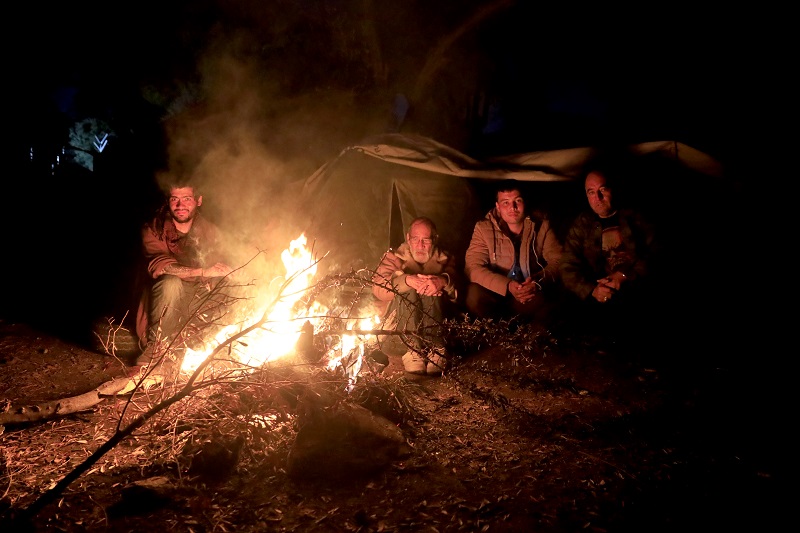
#Stranded

Giorgos Moutafis for SolidarityNow

It is end of January, and we are in Lesvos island. The car slides on the road as we drive from Mytilene -island’s capital- to Moria refugee camp. The refugees are hiding in their tents. As you climb up onto the hill the human geography of the area changes.  First you meet the “single men” and then the families. The space is packed by tents. In December it wasn’t like that.

Mud and piles of rubbish dotting the area. We enter the biggest tent of olive grove -the area outside Moria refugee camp. It has the size of a small basketball court. Single men from Cameroon, Congo, Nigeria and three men from Sri Lanka who belong to the Tamil ethnic group, live side by side. They sleep on bunk beds. The only thing that divides the beds is a dark grey woolen blanket. “Room to rent in hell”. Some of the men are playing with their mobiles, some others are sleeping, others are laughing, or they’ re shouting in a foreign language, or they’ re losing their hope. “I’ve been here for 2 years, I’ve been here for 19 months, I’ve been here for 8 months…”, “I’m going to lose my mind”, “I am taking sleeping pills to fall asleep”, “I love Asma. She is in Germany and she is waiting for me”.

Once again, SolidarityNow has visited Lesvos island to report on the asylum-seekers and migrants who remain trapped in appalling conditions. Their testimonies reveal the inside stories of their lives in the island. The name of this project is “Stranded”.

The photojournalist Giorgos Moutafis captures the soulful night portraits of different people who share with us their personal stories. Through the darkness of Moria refugee camp, through the darkness of mankind. All of them have a common wish about their lives: they want to be saved.

SolidarityNow calls for action to end the containment of asylum seekers on the islands. The Greek government must respect the international and European laws and transfer the asylum seekers from the overcrowded islands to the mainland Greece as soon as possible. Moreover, it must provide them accommodation and access to health care and other services, by extending the relevant humanitarian programs.

We know that the EU-Turkey deal will not stem the arrivals of refugees. The Greek government and the EU must move beyond the short-term conventional approaches, that offer only temporary solutions. The Greek government must design and implement a more effective strategy for the reception of asylum seekers.

Share your story with us!


Are you a refugee who is being moved from the islands to the mainland?

Please share your story with us!

Help us keep up the pressure for improved treatment, conditions and rights of refugees in Greece. A group of human rights and humanitarian non-governmental organizations have come together to campaign for Prime Minister Tsipras to #OpenTheIslands and we need your help.

Step 1: Take a selfie video using your phone (ideally two minutes or less) and answer these questions:

  1. Where are you from and who is traveling with you?
  2. Why did you leave your home country?
  3. How long have you been on the Greek islands?
  4. Show us what you are taking with you to the mainland?
  5. How do you feel today to be moving?

Step 2: Post your video to social media using the hashtag #OpenTheIslands or email the video to OpenTheIslands@solidaritynow.org

Step 3: Share the campaign at www.solidaritynow.org/opentheislands with your friends and family

*Videos sent via email may be edited. Not all videos will be used in the campaign. SolidarityNow will not disclose any contact or otherwise identifiable information outside what is shared on social media and in the submitted video.

Greece: Urgent Need to Move Asylum Seekers from Islands

Giorgos Moutafis for SolidarityNow

As Winter Begins, Accelerate Transfers, End Containment Policy

Athens, December 21, 2017. More than 13,500 asylum seekers remain trapped on the Greek islands in most deplorable conditions as winter begins today, December 21st, SolidarityNow states. Greece, with support from its EU partners, should urgently transfer thousands of asylum seekers to the Greek mainland and provide them with adequate accommodation and access to fair and efficient asylum procedures.

The Greek government committed in early December that it would move 5,000 asylum seekers from the islands to the mainland as an emergency measure, before the onset of winter. Despite the transfer of almost 3,000 people since early December, the hotspots on Lesbos, Chios, Samos, Leros, and Kos still have 11,005 people in facilities with a total capacity of just 5,576. More than 1,000 people have arrived to the Greek islands during the same period.

“Αfter the recent incidents in Moria’s camp, resulting in pregnant women and children being injured, the transfer of the population to the mainland, becomes even more urgent. Under these circumstances, we welcome the Greek Government’s decision to promptly move thousands of people to better conditions on the mainland as an emergency measure, however much more needs to be done to improve the situation for refugees in the country. Greece, with the support of the EU and its member states, has to act immediately and protect the human rights of the people arriving at Europe’s borders”, stated SolidarityNow.

In a campaign that began on December 1st, 13 human rights and aid organizations called on Prime Minister Alexis Tsipras, to end Greece’s policy of containing asylum seekers on the islands. The groups said that Greek authorities should immediately transfer people to improved conditions on the mainland and take concrete measures before the official start of winter so that no asylum seekers are left out in the cold. The groups also said that other EU leaders should take a clear stand to end the containment policy that keeps asylum seekers trapped on the islands under an agreement with Turkey to send people refused asylum back there.

SolidarityNow and other groups participating in the campaign will continue campaigning throughout the winter, highlighting the deplorable conditions asylum seekers trapped on the islands face. The groups will press the Greek government and EU leaders for a more effective response that protects the rights and reduces the suffering of asylum seekers arriving in Greece.

The Greek government is expected to introduce a bill in Parliament in the coming days to accelerate the asylum process with the aim of expediting returns to Turkey, under the EU-Turkey deal. While the length of the asylum procedure is one factor contributing to people’s distress on the islands, reducing the length of asylum procedures at the expense of the quality of the process would put asylum seekers at risk of being denied the protection they need, SolidarityNow said.

Such an approach is the wrong way to alleviate overcrowding or address the systemic issues linked to the containment policy and EU-Turkey deal that have created this inhumane situation on the islands. Any reform should ensure that asylum seekers have access to fair and efficient asylum procedures that allow for all asylum claims to be fairly examined on their individual merit.

Organizations Participating in the Campaign:
Amnesty International
Caritas Hellas
Greek Council for Refugees

Greek Forum of Refugees
Help Refugees
Human Rights Watch
International Rescue Committee
Jesuit Refugee Service
Oxfam
Praksis
Spanish Commission for Refugees (CEAR)
SolidarityNow
Terre des Hommes

Concerns for hundreds of unaccompanied children sleeping rough in Greece this winter

Giorgos Moutafis for SolidarityNow

NGOs launch roadmap for handover of refugee response to Greek Government

More than 2,000 unaccompanied children are on the waiting list for safe shelters in Greece, according to a new report by 15 organisations. The chronic shortage of accommodation for children is just one of the gaps in services that is worsening as the Greek Government prepares to take full control of the refugee response.

The report provides an overview of the current situation on the islands as well as on the mainland. It sets out a series of recommendations for the Greek Government, EU leaders and the UN for a successful handover to address the persistent gaps in services, access to asylum and opportunities to integrate with Greek society.

While some steps have been taken to move people to the mainland, the islands remain dangerously overcrowded with many families sharing unheated tents as winter sets in. A dangerous shortage of medical and legal staff risks people’s health and has contributed to long delays in the asylum procedure. On the mainland, unaccompanied children are increasingly spending nights in police cells, in squats or on the streets because of a shortage of safe shelters.

To improve the situation, the report says a mechanism is needed to move people to accommodation on the mainland as soon as reception centres reach their capacity. It also calls for all EU states to recognise their legal and moral obligation to consider asylum claims and to relocate the most vulnerable people to other countries in Europe.

It recommends that NGOs and the Greek Government invest in more programmes that build tolerance and integration, and in Greek communities that have borne the brunt of the sudden influx. It also calls on UNCHR – the UN refugee agency – to be more vocal and take a stand against the policies and practices being implemented in Greece that reduce standards and minimize safeguards in the reception, asylum and returns procedures.

Nicola Bay, Head of Mission for Oxfam in Greece, said: “It’s time for the Greek Government to step up and take control of the situation. It should seize this opportunity to learn the lessons of the past two years and to move people from overcrowded and unsafe shelters. Sadly, the misery we are witnessing on the islands will only deepen when winter sets in.”

Jana Frey, Country Director for the International Rescue Committee, said: “Of paramount concern is the safety and wellbeing of the over 3,000 children who are without their family and on their own in Greece. Only about 1,000 are staying in shelters set up to accommodate them. The rest are on a waiting list, with potentially hundreds of children sleeping on the streets or in squats. These children are at grave risk.”

Antigone Lyberaki, General Manager for SolidarityNow, said: ”The Greek Government has the required resources to receive refugees in a safe and dignified manner and support their inclusion into the society. What is needed now is full political will to resolve existing problems that make thousands of people suffer and to create a response system that will benefit both refugees and the hosting community.”

Aleksandra Godziejewska, Head of Mission of CARE in Greece, said: “Despite being in one country, as a direct result of the EU-Turkey statement, the living conditions and protection safeguards of asylum seekers on the Greek islands and the mainland are substantially different. We look forward to the results of the efforts to decongest the islands, and call the Greek government to implement strategies to counter the exclusion and marginalization that all refugees, men, boys, women and girls, can face during the upcoming process of integration.”

Notes to editors

Download the report, here

The report was jointly written with input from the following organisations:

ActionAid, Advocates Abroad, CARE, Caritas Greece, Danish Refugee Council (DRC), Greek Forum of Refugees, Greek Helsinki Monitor, HIAS, International Rescue Committee (IRC), JRS, Oxfam, SolidarityNow, Spanish Commission for Refugees (CEAR), Terre des hommes and Translators Without Borders.

More than 2,100 unaccompanied children are already on the waiting list for safe shelter on the Greek islands, with at least 100 more arriving each month. As of 1 August 2017, the Greek Government took over financing of the existing shelters for these children. At least four of them are facing funding difficulties and may close without immediate action, forcing even more children into police cells, unsafe accommodation or onto the streets.

At the end of July 2017, the Greek Government took over control of the management and funding of the response on the Greek islands from ECHO, the European Commission’s humanitarian division. Some humanitarian agencies have downsized or pulled out of the islands altogether, leading to gaps in vital services such as medical care.

Greece: Move Asylum Seekers to Safety Before Winter Hits

Giorgos Moutafis for SolidarityNow

 12 Groups Open Campaign to End Containment Policy

(Athens, December 1, 2017) – The Greek government, with the support of European Union leaders, should act now before the onset of winter to end Greece’s “containment policy,” 12 human rights and humanitarian organizations said in a campaign that began today.

The groups began a countdown to the official start of winter, December 21, 2017. They said that Prime Minister Alexis Tsipras, with the support of EU leaders, should immediately transfer people to improved conditions on the mainland and take concrete measures by December 21 so that no asylum seekers are left out in the cold.

As of November 30, the hotspots on Lesbos, Chios, Samos, Leros, and Kos are almost 7,200 over capacity: 12,744 people in facilities with a capacity of just 5,576. Thousands, including single women, female heads of households, and very young children, live in summer tents, essentially sleeping on the ground, exposed to the cold, damp, and rain as the weather worsens. Some women are forced to share tents and containers with unrelated men, putting their privacy and safety at risk. There is lack of access to clean water, sanitation facilities and health services.

This will be the second winter asylum seekers have had to spend in unsuitable facilities on the islands since the EU-Turkey Deal went into effect in March 2016. Last winter, three men died on Lesbos in the six days between January 24 and 30. Although there is still no official statement on the cause of these deaths, they have been attributed to carbon monoxide poisoning from makeshift heating devices that refugees have been using to warm their freezing tents. In late 2016, a blast likely caused by a cooking gas container killed a Kurdish woman and her young grandchild, also sleeping in a tent in Lesbos.

EU and Greek officials have referred to the EU-Turkey deal as a justification for the containment policy. The policy, put in place as part of the deal, forces asylum seekers arriving on the Greek islands to remain there until their asylum claims are decided, regardless of if there is accommodation capacity or adequate access to services. However, forcing asylum seekers to remain in conditions that violate their rights and are harmful to their well-being, health, and dignity cannot be justified, the groups said. Some who arrived on the islands in the early days of the deal have remained stuck there for 20 months.

As part of the campaign, the groups are teaming up to highlight the deplorable conditions asylum seekers trapped on the islands face; to call on European citizens to get involved; and to monitor and update the public on the response of the Greek government and EU leaders.

For more information on the digital campaign, please visit:
www.solidaritynow.org


Organizations Participating in the Campaign:

  • Amnesty International
  • Caritas Hellas
  • Greek Council of Refugees
  • Help Refugees
  • Human Rights Watch
  • International Rescue Committee
  • Jesuit Refugee Service
  • Oxfam
  • Praksis
  • Spanish Commission for Refugees (CEAR)
  • Solidarity Now
  • Terre des Hommes

20 organisations continue to press Greek Officials and EU States to transfer asylum seekers to the mainland and offer improved reception conditions

Giorgos Moutafis for SolidarityNow

Groups Press Greek Officials, EU States for Mainland Transfers, Improved Conditions

The Greek government, with the support of EU member states, should act now to end Greece’s “containment policy,” 20 human rights and aid groups said today. The policy forces asylum seekers arriving on the Greek islands to remain in overcrowded, unsafe facilities, an urgent concern with winter approaching.
Conditions on the Greek islands have continued to deteriorate in the month since 19 nongovernmental groups wrote an open letter to Greek Prime Minister Alexis Tsipras, calling on him to move asylum seekers to the mainland, where better conditions and services are available.

“This remains a matter of life and death,” said Jana Frey, the International Rescue Committee’s country director in Greece. “There is absolutely no excuse for the conditions on the islands right now – thousands of people crammed into overcrowded and desperately under-resourced facilities. We are in a race against time. Lives will be lost – again – this winter – unless people are allowed to move, in an organised and voluntary fashion, to the mainland.”

Members of the group recently asked to meet with Tsipras to discuss the most urgent needs on the islands and provide recommendations for addressing this increasingly dire situation. They have received no response.

Over the past month, the Greek government has transferred 2,000 people from Samos and Lesbos to the mainland as a one-time emergency measure. When the government announced this initiative in October, these islands were already 5,000 people over capacity. It was clear then that this measure, while helpful, would not suffice.

“Nothing can justify trapping people in these terrible conditions on the islands for another winter,” said Eva Cosse, Greece researcher at Human Rights Watch. “Greece and other European Union member states should act urgently to remove the obstacles to people getting the care and assistance they need on the Greek mainland.”

As of November 20, 2017, the hotspots on Lesbos, Samos, and Chios are hosting 7,000 over capacity: 10,925 people are staying in facilities with a capacity of just 3,924. Thousands, including single women, female heads of households, and very young children, are being forced to live in summer tents, essentially sleeping on the ground, as the weather worsens. Some women are forced to share tents with unrelated men, putting their privacy and safety at risk. This will be the second winter asylum seekers have had to spend in unsuitable facilities on the islands since the EU-Turkey Deal went into effect.

“The EU-Turkey Deal is condemning refugees and migrants to a second winter in squalor on the Greek islands. Instead of trying to maintain the deal at all cost, European countries and Greece should urgently work together and move asylum seekers off the islands,” said Gabriel Sakellaridis, director of Amnesty International in Greece.

EU and Greek officials have cited the EU-Turkey Deal as a justification for the containment policy. However, forcing asylum seekers to remain in conditions that violate their rights and are harmful to their well-being, health, and dignity cannot be justified, the organisations said. As such, the groups have also written to EU member state ambassadors to Greece urging them to immediately call on the Greek government to suspend, the containment policy.

The groups urged Prime Minister Tsipras to protect the human rights of asylum seekers trapped on the islands by ending the containment policy, immediately transferring people to improved conditions on the mainland, and making a commitment to ensure that no one is forced to sleep in a tent.

Because the “containment policy” is being implemented in response to the EU-Turkey deal, the organizations highlighted the responsibility of the European Commission and the EU member states to address the situation on the Greek islands and to press the Greek government to reverse the policy. EU member states should support the Greek government’s efforts to ensure the safety and dignity of asylum seekers in EU territory, including by expanding safe accommodation and access to services on the mainland.

“In an effort to make the EU-Turkey deal work, the Greek islands have been transformed into places of indefinite confinement for asylum seekers who have risked their lives in search of safety and a better life in Europe,” said Nicola Bay, head of mission for Oxfam in Greece. “The EU and the Greek government need to start putting people’s lives ahead of politics and uphold Europe’s commitment to human rights.”

To read the joint letter to Prime Minister Alexis Tsipras, please visit:
https://www.solidaritynow.org/en/prime_minister_letter/


Human Rights Watch

International Rescue Committee

ActionAid

Advocates Abroad

AITIMA

Amnesty International

Arsis

CARE

Caritas Hellas

Danish Refugee Council Greece

Greek Council for Refugees 

Greek Forum of Refugees

Greek Helsinki Monitor

Help Refugees

Jesuit Refugee Service

Lesbos Legal Center

OXFAM

Praksis

SolidarityNow

Terre des hommes