“The photo has now become a common language, more than speech and writing”


Alexandros Avramidis, photographer

It is the end of February and we are in the port of Thessaloniki. Ahmed, Abdul, Mariam and other teenagers are holding a camera in their hands and are taking photographs of the scenery. Every shot reveals a different image, but actually it’s more like a personal testimony. Through this creative way, SolidarityNow chose to educate refugees and migrants, to express their thoughts and criticism on the organization so that it can be improved and respond to their needs.

“Photography, beyond its creative angle, is a popular medium. First of all, we’re all taking photos and more than before we take selfies. It is easy to express yourself through photography, and now it has become a common language, more than speech and writing”, says the renowned photojournalist Alexandros Avramidis, who gave photography lessons to teenagers, adult refugees and migrants, all beneficiaries of the organization. These seminars took place within the framework of the Resilient Roots* project. After the theory lesson the teenagers had to practice everything they have learned. All of them are walking at the harbor’s pier and take photographs of the sea, of themselves, of the boat that has been moored in Thermaikos golf. You hear the whistling sound of the cameras’ click while at the same time Alexandros gives them instructions and advice. “At first you see their own unique glance, what they have inside them; the way they see the world”, he states.

Alexandros has been awarded with the Pulitzer prize for covering the refugee crisis and has been working with Reuters for years. His images have traveled all over the world, transmitting news and provoking a variety of feelings. For him, photography is not only his art; his profession is a common language, and this is what he has tried to communicate to his students as well.

As he tells us, the contact with the students gave him some kind of knowledge. “The children who come here are in this loving environment, at the same time they have the opportunity to do all these activities”, he notes. By giving to children incentives and expression options, you give them the opportunity to shout out everything they think and cannot confess. “Let us not fool ourselves, at this age youngsters who do not receive support delinquency is almost inevitable. The fact that they come to this place and can do all these activities in a very decent way is very nice”, underlines Alexandros.


* Since July 2018, SolidarityNow has been implementing the pilot project “The Resilient Roots Initiative”. The program, co-ordinated by the CIVICUS network in partnership with Keystone Accountability & Accountable Now, aims to improve communication and interaction channels between SolidarityNow Management and its beneficiaries. About 60 young people beneficiaries of the organization, from Athens and Thessaloniki, are involved in a number of activities.


Kamran and Hamid in the radio and photo days’ seminar

Giorgos Moutafis for SolidarityNow

Kamran from Pakistan is one of the 60 SolidarityNow beneficiaries who took part in the photography and radio trainings organized and completed by the organization under the program entitled “The Resilient Roots Initiative”.

Radio, podcasts and photography, are powerful tools of modern media. Words and images, if they are used properly, they can express feelings, ideas, opinions and a constructive criticism. SolidarityNow chose this innovative way to train and enable its beneficiaries to jury the organization itself in order to help its evolution towards a more effective operation mode and a more efficient programs’ orientation upon their real needs.

“I like it very much. Anything new I do I like it”, says Kamran during the break of the photography training implemented in Athens by the photojournalist, Giorgos Moutafis. The 19-year-old Kamran and his classmates are all beneficiaries of the organization’s accommodation program and live together at the organization’s Youth Hostel in downtown Athens. He arrived at Greece from Pakistan 2.5 years ago, in order to chase his dream of studying computers. He was recognized as an unaccompanied minor and as soon as he turned 18, he was transferred to the Shelter, which is exclusively for men aged 18-24.

When we asked Kamran why he decided to participate in the seminar, since he already has a very busy schedule with school and Greek and English lessons, he responded: “I always want to learn something new. Whatever I learn, I think will be useful“. Kamran actively participated in the lessons, according to the photography and radio training instructors, Giorgos Moutafis and Katerina Kafentzi, who has held the radio trainings in Athens.

Kamran was excited when he visited a real radio studio where the instructor held the radio trainings aimed at producing radio podcasts. Through this experience Kamran discovered another aspect of himself as he describes us. He made his own podcast and his own portfolio of photographs taken in the new city that has become his new home.

Did you know what a podcast is before you participated in the seminars? “Not at all! But I enjoyed the experience. I wore earphones, talked to the microphone, then I heard my voice, it was very professional!”, the young Kamran says enthusiastically.

The joy for this experience is shared by the 18-year-old Hamid from Afghanistan. He came from his homeland to Greece three years ago, stayed for a year and a half at the Unaccompanied Minors’ Shelter of the Society for the Care of Minors, and, for the past nine months, he has resided at the SolidarityNow Youth Hostel.

Hamid goes to a high school in Athens and his dream is to become a nurse. At the same time, he attends Greek classes, and, in the afternoons, he works as an interpreter and caregiver at the Unaccompanied Minors’ Shelter. He is lively, extroverted, and gentle, so he immediately matched the character of the program and the lessons in radio and photography. Hamid took part and unfolded his artistic talents! Additionally, he says that living here for him “is almost perfect!”

*Since July 2018, SolidarityNow has been implementing the pilot project “The Resilient Roots Initiative”. The program, co-ordinated by the CIVICUS network in partnership with Keystone Accountability & Accountable Now, aims to improve communication and interaction channels between SolidarityNow management and its beneficiaries. About 60 young people beneficiaries of the organization, from Athens and Thessaloniki, are involved in several activities.

*The Youth Shelter operated by SolidarityNow in partnership with the Society for the Care of Minors and Youth in the framework of the organization’s Accommodation program, is part of the ESTIA- Emergency Support to Integration and Accommodation of the UNHCR GREECE and funding by DG-Home.

“Artistic expression has no age limit and it’s above origin”

Stella Delliou

Christos Kiousis, journalist

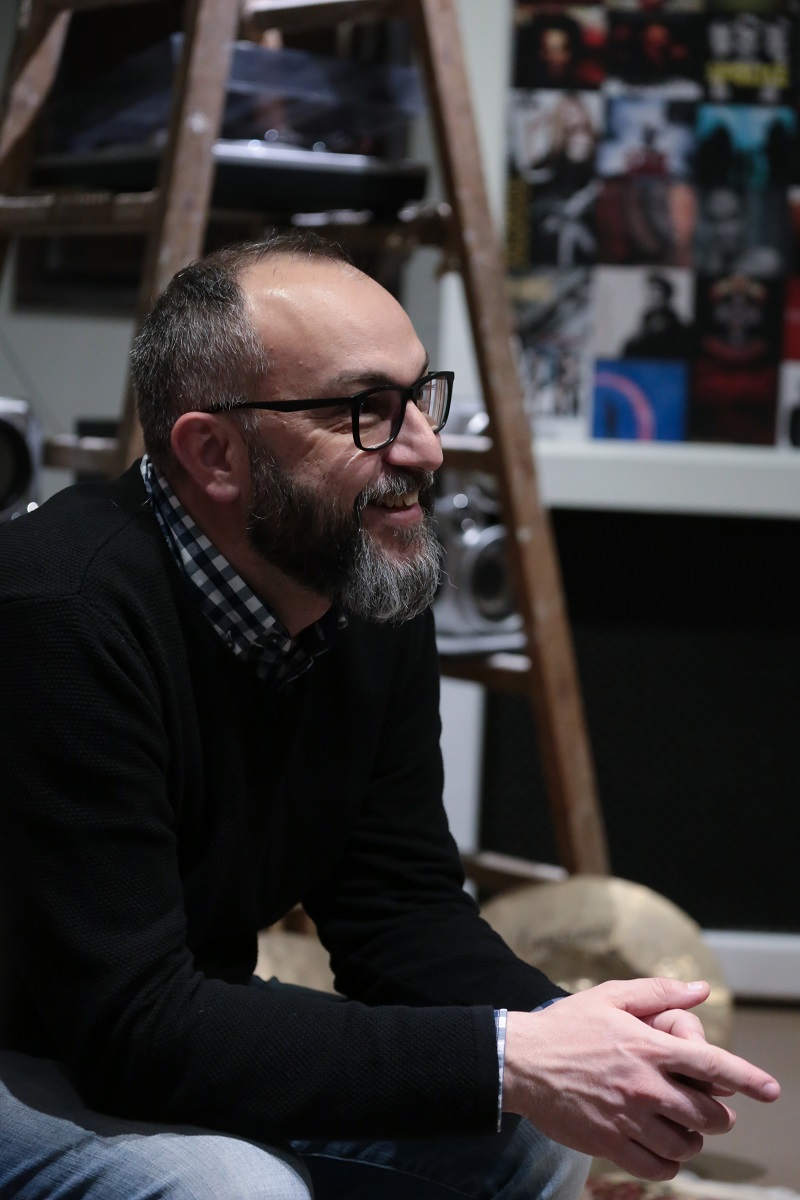
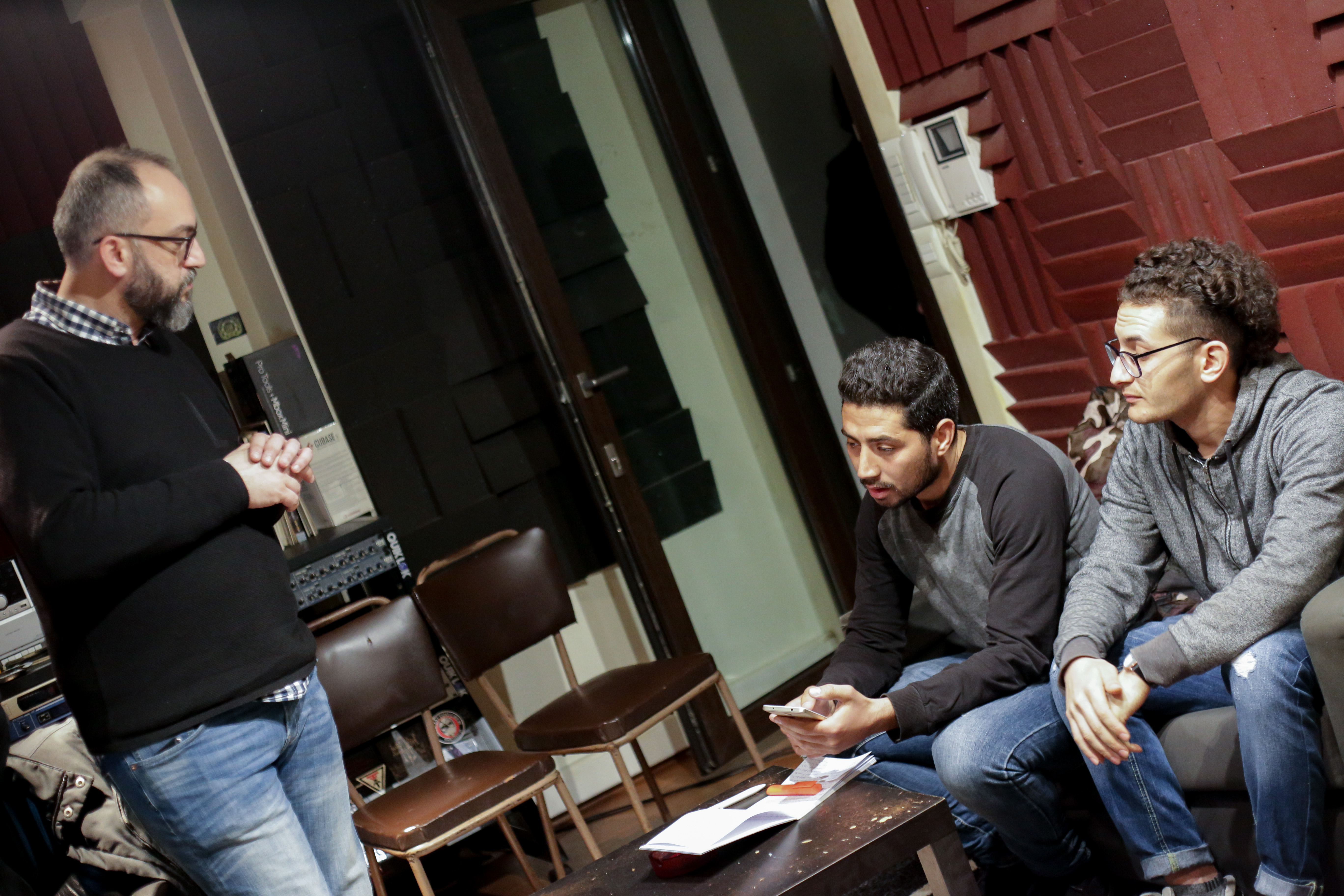
We’re at the Revolver Recording studio. Omar, 24 years old from Algeria, stands in front of a microphone and narrates his story. Next to him is the journalist and his teacher Christos Kiousis, who guides him. In a moment he will start recording his podcast and we all have to be quiet.

Music, words and thoughts, ideas, opinions, feelings, this is the magic of podcasts. Radio is one of the most significant mediums of communication. Adult and teenage refugees who attended the seminars organized by SolidarityNow within the framework of the innovative program “Resilient Roots”* have been introduced to radio lessons. In particular, 60 young SolidarityNow beneficiaries from Athens and Thessaloniki attended creative photography and radio seminars to learn how to express their ideas and give feedback regarding the services provided by the organization. The journalist and radio producer Christos Kiousis volunteered to teach the participants in Thessaloniki how to create their own podcast. To have quality in life, besides ensuring your survival, you need to be able to express yourself freely. “Whatever they do to express themselves, this will help them calm their soul and mind”, Christos tells us.

“As strange and unprecedented as it seemed to the children to create their own podcast, by letting them into the magical world of sound and radio, it is as well strange and unprecedented for me to collaborate with people who have gone through a lot,” notes Christos. It was his first contact with refugees and migrants, but also with people working in the humanitarian field. “To be honest, from a sociological perspective you are another very interesting case of people” he adds.

At the beginning, as Christos confesses us, he was anxious because he was not familiar with our activities, but also because it was the first time for him to teach refugees and migrants. But his initial embarrassment was immediately overcome thanks to the people of the organization and his students. “By seeing the smiley faces of the people, I felt relaxed. At the end of the lesson when the children thanked me and expressed their willingness to come again to the lesson, I felt that I was useful for them”, he underlines.

The time has passed, and all the participants have completed their recordings. Dimitris Karavasilis, who is the owner of the studio and a personal friend of Christos, offered his space for free; he will now edit the students’ podcasts. “What is happening here today is very important; people who have never had the opportunity before, are learning how to make radio podcasts”, Vasilis stresses. “Artistic expression combined with technical means, like radio, photography or something else, has no age limit and since it has no age limit, it’s above origin as well”, adds Christos.


* Since July 2018, SolidarityNow has been implementing the pilot project “The Resilient Roots Initiative”. The program, co-ordinated by the CIVICUS network in partnership with Keystone Accountability & Accountable Now, aims to improve communication and interaction channels between SolidarityNow management and its beneficiaries. About 60 young people beneficiaries of the organization, from Athens and Thessaloniki, are involved in several activities.

“If words and images are used correctly can express real feelings and ideas”

Stella Delliou

Omar and Usama

We are all made of stories. Stories create feelings, connections, express thoughts and ideas, inspire and motivate people to pursue their goals and dreams. The human mind remembers stories than statistics and numbers. The 24-year-old Omar, 23-year-old Usama and the rest of the participants at the seminars, organized by SolidarityNow as part of the “Resilient Roots” program, will learn how to tell their own stories and how to express themselves.

Radio-podcasts and photography are two powerful, modern media. If speech and images are used correctly can express real feelings, ideas, opinions and a constructive critique. SolidarityNow chose this way to teach its beneficiaries to give their feedback in order to improve and tailor its programs to their needs.

Omar loves football and art. When he was living in Algeria he used to play in various theatrical performances. As he tells us, he finds many similarities among theater, photography and radio: “It’s just like in photography and radio; while performing we want to pass a message. I look forward to recording our own podcast and taking photos”. Omar comes to the Blue Refugee Center, where he benefits from the free services provided. He is currently living in a shelter for homeless – along with Greeks, refugees and migrants. “Through this seminar, we learn to express our thoughts and our opinion. I want to inform and prepare all the people who are planning to leave their country about the difficulties they will encounter”, he points out.

Usama, who has been in Greece for the last 6 months, has studied microbiology, but his big dream was to become a journalist. This seminar awakened him memories from the past. “I’m more interested in photography. I remember the tourists in Algeria who were taking photos capturing the everyday life of my country”, he states. He as well wants to portray his own daily life, the difficulties he has confronted here, his need for communication and education -useful tools to a migrant. “I want to explain all these to the people, in order to decide if they will eventually leave their country”, he underlines.


* Since July 2018, SolidarityNow has been implementing the pilot project “The Resilient Roots Initiative”. The program, co-ordinated by the CIVICUS network in partnership with Keystone Accountability & Accountable Now, aims to improve communication and interaction channels between SolidarityNow Management and its beneficiaries. About 60 young people beneficiaries of the organization, from Athens and Thessaloniki, are involved in several activities.

* The Blue Refugee Center is supported by UNHCR and funded by the EU.

Radio and Photo Days in SolidarityNow

Στέλλα Δέλλιου

Or how “The Resilient Roots Initiative” helped young refugees express themselves

Omar is one of the SolidarityNow beneficiaries who took part in the photography and radio trainings organized and completed by the organization under the program “The Resilient Roots Initiative”.

Radio, podcasts and photography are powerful tools of modern media. Words and images, if they are used properly, can express feelings, ideas, opinions and constructive criticisms. SolidarityNow chose this innovative way to train and enable its beneficiaries to jury the organization itself in order to help its evolution towards a more effective operation mode and a more efficient programs’ orientation upon their real needs.

“Through this seminar, we learned to express our thoughts and our opinions. I wanted to inform and prepare all the people who are leaving their country for what difficulties they will encounter“, Omar from Algeria confesses. Omar comes to the organization’s Blue Refugee Center and make use of the pro bono services. He is currently hosted in the Thessaloniki homeless dormitory along with other Greeks, refugees and migrants.

Many students already have very busy schedules because they attend school and Greek and English lessons, but these students still chose to participate in these seminars. “I always want to learn something new. Whatever I learn, I think it will be useful“, says another student of the seminar.

A total of 60 young people, refugees and asylum seekers from the organization’s programs in Athens and Thessaloniki, had the opportunity to attend these photo and radio trainings as means to help them express their needs and desires.

“The beneficiaries themselves have to express their needs”, notes Danae Kapralou, the project’s coordinator, adding that the notion of accountability is something missing in Greece. “It is important for people who are trying to build their lives here, to learn that only they can talk about their problem well”.

In Athens the “students” were all beneficiaries of the organization’s accommodation program; some of the youngsters live together at the organization’s Youth Hostel. In Thessaloniki, the students were beneficiaries of the Blue Refugee Center. In Athens the photography lessons were taught by the photojournalist Giorgos Moutafis and the radio trainings were held by the radio producer Katerina Kafetzi. In Thessaloniki, Alexandros Avramidis was the photo instructor and Christos Kiousis was the one who introduced them to the magical world of radio and podcasts.

Starting from today and for the next few days, we will share with you, through the SolidarityNow social networks, the students’ and teachers’ stories, developing a dialogue among them. We can all learn from these stories of other people improving themselves.

Follow the stories!

*Since July 2018, SolidarityNow has been implementing the pilot project “The Resilient Roots Initiative”. The program, co-ordinated by the CIVICUS network in partnership with Keystone Accountability & Accountable Now, aims to improve communication and interaction channels between SolidarityNow management and its beneficiaries. About 60 young people beneficiaries of the organization, from Athens and Thessaloniki, are involved in several activities.

* The Blue Refugee Center is supported by UNHCR and funded by the EU.

*The Youth Shelter operated by SolidarityNow in partnership with the Society for the Care of Minors and Youth in the framework of the organization’s Accommodation program, is part of the ESTIA- Emergency Support to Integration and Accommodation of the UNHCR GREECE and funding by DG-Home.


INTERNATIONAL WOMEN’S DAY_Lena: ” I want to ask women to claim their rights!”


“Strength is something that can only be transferred from one to another. You cannot strengthen someone if you don’t feel strong at the same time“, this is how Lena Zachou, a psychologist at the organization’s Solidarity Center in Athens feels and sums up the concept of empowering and supporting people from vulnerable social groups. The summer of 2019 will be the third for Lena at the Individual Counselling & Psychotherapy Service, which operates at the Athens Solidarity Center.

On World Women’s Day on March 8th, Lena wants to say a lot: “No matter which country they come from, how they have grown up if they are Christian or not, yes, women are more oppressed than men. They must deal with stereotypes and imposed social roles. Maybe in some countries, this is more obvious, but I think it is something that we, women, face in East and West, North and South, sometimes more clearly and others less; but it’s the same”.

“I have a request to make to women. I want to ask them to claim their rights and take charge and make their own decisions about their lives. And of course, if they need support to do so, they should claim it too and not hesitate!”

Lena was lucky enough to realize at a young age, what she likes: “Whatever you do, it makes sense if it’s done with people. I always had the need, the tendency to be close to people“, and this need led Eleni to choose psychology as the focus of her studies, and after her first degree, she moved abroad in order to get her master’s degree in child and adolescent psychology. Her return to her hometown, Thessaloniki, did not satisfy her professionally, and Lena dared a change.

She left from Thessaloniki and travelled to Kalymnos for work -there she witnessed the real crisis- refugees arriving to the island seeking for protection. The continuity of her journey was inevitable. A new trip from Kalymnos to Lesvos and a new job at a humanitarian organization. Her next stop was Athens; and SolidarityNow – “My job here is rewarding because I have an active role in people’s lives. My job satisfies me; I want to be with those in need. What I am doing and experiencing now is exactly what I had imagined when I was saying as a kid ‘I want to become a psychologist’“.


*The Athens Solidarity Center has been financed by SolidarityNow and Open Society Foundations (OSF/OSIFE) and supported by the Municipality of Athens.

INTERNATIONAL WOMEN’S DAY_Jennifer: “Women must definitely know their rights, claim them with dignity and leave from where they don’t show them respect”


A chef from Ghana and a student of economics from Sri Lanka and Argentina gave an appointment in Lebanon without knowing it. There they met, they fell in love, they returned to their respective countries, but they never separated actually and ended up in Lebanon again, where their daughter Jennifer was born. The 24-year-old Jennifer Adjei, who speaks Arabic, French, English, Greek, understands Spanish and is learning Russian, works as an interpreter for SolidarityNow’s accommodation program in Athens.

Jennifer was introduced to Greece in 2009, when she moved at age 14, along with her parents from Lebanon. The reason for the family relocation was nothing else but more job opportunities for the parents but also respectively more opportunities for little Jennifer, better studies and later better work conditions and environment. Her model is her father – “He always wanted both for my mother and me, to be free to choose what we want to do. So, I also learned from him and my mother to work hard and believe in myself”.

Her initial dream was to become an environmentalist; however, Jennifer finally chose to study nursing. “I think I chose it for a reason. I always loved my grandmother from Argentina so much, but I didn’t have the chance to take care of her when she needed it. That’s why when I did my training as a nurse, I was very happy to help older people, it felt as if I was taking care of my grandmother in a way”. Nursing led Jennifer to find out her wider tendency to offer assistance to the most vulnerable. Her first job was in a humanitarian organization, where her role was focused on the psychosocial empowerment of women who arrived in Greece as refugees or migrants. There, she also realized her increased sensitivity towards women “they must definitely know their rights, claim them with dignity and leave places where they are not respected“, she says.

“By being on the side of women I learned a lot – I realized there are other realities out there, not just the one I live or have learned. I changed with them. Now, I feel even stronger in my desire to support my sex and to help women overcome their fears. This is something I try to do with my work today as an interpreter at SolidarityNow, which I love, and through it my aim is to support women who want to change and improve their lives. A new life, that unfolds in the western world”.

*The SolidarityNow Accommodation program is part of the ESTIA-Emergency Support to Integration & Accommodation of the United Nations High Commissioner for Refugees (UNHCR GREECE) and funded by the EE.


INTERNATIONAL WOMEN’S DAY_Christina: “Strength is drawn from the control of our own life”


Christina Koufopoulou has studied Philosophy, Pedagogy and Psychology at the Aristotle University of Thessaloniki and has been working as a teacher at SolidarityNow for the past 3 years. Her involvement with the humanitarian sector was almost fatal. Years ago, a friend asked her, in which job she feels like herself. Christina said that could be herself working in nature or by helping other people. Until then, she has worked as a volunteer with Roma children and on programs about child entrepreneurship. Eventually life brought her close to what she really loved.

“Every woman who works in an NGO is a role-model. The first thing the refugees and migrants encounter is the female sex. They ask us for help and support, and this automatically overturns some roles”, Christina tells us. She believes that it is important how teachers work in the workplace and how the curricula is delivered in order not to promote gender stereotypes, and this must be done with discretion and respect for the culture and values ​​of refugees and migrant women. “If you talk to the girls and their mothers you will understand that they obvious have stereotypes. They believe that they cannot do things and you observe this at all ages to a different degree of course”, Christina adds.

“Generally, I think it is very important for a person to feel useful and to produce something for which he is proud. Because this is ultimately something that makes us feel stronger”. For Christina strength is drawn from the control of our own life. She believes that NGO workers help women beneficiaries and not only, to learn to take control over their lives. They might not achieve an ideal result but at least they help them find their way.

“What really empowers you is love, which gives you an incentive to try more in this direction”

*Following a proposal by the Metropolitan Development Agency of Thessaloniki, SolidarityNow unites its forces with the Municipality of Thessaloniki and the YMCA to create a program for the education of refugee children in the center of Thessaloniki. The project «Dia-Drasis» is funded by Open Society Foundations.

INTERNATIONAL WOMEN’S DAY_Antigone: “We women have a lot more power than other people think”

Giorgos Moutafis for SolidarityNow

Antigone Lyberaki is a somewhat unorthodox economist and has been active in the field of activism for years. She is the General Manager of the organization for the past 1.5 years and is involved in “a creative, human puzzle of effort and solidarity”, as she says. “We have our brilliant moments, but we also have our sad moments. But we always do what we think is right. We help others and we receive from them strength. We are every single word and every single letter of SolidarityNow”.

At a time when, as she says, politics are running late, she is part of something that really has a positive impact on people’s lives. And through her passion for activism, she is also struggling for women’s rights while she is a member of the International Union for Feminist Economics. “Economic arguments in favor of strengthening the economic position of women are only part of the wider argument for equality: equality itself is a moral project, as it promotes justice and life opportunities for all”, she notes in her book “Women in Economy”.

On International Women’s Day, Antigone Lyberaki sends her message to all women: “One thing I’ve learned all these years at the University, in activism and in politics, is that we, women, have a lot more strength than other people think; but also, more strength than what we think we have. And we can use this strength”.


INTERNATIONAL WOMEN’S DAY_Marina: “We must accept ourselves and embrace our weaknesses”


Almost nothing had ever stopped her. The only thing that “halted” her, made her change direction and start something new. Her new-found purpose and direction come through her work as a lawyer at the Athens Solidarity Center of SolidarityNow: “Every day I interact with different people, learn new things and change“.

Marina at the age of 39, is not only a lawyer, but a wife and a mother of three children. She shares with us spontaneously moments and events from her life. Through her narration it becomes clear that Marina always challenged herself and questioned her choices; today, when looking back her life path so far seems to prove her right.

“We must accept ourselves and embrace our weaknesses“, Marina sums up in her message to all women on the International Women’s Day. This was the leading force and factor that defined her choices at a crucial time in her life, which at the same time was also crucial for Greek society as a whole. Marina, as an open minded and sensitive woman, who was active in a technocratic working environment back then, was unable to remain unaffected by issues such as the economic crisis, the refugee and migration crisis and the dire consequences on people’s lives. When these crises were taking place, she had a very good job, she had her family, but she realized her need for a change in her career orientation and she chose to take the leap and do it. She accepts and embraces her sensibilities, transforms her skills and puts at work her scientific major, as a tool in order to offer to those that are the most vulnerable. She quickly became a volunteer in a humanitarian organization “I was keeping company to refugee or migrant children while their parents received help from the organization’s services. This interaction with the children was redeeming. I offered the love I had, and I have; I was communicating with children through music and games, but mostly through love“.

Alongside her volunteering, she recalled her interest for human rights law courses when she was a postgraduate student. Her job as a lawyer at the organization’s Solidarity Center in Athens is what answered to Marina’s need for change and purpose. She started in her position as a lawyer in November 2016 and tells us that “I was very anxious at the beginning. On the one hand, because the subject was new and on the other hand because of the emotional transition from the Center’s microcosm and the stories of our beneficiaries, back to my own reality; this was difficult for me. But I gradually loved the nature of work, the new knowledge I acquired, the interaction with people, and the mental fulfilment when changing people’s lives.

I work with people who have urgent needs, but I also get strength through them. I admire them for their strength and endurance. I’ve changed. I am more adaptable, gentler, more open in accepting others as they are, and feeling overall emotionally fulfilled. I firmly believe that when you give love and show empathy, you receive it back. This is the world, I try to introduce to my children as well“.

*The Athens Solidarity Center has been financed by SolidarityNow and Open Society Foundations (OSF/OSIFE) and supported by the Municipality of Athens.